—Kerry Hill, B1Daily
There are advertising mistakes.
And then there are images so historically grotesque that you wonder how they survived one meeting, much less enough corporate checkpoints to reach millions of consumers.
Converse has landed squarely in the second category.
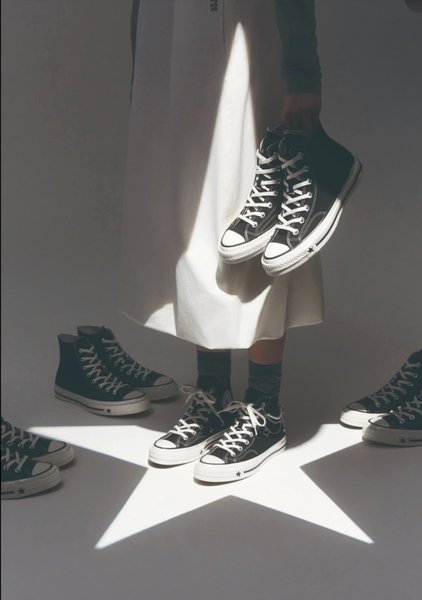
The sneaker company recently released an advertisement featuring K-pop star Karina holding a pair of black Chuck 70 X sneakers. A white triangular shape created by the lighting and her clothing immediately reminded critics of a Ku Klux Klan hood, while the dangling black sneakers were interpreted by many viewers as resembling the feet of a lynching victim.
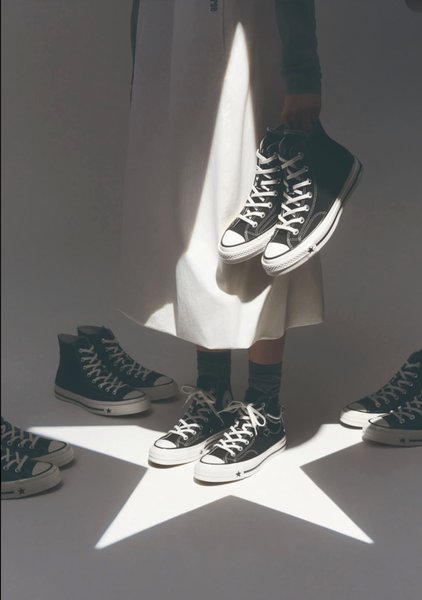
Converse subsequently pulled the advertisement and apologized, saying it understood why people found the image deeply upsetting and acknowledging that the company “got this wrong.”
Got it wrong?
That’s one way to describe it.
For Black consumers, another description is available:
Completely unacceptable.
Black People Have Every Reason to Stop Buying Converse
Nobody is obligated to financially support a company after deciding its behavior crossed a moral line.
That includes Black consumers.
If somebody looks at this advertisement, thinks about America’s history of lynching and decides Converse will never receive another dollar from them, that’s an entirely legitimate consumer decision.
Because companies understand money exceptionally well.
An apology costs almost nothing.
Losing customers costs considerably more.
The controversy has already generated boycott calls, with critics asking how imagery this explosive could possibly make it through a major corporation’s advertising approval process. Converse declined to provide the Associated Press with details about how the advertisement was screened or approved.
And that’s precisely the problem.
Nobody Saw This?
Converse isn’t somebody selling homemade sneakers from a garage.
It’s an internationally recognized brand owned by Nike.
Advertising campaigns at corporations of this size can involve photographers, creative directors, marketing executives, brand managers, editors and legal or communications personnel.
Yet somehow an image that thousands of ordinary people immediately associated with America’s most notorious white supremacist organization and the lynching of Black Americans reached the public.
How?
That’s the question Converse’s apology doesn’t answer.
Civil-rights attorney Lee Merritt made essentially this point after the controversy erupted, arguing that apologizing afterward doesn’t explain how the material passed through marketing, legal and leadership beforehand.
Exactly.
Corporate accountability cannot permanently operate according to the same exhausting script:
Release something offensive.
Watch social media explode.
Delete it.
Issue apology.
Promise to “do better.”
Wait for everybody to forget.
Repeat.
At some point, consumers are entitled to decide they’re finished participating.
Lynching Imagery Isn’t Edgy Advertising
This particular controversy cuts deeply because lynching isn’t some obscure historical reference.
Thousands of Black Americans were murdered through racial terror lynchings during American history.
Victims were hanged, mutilated, burned and murdered before crowds. Photographs were sometimes taken. Families were destroyed. Communities were terrorized.
The rope and the hanging Black body consequently became among the most horrifying symbols of American white supremacy.
So when an advertisement combines imagery interpreted as a pointed white hood with dangling black footwear, Black Americans don’t need a corporate marketing seminar explaining why people reacted strongly.
The historical association is radioactive.
Converse says it got the image wrong.
Fine.
But “we didn’t intend that” and “we shouldn’t have published that” are two entirely different questions.
Deliberate racist intent has not been established.
The impact is sitting directly in front of us.
And Then There Was the Tree Advertisement
The Karina image wasn’t the only Converse advertising photograph drawing criticism.
Another campaign image showed people climbing a ladder toward shoes hanging from a tree branch.
Again, a shoe hanging from a tree isn’t inherently racist.
Context matters.
But when your brand is simultaneously being criticized because another advertisement reminds viewers of a KKK hood and dangling lynching victims, perhaps hanging things from trees isn’t exactly helping the presentation.
The Los Angeles Times reported that both images drew criticism as part of the backlash surrounding Converse’s campaigns.
At minimum, it suggests a stunning lack of cultural awareness.
And cultural awareness shouldn’t be an optional accessory for a company selling products in a country whose history includes racial terrorism.
Black Culture Helped Make Sneakers Cultural Currency
There is another reason the controversy deserves attention.
Sneakers stopped being merely athletic equipment a long time ago.
Basketball, hip-hop, streetwear and Black American popular culture helped transform sneakers into cultural objects.
Converse itself spent decades intertwined with basketball. The company acknowledges that the Chuck Taylor All Star became the dominant basketball shoe of its era, worn by top players before 1965.
Black athletes became central to professional basketball after the NBA integrated in 1950, when Chuck Cooper, Nat “Sweetwater” Clifton and Earl Lloyd broke the league’s color barrier.
Sneaker companies have profited enormously from the cultural world that Black athletes, musicians and consumers helped build.
That makes racial literacy something considerably more important than a public-relations bonus.
You want Black culture?
Black athletes?
Black consumers?
Black influence?
Then understanding Black history shouldn’t suddenly become impossible when the marketing department opens Photoshop.
An Apology Doesn’t Require Forgiveness
Converse deserves acknowledgment for removing the advertisement rather than defending it indefinitely.
But an apology is not a coupon redeemable for automatic forgiveness.
Consumers get to decide whether an apology is sufficient.
Black consumers especially have every right to look at this campaign and say:
No.
No more Chucks.
No more giving money to a company whose internal safeguards somehow failed to catch imagery that immediately reminded people of the KKK and lynching.
No obligation to accept “we’ll do better” as the end of the conversation.
Converse can demonstrate what “better” means through its future actions.
It can explain how the advertisement was approved.
It can strengthen cultural review of advertising.
It can demonstrate that Black consumers aren’t merely another demographic to court when convenient.
And consumers can watch.
Keep the Shoes, We’ll Keep the Money
Black Americans don’t need Converse.
There are thousands of shoes in the marketplace.
There are countless brands competing for consumer dollars.
And spending money is one of the simplest forms of accountability available to ordinary people.
Converse hasn’t been proven to have intentionally designed racist propaganda.
But it did publish an advertisement widely interpreted as evoking two of the most infamous images of anti-Black racial terror in American history.
Even Converse acknowledges the advertisement should never have happened.
That’s enough for consumers to make their own decision.
Mine, for purposes of this opinion column, is simple:
When a corporation wants your money, you’re allowed to examine what it puts into the world.
When it fails spectacularly, you’re allowed to close your wallet.
Black consumers have spent enough generations watching corporations discover racial sensitivity approximately five minutes after the backlash begins.
If someone decides this advertisement is where their relationship with Converse ends, the company has nobody to blame for that lost customer but itself.
The Chuck Taylors can stay on the shelf.
—Kerry Hill, B1Daily




Leave a comment