—Josh Allen, B1Daily
Donald Trump has spent years presenting American energy dominance as a cornerstone of his political agenda. Oil, natural gas, drilling rights, pipelines, and foreign petroleum reserves have become recurring features of his economic and foreign policy.
But the administration’s activities in Venezuela during 2026 have introduced a much more consequential question: How much petroleum does Washington actually control, and where does the money go?
The answer involves tens of billions of barrels in claimed foreign oil rights, billions of dollars in Venezuelan export revenue, enormous domestic energy reserves, and military threats directed at another major oil-producing nation.
It also requires separating three very different concepts: oil owned by the United States, oil controlled through foreign agreements, and oil that American companies merely have permission to extract.
Venezuela: The 65-Billion-Barrel Agreement
The largest development came in August 2026, when Trump announced an agreement granting American interests majority control over more than 65 billion barrels of Venezuelan oil reserves.
The arrangement involves 17 oilfields, primarily in Venezuela’s Orinoco Belt and Lake Maracaibo regions. According to the White House, privately held North American Blue Energy Partners received 100-year concessions, while the United States obtained governance rights and economic interests in the arrangement.
For perspective, the approximately 46 billion barrels of proved crude oil reserves within American territory cited by the administration are considerably smaller than the Venezuelan volume covered by the announced agreement.
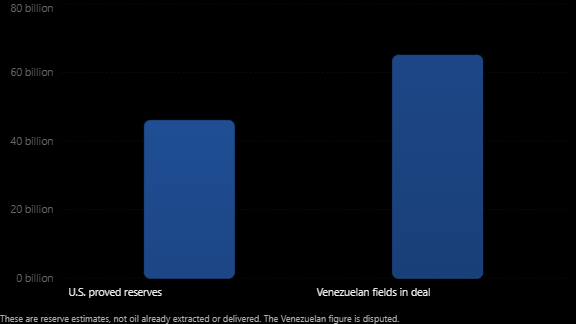
These are reserve estimates, not oil already extracted or delivered. The Venezuelan figure is disputed.
However, the Venezuelan reserves are not barrels already sitting in American storage tanks. Much of the crude remains underground, and extracting it could require decades of drilling, infrastructure repairs, and investment.
There is also a significant dispute over the underlying numbers. Petroleum experts have questioned whether Venezuela’s official reserve estimates accurately reflect oil that can be recovered economically.
The administration describes the agreement as an energy-security achievement that could generate investment, expand Venezuelan production, and lower American fuel costs. Critics question its legality, transparency, and implications for Venezuelan sovereignty.
The Oil Already Taken From Venezuela
The administration’s control extends beyond undeveloped reserves.
Following the January 3 American military intervention that removed Nicolás Maduro from power, Washington began directing significant portions of Venezuela’s petroleum exports.
American forces seized Venezuela-linked tankers, while Trump publicly acknowledged that oil from seized vessels would be processed in American refineries.
By June, an analysis from the Council on Foreign Relations estimated that nearly 100 million barrels of Venezuelan oil, worth approximately $8 billion, had moved through the U.S.-controlled export system during its first four months.
A later Financial Times analysis, reported in July, placed the value of oil revenues associated with the American-controlled system at approximately $13 billion.
Those numbers describe the estimated value of oil moving through the arrangement, not necessarily cash retained by the U.S. Treasury or profits earned by the American government.
Nevertheless, the scale of the operation is extraordinary. A foreign government has exercised substantial control over another nation’s primary export industry following military intervention.
Where Did the Venezuelan Oil Money Go?
This is where the financial picture becomes especially difficult to reconstruct.
The Trump administration initially established a mechanism involving accounts in Qatar to receive Venezuelan petroleum revenue. Officials subsequently described moving the process into U.S. Treasury-controlled accounts.
Secretary of State Marco Rubio said the arrangement was intended to prevent economic collapse in Venezuela, maintain essential government services, and ensure that oil proceeds benefited Venezuelan citizens.
The White House also declared that the money remained Venezuelan sovereign property, even while held under American control.
Yet outside analysts and congressional critics have identified substantial gaps in the public accounting.
Questions remain over the total revenue collected, the amounts transferred to Venezuelan institutions, the companies receiving payments, and the safeguards governing expenditure.
The lack of a complete public ledger does not establish that funds were stolen or personally diverted. It does, however, make independent verification of the administration’s claims considerably more difficult.
For an operation involving billions of dollars and another country’s principal natural resource, the absence of comprehensive financial disclosure is a significant accountability issue.
America’s Natural Gas: The Other Energy Empire
While Venezuelan oil has dominated headlines, America’s domestic natural gas reserves represent another enormous source of economic and geopolitical power.
According to the U.S. Energy Information Administration, the United States held approximately 584 trillion cubic feet of proved natural gas reserves at the end of 2024, the latest comprehensive annual reserve estimate available.
That figure is separate from America’s crude oil reserves. Natural gas is primarily methane, while crude oil is a liquid petroleum resource. Their reserves cannot simply be added together as though they were the same commodity.
The United States also produces enormous quantities of natural gas. In 2024, American dry natural gas production reached approximately 37.7 trillion cubic feet, while exports supplied customers across Europe, Asia, Africa, and the Americas.
By June 2026, American liquefied natural gas exports were reaching 37 countries.
Trump has promoted expanded drilling, increased LNG exports, and reduced regulatory barriers as central elements of his energy policy. The administration argues that greater production strengthens national security, supports American employment, and provides reliable energy to international allies.
Environmental organizations counter that additional fossil fuel infrastructure risks locking in emissions, increasing methane leakage, and delaying investment in cleaner energy systems.
Another important distinction is ownership. The Trump administration does not personally own America’s natural gas reserves. Production rights are distributed among private mineral owners, companies, states, tribal governments, and the federal government.
The president can influence permitting, federal leasing, sanctions, and export policy, but that is not equivalent to owning the resources.
Iran: Trump Threatened to Take Another Country’s Oil
Venezuela is not the only petroleum-rich nation targeted by Trump’s energy strategy.
During the 2026 war involving the United States, Israel, and Iran, Trump openly discussed taking control of Iranian oil infrastructure.
Particular attention centered on Kharg Island, a critical export terminal responsible for handling roughly 90% of Iran’s crude exports before wartime disruptions.
Trump publicly expressed interest in seizing the island, while American military operations and a naval blockade placed enormous pressure on Iranian petroleum exports.
Iran is also home to substantial natural gas resources, including its portion of the South Pars/North Dome reservoir shared with Qatar.
However, there is no verified evidence that the United States has acquired ownership of Iran’s oil reserves comparable to the agreement announced in Venezuela.
Threatening to seize an oil terminal, restricting exports through a blockade, and actually acquiring petroleum production rights are different forms of power.
Iranian officials have condemned American military pressure as an infringement on national sovereignty. Washington has described its operations in terms of national security and regional military objectives.
The economic consequences have extended far beyond Iran, affecting international petroleum markets and increasing the risks associated with shipping through the Persian Gulf.
Iraq, Syria, and the History of American Oil Politics
Trump’s interest in foreign petroleum predates his second administration.
During his first presidency, he repeatedly argued that the United States should have taken Iraq’s oil following the 2003 invasion. He also emphasized protecting oilfields in northeastern Syria, where American troops operated alongside Kurdish-led forces fighting the Islamic State.
Those statements generated controversy because military control of territory does not automatically confer lawful ownership of its natural resources.
In Iraq, oil revenues continued to belong to the Iraqi state under its petroleum framework. American companies could participate in commercial contracts, but that did not make Iraqi reserves American government property.
In Syria, U.S. military involvement around oil-producing areas did not establish American sovereign ownership of the fields.
These historical examples reveal a recurring feature of Trump’s rhetoric: describing foreign energy resources in terms of American strategic advantage, even where the United States has no recognized ownership claim.
The Numbers Behind Trump’s Oil Strategy
The publicly documented picture can be summarized as follows.
| Resource or country | Reported quantity | Nature of U.S. involvement |
|---|---|---|
| United States crude oil | 46 billion barrels | Domestic proved reserves |
| United States natural gas | 584 trillion cubic feet | Domestic proved reserves |
| Venezuela oil agreement | 65 billion barrels claimed | Majority control under disputed foreign concessions |
| Venezuelan exports, first four months | Nearly 100 million barrels | U.S.-controlled export process |
| Venezuelan export value, first four months | Approximately $8 billion | Estimated gross value, not U.S. profit |
| Iran | No verified U.S.-owned reserve volume | Military pressure, blockade, and threats |
| Iraq and Syria | No established U.S. sovereign reserve ownership | Historical military involvement and commercial interests |
These figures should not be combined into a single total of oil owned by Trump. They describe different categories of reserves, production, financial transactions, and geopolitical influence.
Who Actually Benefits From Energy Dominance?
The central financial question is not merely how much oil the United States can influence. It is who receives the revenue generated by that influence.
American energy companies can earn profits through extraction, refining, transportation, and international sales. Governments collect royalties, taxes, and other payments. Consumers may benefit when additional supply lowers prices, although global market conditions can offset those gains.
In Venezuela, the arrangement introduces an additional layer of complexity because American authorities exercise significant influence over revenue generated from another country’s resources.
The White House maintains that the arrangement is intended to support both American energy security and Venezuela’s economic recovery. Venezuelan interim authorities have welcomed the agreement as an opportunity to attract investment.
Critics argue that long-term concessions negotiated under extraordinary political circumstances warrant closer scrutiny, particularly when the underlying contracts and financial distributions are not fully public.
The distinction matters because oil wealth does not automatically translate into public prosperity. A country can possess enormous petroleum reserves while its citizens experience poverty, inflation, deteriorating infrastructure, and weak public services.
The Unanswered Questions
Several issues remain unresolved.
The full contractual terms governing the Venezuelan concessions have not been made sufficiently transparent for independent assessment. The actual recoverable reserves are disputed. The distribution of petroleum revenue remains difficult to verify, and the ultimate beneficiaries of the arrangement require further examination.
Likewise, the administration’s military pressure against Iran has not produced a publicly established American ownership claim over Iranian petroleum.
For an administration that frequently invokes energy independence, the expansion of American influence over foreign oil raises a larger question about the difference between securing reliable energy supplies and controlling another nation’s resources.
The United States already possesses substantial domestic oil and natural gas reserves. Its companies operate across the global petroleum industry, and American energy exports reach dozens of countries.
The Venezuelan agreement represents an additional and unusually direct extension of American influence over foreign reserves.
The Bottom Line: Oil, Power, and Accountability
Trump’s energy strategy involves three overlapping forms of power: expanding domestic production, influencing international petroleum markets, and pursuing direct control over foreign oil assets.
The administration’s claimed Venezuelan agreement covers more oil than the United States’ own reported proved crude reserves, but that does not mean those barrels have been extracted, delivered, or transferred into American ownership.
The financial consequences are potentially enormous, particularly when billions of dollars in petroleum revenue move through accounts subject to limited public scrutiny.
For Americans and Venezuelans alike, the most consequential question is not simply how much oil Washington can control.
It is whether the governments and companies exercising that control can provide a complete accounting of the resources, contracts, payments, and public benefits involved.
Without that transparency, the true financial value of Trump’s expanding energy strategy remains impossible to establish independently.
—Josh Allen, B1Daily



Leave a Reply