—Michael Lyles, B1Daily
America needs more affordable homes. Yet building them often means navigating a system that makes modest housing difficult to approve, expensive to finance, and challenging to deliver at a price ordinary households can pay.
The consequences reach well beyond first-time buyers. Renters postpone moving out on their own, families crowd into smaller spaces, and workers face longer commutes to find housing within their budgets.
Freddie Mac estimated that the United States was short approximately 3.7 million homes in the third quarter of 2024. That estimate measures the overall supply gap; it does not mean that adding that many homes would automatically make housing affordable for everyone. Location, household income, and the cost of new construction also matter. Source: Freddie Mac
Local Rules Limit What Can Be Built
In many communities, housing shortages begin before anyone applies for a construction loan.
Zoning determines where homes can go and which types are allowed. Rules that permit only detached houses, require large lots, or restrict building heights can prevent developers from adding smaller, less expensive options near jobs and services.
Parking requirements create another obstacle. Mandatory spaces consume land and can add substantial construction costs, even where residents might use fewer cars.
These rules influence the price of the finished home. When each household must pay for more land and parking, building a modest property becomes harder. HUD identifies minimum lot sizes and parking requirements among the barriers communities can address to expand housing choices. Source: HUD’s zoning barriers guide
Delays Make Housing More Expensive
Permission to build is only part of the equation. The time required to secure that permission also matters.
A project may face multiple reviews, revisions, and hearings before construction begins. During that period, developers can continue paying interest, taxes, and professional fees without collecting rent or selling a home.
Uncertainty adds another expense. A project that might be rejected after substantial upfront spending becomes a riskier investment.
Predictable approval processes can reduce these burdens while preserving meaningful safety and environmental standards. Research reviewed by the Urban Institute suggests that permitting reforms can strengthen the construction response to zoning changes. Allowing more homes on paper accomplishes less if other restrictions still prevent projects from proceeding. Source: Urban Institute
A Smaller Home Still Has Significant Costs
Building a less expensive home does not reduce every expense proportionately.
A compact house still needs plumbing, electrical connections, a kitchen, a bathroom, and site preparation. Builders must also cover land, labor, materials, financing, and the risk that a property will take longer than expected to sell.
Those costs help explain why strong demand for inexpensive homes does not automatically produce enough of them. A household may urgently need housing while being unable to pay the price required to make a new project financially workable.
A persistent shortage of skilled construction workers compounds the problem, limiting how quickly builders can deliver homes and adding cost pressure. The Federal Reserve identifies labor availability and development costs among the factors restricting housing supply. Source: Federal Reserve
Financing Can Slow Construction When Homes Are Needed Most
Higher borrowing costs affect both sides of the housing market.
Buyers face larger mortgage payments, reducing what they can afford. Developers face more expensive construction financing, making some projects harder to justify.
This creates a frustrating outcome: families need lower-priced homes, but the financial conditions facing builders can discourage new construction.
Harvard’s 2026 housing report describes this tension. Single-family housing starts fell in 2025 as high homebuying costs weakened demand, even while affordable housing remained scarce. A shortage of affordable homes can coexist with unsold homes priced beyond buyers’ reach. Source: Harvard Joint Center for Housing Studies
More Supply Helps, but the Lowest-Income Families Need More
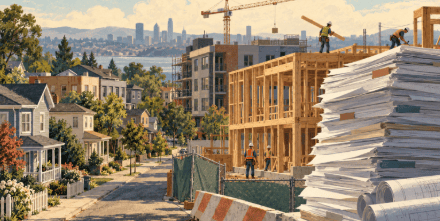
A wider range of housing types can accommodate more households. Original AI-generated editorial illustration.
There are two overlapping challenges: building enough homes overall and providing homes affordable to people with very limited incomes.
The National Low Income Housing Coalition’s 2026 Gap report estimates a shortage of 7.2 million affordable and available rental homes for extremely low-income households. That is a different measure from Freddie Mac’s overall housing shortage, and the two figures should not be added together. Source: NLIHC
Expanding supply can give households more choices and reduce competition for existing homes. But new market-rate construction cannot reliably serve everyone whose income falls below the cost of providing housing.
Deep affordability often requires public investment, rental assistance, or other subsidies. Preserving existing low-cost homes matters, too: repairs and continued affordability protections can prevent communities from losing housing they already have. Harvard’s researchers identify both inadequate assistance and the shrinking supply of low-rent homes as major concerns. Source: Harvard Joint Center for Housing Studies
What Would Make a Difference?
A stronger response would address several barriers together:
- Allow more housing choices: Smaller lots, duplexes, townhouses, accessory apartments, and multifamily buildings where appropriate.
- Make approvals more predictable: Clear standards and dependable timelines help reduce uncertainty.
- Reduce avoidable costs: Reconsider parking mandates and other requirements that add expense without meeting local needs.
- Support construction capacity: Expand skilled trades training and infrastructure that enables new housing.
- Fund deep affordability: Pair additional construction with assistance for households the market cannot adequately serve.
- Preserve existing homes: Support repairs and protect affordable properties at risk of being lost.
America’s housing shortage reflects decisions about land, money, infrastructure, and whose needs receive priority. Changing those decisions will take sustained work across local, state, and federal government.
Success would mean more than a higher construction count. It would mean that a young adult can afford to move out, a worker can live near a job, and a family can secure a stable home without sacrificing other essentials.
—Michael Lyles, B1Daily





Leave a Reply