—Kerry Hill, B1Daily
The argument that reparations are somehow foreign to American law collapses under the weight of American history.
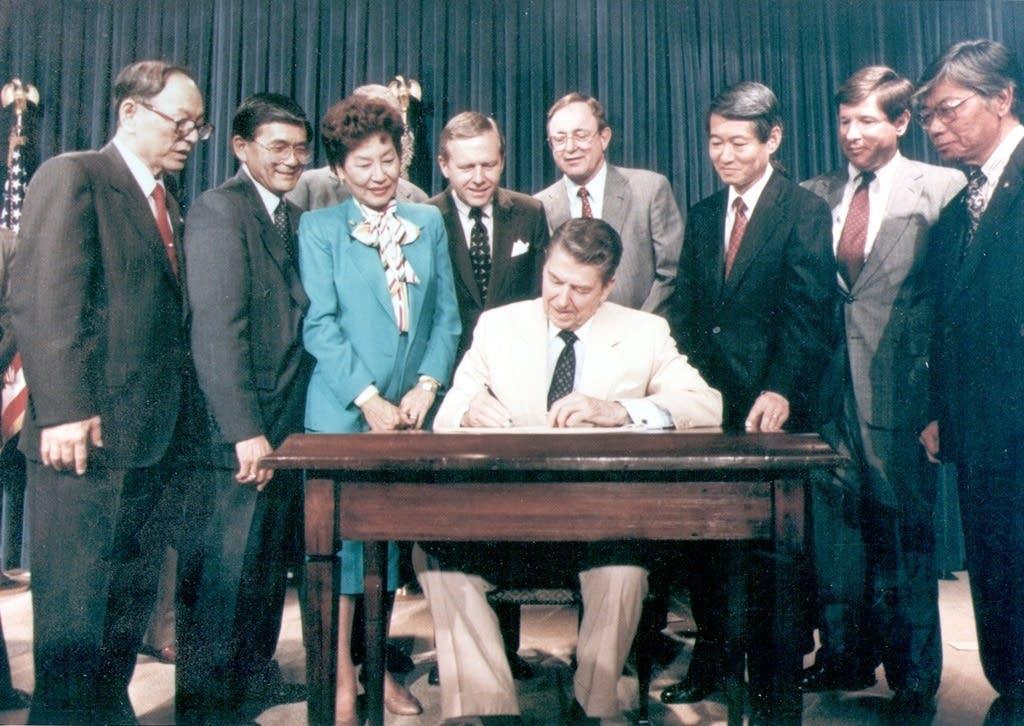
In 1988, Congress passed the Civil Liberties Act, formally apologizing for the incarceration of Japanese Americans during World War II and authorizing $20,000 payments to eligible survivors.
The legislation acknowledged that the federal government had committed a serious injustice and that an apology alone was insufficient.
It was an important and justified act of accountability.
Yet nearly four decades later, descendants of enslaved Americans are still asking Washington to apply a comparable principle to their own historical claims.
The distinction is difficult to ignore. When governments acknowledge certain historical wrongs, financial compensation becomes an available remedy. When American Freedmen demand redress for slavery and its aftermath, the debate often becomes whether compensation should even be considered.
Japanese Americans Received Compensation. American Freedmen Received Promises.
The treatment of Japanese Americans during World War II provides one of the clearest examples of federal reparations.
Approximately 120,000 people of Japanese ancestry were forcibly removed from their communities and incarcerated.
Decades later, the government investigated the injustice, acknowledged responsibility, apologized, and authorized payments.
The program was limited to eligible living survivors, rather than descendants generally. That distinction matters when comparing it with slavery reparations.
Nevertheless, the fundamental precedent remains: The federal government recognized a historical injustice and used public money to compensate its victims.
Following emancipation, formerly enslaved Americans briefly received the prospect of land redistribution through General William T. Sherman’s Special Field Orders No. 15.
But the policy was reversed, and much of the land was restored to former Confederate owners.
The result was devastating. Millions of newly freed Americans entered an economy in which landownership, credit, and political power remained overwhelmingly concentrated elsewhere.
Freedom arrived without the economic foundation necessary to make that freedom secure.
Other Reparations Programs Prove Compensation Is Possible
The United States is hardly alone in recognizing historical financial obligations.
Germany has provided compensation to Holocaust survivors through multiple programs established after World War II.
The United States also created the Indian Claims Commission in 1946 to adjudicate certain historical claims brought by Native American tribes.
Those programs were imperfect. Financial payments could not undo genocide, dispossession, or the destruction of communities. Native American settlements frequently failed to restore lost land or adequately compensate for historical losses.
Nevertheless, they established mechanisms for investigating claims, identifying beneficiaries, and providing financial remedies.
These examples are not interchangeable. They involved different legal frameworks, eligible populations, and historical circumstances.
But they challenge the suggestion that governments are incapable of addressing past wrongdoing through compensation.
The obstacle to reparations is not necessarily the absence of a legal or administrative model. It is whether political institutions are willing to create one.
Slavery Was Not America’s Only Unresolved Debt
The case for American Freedmen reparations extends beyond unpaid labor during slavery.
After emancipation came Black Codes, racial terrorism, segregation, discriminatory federal housing policies, and systematic barriers to property ownership.
These were not simply unfortunate private acts of prejudice.
Government institutions frequently authorized, enforced, or tolerated policies that restricted Black Americans’ opportunities to accumulate wealth.
The consequences extended across generations.
Families denied access to affordable mortgages could not build the same housing equity as families who benefited from government-supported homeownership.
Communities subjected to discriminatory property seizures and racial violence lost businesses, homes, and economic opportunities.
For descendants of American slavery, reparations advocates argue that the debt involves both the original institution of enslavement and subsequent government-supported discrimination.
That is why the issue cannot be adequately addressed through a symbolic apology alone.
Why Is Forgiveness Always the Preferred Remedy?
American political culture frequently celebrates reconciliation.
Forgiveness can be valuable, particularly when communities seek to overcome historical conflict.
But forgiveness and compensation are not substitutes for one another.
A government can apologize while also acknowledging financial responsibility.
Indeed, the Japanese American redress program demonstrated precisely that.
The demand that Black Americans move beyond slavery without a comprehensive accounting of its economic consequences creates an uncomfortable double standard.
Why should reconciliation require descendants of the injured population to abandon financial claims while institutions retain the benefits of accumulated historical wealth?
Forgiveness is a personal or communal choice.
Restitution is a question of responsibility.
One does not automatically cancel the other.
The Reparations Movement Is No Longer Merely Theoretical
California’s Reparations Task Force issued an extensive report in 2023 documenting historical harms and proposing remedies for eligible descendants.
In 2025, California enacted legislation establishing a Bureau for Descendants of American Slavery, with responsibilities involving genealogical verification and investigation of certain historical property claims.
These developments do not amount to a comprehensive statewide cash reparations program.
However, they demonstrate that governments can develop administrative structures for identifying eligible descendants and examining specific claims.
At the federal level, H.R. 40 proposes establishing a commission to study slavery’s consequences and recommend reparations.
As of October 2026, Congress has not enacted a comprehensive federal slavery reparations program.
A separate bill introduced in March 2026 proposed a commission addressing land reparations for descendants of enslaved Americans.
The proposals remain politically contested, but they show that the question of eligibility and compensation can be addressed through concrete legislation rather than endless abstract debate.
Reparations Should Be Specific, Documented, and Enforceable
A serious reparations program would require clearly defined eligibility standards, historical documentation, transparent administration, and a legally sustainable funding structure.
For advocates of lineage-based reparations, eligibility should center on documented descent from people enslaved in the United States, rather than treating every person of African ancestry as having the same historical claim.
Such an approach would distinguish the specific injuries of American slavery and subsequent government discrimination from other forms of racial inequality.
Policymakers would still need to resolve difficult questions involving documentation, mixed ancestry, eligibility boundaries, and constitutional requirements.
Potential remedies could include direct compensation, property restitution, housing assistance, educational investments, and other measures tied to documented harms.
No single payment could reverse centuries of exploitation.
But the impossibility of perfectly repairing an injustice has never been a convincing argument for refusing all repair.
America Cannot Apologize Its Way Out of a Financial Reckoning
The comparison with other reparations programs does not establish that every historical injustice must receive identical compensation.
It establishes something more fundamental: governments have repeatedly recognized that historical wrongdoing can create obligations extending beyond expressions of regret.
American Freedmen are entitled to have their claims examined with the same seriousness afforded to other populations seeking redress.
The debate should focus on evidence, responsibility, eligibility, appropriate remedies, and the practical challenges of implementation.
It should not begin with the assumption that descendants of American slavery must simply accept the past and move on.
A nation that has compensated victims of historical injustice cannot credibly argue that historical compensation is inherently impossible when descendants of slavery request it.
The United States has already demonstrated that apologies and financial restitution can coexist.
The unresolved question is whether it will extend that principle to one of the foundational injustices in its own history.
—Kerry Hill, B1Daily




Leave a Reply