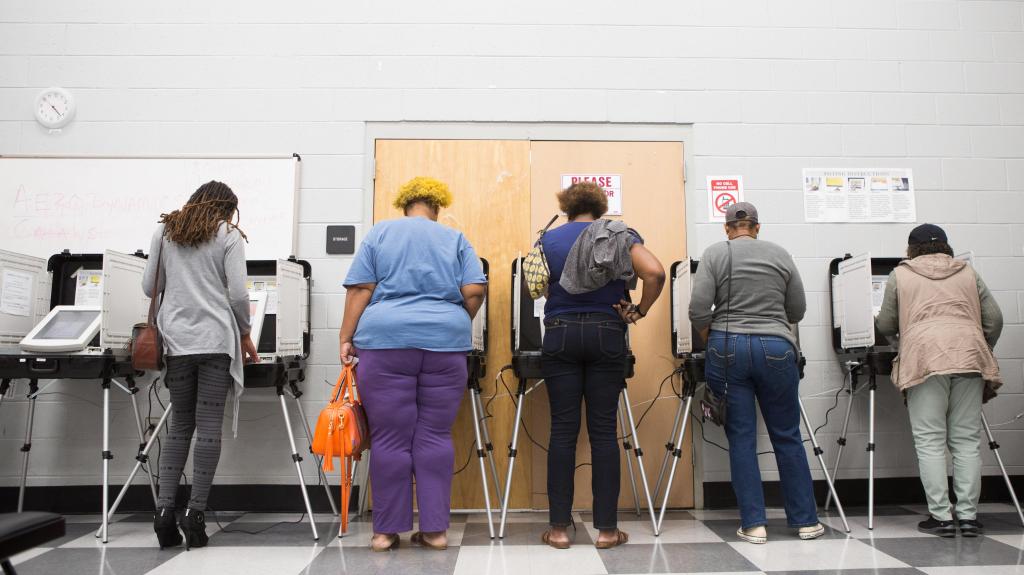
—Sylvester Loving, B1Daily
The Democratic Party has regained control of Congress following its sweeping victories in the 2026 midterm elections. With majorities in both the House of Representatives and Senate, the party now has an opportunity to revisit one of its most consequential unfinished legislative priorities: restoring and strengthening the Voting Rights Act of 1965.
For Black American voters, the stakes extend beyond which political party controls Washington. Federal voting protections influence congressional representation, redistricting, election administration, and the ability to challenge discriminatory voting practices.
The question facing Democrats is whether their new congressional power will translate into meaningful legislation, or whether voting-rights reform will remain stalled by the same institutional obstacles that defeated earlier efforts.
The Voting Rights Act Has Been Weakened
The Voting Rights Act was among the most significant achievements of the civil rights movement. Its provisions helped dismantle discriminatory election practices that had systematically excluded Black Americans from political participation.
However, Supreme Court decisions have substantially changed how the law operates.
In Shelby County v. Holder in 2013, the Court invalidated the coverage formula that determined which jurisdictions were required to obtain federal approval before changing election rules. Without a replacement formula, the law’s preclearance system became largely inoperative.
Subsequent rulings, including the Court’s 2026 decision in Louisiana v. Callais, further altered the legal landscape surrounding race and congressional redistricting.
Supporters of stronger federal protections argue that these decisions have made it more difficult to challenge discriminatory voting systems. Critics of race-conscious districting maintain that election laws must also comply with constitutional limits on racial classifications.
Congress now faces the difficult task of determining what protections can be restored through legislation and which constitutional questions would remain subject to judicial review.
The John Lewis Voting Rights Advancement Act Returns to the Conversation
One potential legislative vehicle is the John R. Lewis Voting Rights Advancement Act.
Democratic lawmakers reintroduced the measure in 2025, proposing updated criteria for federal oversight of jurisdictions with documented histories of voting discrimination.
The legislation would seek to restore an enforceable preclearance system and strengthen mechanisms for challenging discriminatory election changes.
The proposal carries particular significance for Black communities in states where congressional district boundaries, polling-place decisions, and election procedures have been the subject of prolonged litigation.
House Democratic leader Hakeem Jeffries identified restoring voting rights as a major priority before the midterms. His statements indicate that the issue remains prominent within the party’s legislative agenda.
However, introducing or passing a bill in Congress is not the same as making it federal law.
The Filibuster Could Become the Deciding Obstacle
Democrats have confronted this problem before.
During the Biden administration, the House approved major voting-rights legislation, only for the measures to encounter Republican opposition and Senate procedural barriers.
Under the Senate’s ordinary legislative rules, most contested bills require 60 votes to advance. A simple Democratic majority therefore may not be sufficient.
Lawmakers could seek bipartisan support, pursue changes to Senate rules, or consider a narrower voting-rights exception to the filibuster. Each option carries political and procedural consequences.
Even if both chambers passed a comprehensive voting-rights bill, President Donald Trump could veto it. Overriding a presidential veto requires two-thirds support in both chambers, a considerably higher threshold than a simple majority.
The Democrats’ electoral victories have changed congressional leadership, but they have not eliminated these constitutional and procedural constraints.
What Would Stronger Voting Protections Mean for Black Americans?
A renewed Voting Rights Act could affect several issues that have long shaped Black political representation.
Federal oversight could provide additional scrutiny of election changes in jurisdictions with repeated findings of discrimination. Updated enforcement provisions could make it easier to challenge certain voting restrictions before elections occur. Congressional action could also establish clearer standards for election administration and voter access.
Yet legislation would need to be carefully drafted to withstand constitutional challenges.
The consequences would extend beyond Black voters, but the historical significance is unmistakable. The original Voting Rights Act emerged from a struggle against racial exclusion, particularly in the American South, and its enforcement remains closely connected to the political representation of Black Americans.
The question is not simply whether Democrats support voting rights in principle. It is what specific protections they propose, how those protections would operate, and whether they can assemble the votes necessary to enact them.
Congressional Control Is Not the Same as Legislative Success
The 2026 election results have given Democrats substantial institutional power. They can determine committee agendas, conduct oversight hearings, advance legislation, and force renewed national debate over voting protections.
They cannot, however, unilaterally guarantee the restoration of the Voting Rights Act while facing Senate procedural hurdles and a president from the opposing party.
The coming congressional session will reveal whether party leaders prioritize comprehensive legislation, narrower reforms, oversight of state election practices, or some combination of these approaches.
For Black voters and voting-rights advocates, the most meaningful measure of progress will be concrete legislative action rather than campaign declarations.
Democrats have regained Congress. Whether that produces a stronger Voting Rights Act remains an open question, and one that will test the limits of their new majority.
—Sylvester Loving, B1Daily



Leave a Reply