—Kel McKnight, B1Daily
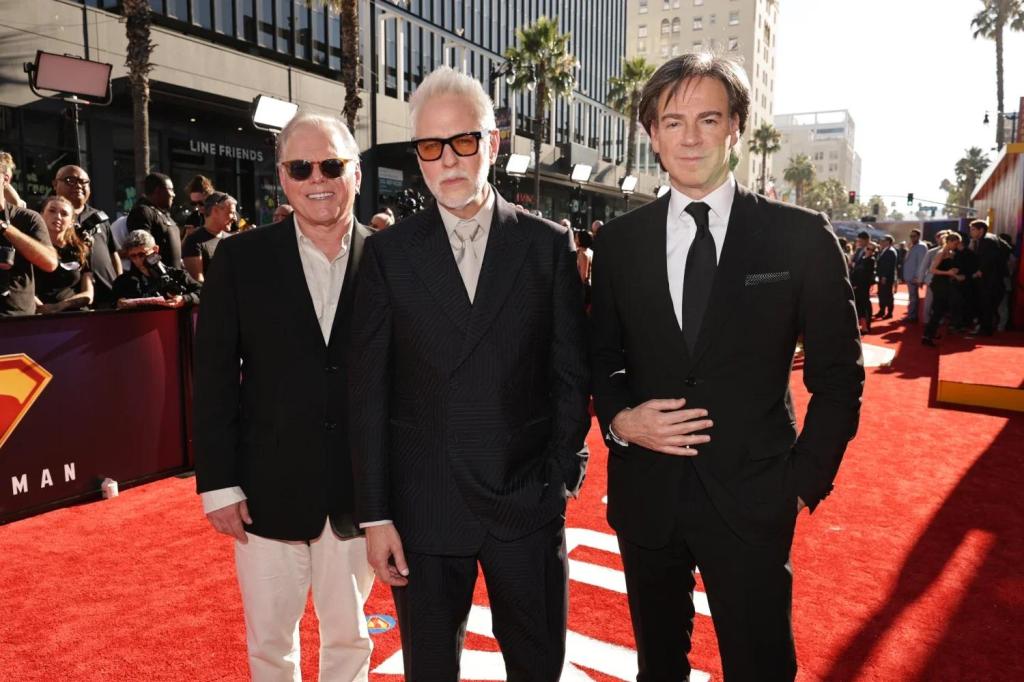
Four years ago, Warner Bros. Discovery handed James Gunn and Peter Safran one of the most difficult assignments in modern entertainment: rescue DC’s collapsing cinematic universe, restore audience confidence, and build a superhero franchise capable of competing with Marvel.
On November 9, 2026, the two men who were supposed to deliver that transformation were officially replaced.
In a stunning executive shake-up, DC Studios announced that Gunn and Safran would step down as co-chairmen and co-chief executives, with former Marvel Studios executive Jeremy Latcham assuming control on December 1.
The announcement arrived barely a month after Skydance completed its acquisition of Warner Bros. Discovery, bringing DC’s legendary collection of superheroes under another corporate regime.
For Gunn and Safran, the departure ends an executive experiment that began with enormous ambition and delivered decidedly mixed commercial results.
For DC, it raises a considerably more troubling question: Does this studio actually know what it wants to be?
The company has spent years rebooting characters, reorganizing leadership, rewriting franchise plans, and promising audiences that its next creative strategy will finally establish a coherent cinematic universe.
Now, before Gunn’s Superman sequel has even reached theaters, the studio is changing its leadership again.
A Four-Year Gamble Ends Before the Universe Is Fully Built
When Gunn and Safran were appointed in October 2022, DC was emerging from years of confusion.
The previous DC Extended Universe had produced major commercial successes, including Aquaman and Wonder Woman, but also endured disappointing releases, controversial leadership decisions, and an increasingly fractured fanbase.
The departure of Henry Cavill’s Superman and the cancellation of the nearly completed Batgirl film became symbols of a studio seemingly unable to decide whether it wanted to preserve its existing franchise or destroy it and begin again.
Gunn, fresh from his success directing Marvel’s Guardians of the Galaxy films, appeared to offer the creative personality Warner Bros. desperately needed.
Safran brought producing experience, business relationships, and familiarity with large commercial franchises.
Together, they proposed an interconnected DC Universe spanning theatrical films, television, animation, and gaming.
Their first major chapter, Gods and Monsters, promised a carefully coordinated slate built around Superman, Supergirl, Batman, and lesser-known comic book characters.
The central argument was straightforward: DC needed one consistent creative vision.
Four years later, the executives responsible for that vision are leaving before most of their proposed universe has been fully realized.
That is not necessarily proof their creative approach failed. It is, however, another demonstration of how frequently DC’s long-term planning has been interrupted by changes above the creative level.
Superman Delivered. Supergirl Did Not.
The commercial record explains why DC’s leadership change is attracting so much attention.
Gunn’s Superman, released in 2025 and starring David Corenswet, earned approximately $618.7 million worldwide.
The film introduced a more optimistic, humorous interpretation of the character and gave DC a recognizable foundation for its new cinematic universe.
It was a meaningful success, particularly after years of uncertainty surrounding Superman’s theatrical future.
But the momentum proved difficult to sustain.
Supergirl, starring Milly Alcock, arrived in July 2026 and grossed approximately $126 million worldwide against a reported production budget of $170 million.
For a major superhero release, those numbers represented a substantial disappointment even before accounting for marketing and distribution expenses.
Then came Clayface, an unusual R-rated body-horror interpretation of the Batman villain. Released in October, the film generated approximately $109 million worldwide against a reported $44 million production budget.
Its performance was more encouraging relative to its production cost, although theatrical grosses alone do not establish a film’s profitability.
Together, the three releases illustrated the challenge facing DC: Superman could attract a large audience, but the studio had not demonstrated that its wider universe could reliably produce major theatrical hits.
The franchise was experimenting with distinct genres and tones, from traditional superhero adventure to cosmic science fiction and horror.
Creatively, that variety offered possibilities. Commercially, it created uncertainty about what audiences should expect from the DC brand.
David Ellison’s Takeover Changes Everything
The timing of the announcement is impossible to separate from the corporate upheaval surrounding Warner Bros.
Skydance’s acquisition of Warner Bros. Discovery brought the studio under the leadership of David Ellison, who has moved to reshape the company’s executive structure.
Gunn and Safran initially appeared positioned to remain in charge of DC following the transaction.
Instead, their departure has become one of the most consequential changes in the new ownership era.
Skydance executives praised their contributions and emphasized that the transition would be collaborative.
But the underlying reality remains: A new corporate owner has installed a new executive to oversee one of Hollywood’s most valuable entertainment properties.
The publicly announced statements do not establish whether Gunn and Safran voluntarily initiated their departure or whether the new ownership ultimately decided to replace them.
What is clear is that the change places DC’s future under a different management structure, with Latcham reporting to Skydance Motion Picture Group co-chairmen Dana Goldberg and Josh Greenstein.
That arrangement gives the new ownership team a more direct role in shaping the studio’s creative and commercial strategy.
For DC fans, the concern is familiar.
Another ownership change. Another executive announcement. Another promise of stability.
And another question about whether the plans announced yesterday will survive tomorrow.
James Gunn Finally Admits the Job Was Exhausting
Gunn’s own public response offered a revealing glimpse into the demands of running DC Studios.
In a lengthy social media statement, the filmmaker described the past four years as personally difficult and acknowledged his discomfort with the corporate responsibilities of the position.
He explained that managing an entire studio required balancing numerous projects, business obligations, and creative decisions, leaving him with little opportunity to step away from work.
The statement suggested that the filmmaker who enthusiastically accepted the opportunity to oversee Superman, Batman, and Wonder Woman had discovered that running a major Hollywood franchise was fundamentally different from directing one.
That distinction matters.
Gunn’s greatest professional achievements came from writing and directing films with distinctive characters, unconventional humor, and strong emotional themes.
But serving as a studio chief requires a different collection of responsibilities: supervising budgets, managing release schedules, coordinating producers, navigating corporate expectations, and overseeing projects that may not personally interest the executive.
Gunn has indicated that he is relieved to return his attention to filmmaking.
He and Safran will remain involved in creative projects, including Man of Tomorrow, the Superman sequel scheduled for July 2027.
Their departure from executive leadership therefore does not mean their relationship with DC has ended.
But it does mean the person who designed the new DC Universe will no longer have final executive responsibility for its future.
Enter Jeremy Latcham: DC Goes Shopping at Marvel Again
The appointment of Jeremy Latcham introduces another familiar element to DC’s corporate strategy.

When the studio needs a new direction, it frequently looks toward the people who helped build Marvel’s success.
Latcham joined Marvel Studios in 2004 and became a senior production and development executive during the company’s formative years.
His credits include Iron Man, The Avengers, Guardians of the Galaxy, Avengers: Age of Ultron, and Spider-Man: Homecoming.
Those productions helped establish the Marvel Cinematic Universe as one of the most commercially successful franchises in film history.
Latcham later left Marvel and produced projects including Dungeons & Dragons: Honor Among Thieves.
His appointment gives DC an executive with direct experience developing interconnected blockbuster franchises.
But the comparison also exposes the central problem.
DC has repeatedly attempted to recreate Marvel’s organizational success without consistently demonstrating the patience necessary to build a comparable universe.
Marvel’s early cinematic strategy benefited from a clear progression of individual character introductions, shared continuity, and major crossover events.
DC’s theatrical history has been more fragmented, with overlapping versions of Batman, multiple continuity resets, and abrupt changes in creative direction.
Hiring another Marvel veteran may provide valuable expertise.
It does not automatically solve the institutional problems that have complicated DC’s strategy for more than a decade.
Batman Is Still in His Own Universe. Superman Has Another One.
One of DC’s most persistent challenges is the relationship between its interconnected cinematic universe and its standalone franchises.
Robert Pattinson’s Batman operates within a separate continuity from Gunn’s Superman.
That arrangement allows filmmakers greater creative freedom and gives audiences different interpretations of iconic characters.
But it also complicates the broader objective of building a single, easily understood franchise.
Matt Reeves’ The Batman established a darker, detective-oriented interpretation of Gotham City. Gunn’s Superman embraced a more colorful, comic-book-inspired world.
Both approaches can succeed independently.
The problem arises when a studio simultaneously promotes a unified cinematic universe while maintaining separate versions of its most important characters.
DC’s solution has been to distinguish its primary continuity from standalone Elseworlds productions.
That may be creatively defensible, but it requires consistent communication and disciplined long-term planning.
With another executive taking control, the studio must decide whether to preserve that approach, consolidate its franchises, or pursue a different model entirely.
No complete creative reset has been announced.
Still, Latcham’s appointment creates uncertainty about how much of Gunn and Safran’s original blueprint will remain intact.
The Snyder Era Still Haunts DC
The studio’s problems did not begin with Gunn.
Zack Snyder’s Man of Steel, Batman v Superman: Dawn of Justice, and Justice League established an ambitious, visually distinctive interpretation of DC’s mythology.
Those films generated passionate support and equally passionate criticism.
Warner Bros. subsequently altered its approach, leading to years of disputes over continuity, tone, casting, and the direction of the franchise.
The 2021 release of Zack Snyder’s Justice League became a landmark moment for a fan movement that demanded restoration of the director’s original vision.
But the studio ultimately moved away from that continuity.
Gunn’s arrival was intended to settle the debate by establishing a new foundation.
Now his departure threatens to revive the same anxiety about unfinished plans and abandoned creative commitments.
The underlying lesson is not that Snyder or Gunn possessed the only correct interpretation of DC.
It is that a studio cannot build lasting audience confidence when major creative strategies are repeatedly disrupted before they have sufficient time to develop.
What Happens to the Films Already in Production?
The immediate future of DC’s slate is not entirely uncertain.
Man of Tomorrow remains scheduled for July 2027, with Gunn writing and directing.
The Batman Part II is also moving forward, alongside television projects including The People v. Gorilla Grodd.
Gunn and Safran’s influence will therefore remain visible across upcoming productions even after their executive departure.
But the longer-term roadmap is less clear.
Projects associated with the original Gods and Monsters plan could face revised priorities, new development oversight, or changes in scheduling.
That does not mean cancellations are inevitable.
Hollywood leadership transitions often preserve existing projects, particularly when significant money has already been invested in development or production.
Nevertheless, filmmakers and producers working within DC’s pipeline now face a different decision-making hierarchy.
The next several months will reveal whether Latcham intends to maintain the established continuity or reshape it around Skydance’s commercial priorities.
DC Has a Management Problem, Not a Superhero Problem
Perhaps the most frustrating aspect of DC’s repeated restructuring is the extraordinary strength of its intellectual property.
Superman, Batman, Wonder Woman, Green Lantern, The Flash, and the Justice League remain among the most recognizable characters in popular culture.
The company possesses decades of acclaimed comic book stories, animated productions, television adaptations, and commercially successful films.
The creative resources are enormous.
What DC has struggled to maintain is a consistent executive strategy.
The studio has moved between darker mythology, interconnected blockbuster filmmaking, standalone auteur-driven projects, and a more colorful shared universe.
None of those approaches is inherently illegitimate.
The difficulty comes when corporate leadership changes the strategy before the audience has fully understood or embraced the previous one.
That cycle can weaken brand identity, complicate marketing, and make audiences skeptical of announcements about the franchise’s future.
The issue is not simply that DC produces unsuccessful films. Every major studio does.
It is that DC’s corporate structure repeatedly appears unable to sustain a coherent plan across changes in ownership and leadership.
Hollywood’s Most Valuable Identity Crisis Continues
Jeremy Latcham inherits a studio with extraordinary characters, established filmmakers, a substantial production pipeline, and a fanbase that has endured years of creative uncertainty.
He also inherits the expectations of a new corporate ownership team seeking to maximize the value of DC’s intellectual property.
His task is not merely to produce successful films.
It is to establish a recognizable creative direction, coordinate standalone and interconnected projects, manage budgets, and restore confidence that announced plans will actually reach the screen.
Gunn and Safran leave behind genuine accomplishments, including a successful Superman reboot and a willingness to explore unconventional genres.
They also leave behind a franchise whose wider commercial identity remains unsettled.
Their departure after only four years reinforces a perception that has followed DC through multiple corporate regimes: The studio keeps changing the people in charge without fully resolving the problems those executives were hired to fix.
For years, DC has promised that its next chapter would finally provide the stability audiences have been waiting for.
Now the company is beginning another chapter with another executive and another opportunity to redefine its future.
Superman may be able to save the world.
But saving DC Studios from its own corporate indecision has proven to be a considerably more difficult assignment.
—Kel McKnight, B1Daily




Leave a Reply