—Gus Aylen, B1Daily
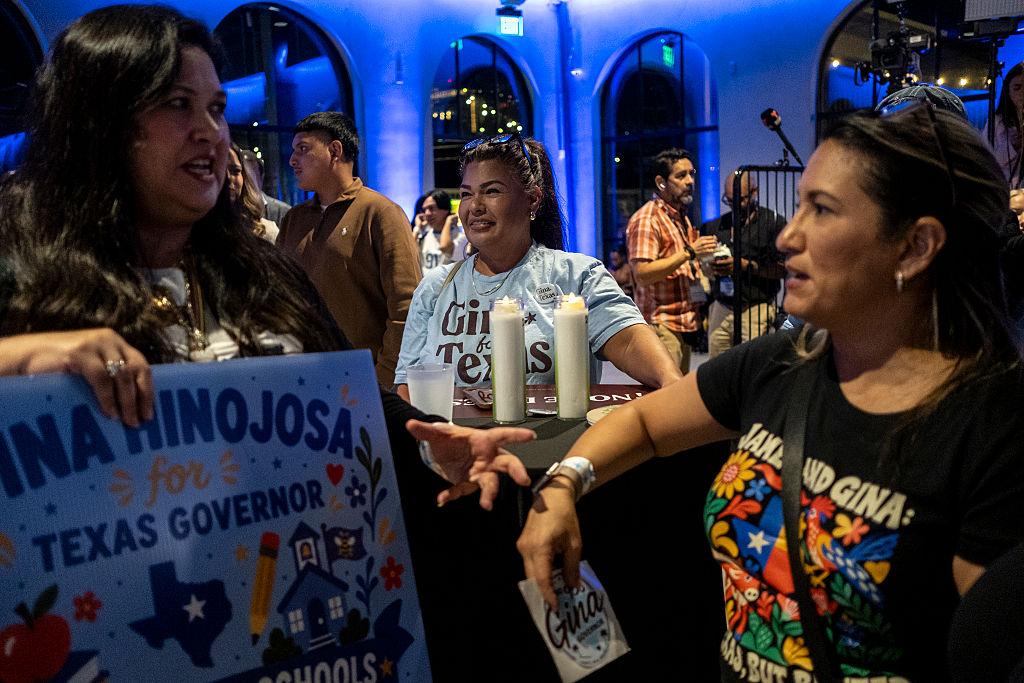
A historic election victory in Texas has exposed an uncomfortable political reality: Black voters overwhelmingly supported Gina Hinojosa, even as Latino men and women backed her by considerably smaller margins.
Gina Hinojosa made history on November 3, becoming Texas’s first Latina governor-elect and ending more than three decades of Republican control of the governor’s office. But behind the celebrations lies an electoral story that deserves considerably more attention.
Black Texans supported Hinojosa at rates substantially higher than those of Latino voters, including Latino men. The results challenge assumptions that shared ethnicity automatically translates into political loyalty and raise an equally important question: What specific commitments will Black Texans receive from the administration they helped elect?
The Numbers Tell a Different Story
According to published election exit-poll breakdowns, Hinojosa received approximately 87% support from Black men and 90% from Black women.
Among Latino voters, the numbers were notably lower. Approximately 57% of Latino men supported Hinojosa, compared with 69% of Latina women.
That represents a 30-percentage-point difference between Black and Latino men and a 21-point difference between Black and Latina women.
The results demonstrate that Latino voters were not politically uniform. While a majority supported Hinojosa, substantial portions of the electorate remained aligned with Republican Governor Greg Abbott.
Black voters, meanwhile, delivered overwhelming support across both genders.
The distinction matters because political coalitions are frequently discussed in terms of demographic representation, while the actual voting behavior of those communities tells a more complicated story.
Black Voters Delivered. What Did They Get Promised?
Hinojosa’s victory represents a historic milestone for Latino political representation in Texas. But Black voters have reason to ask whether their extraordinary support will translate into specific policies addressing their communities.
During the campaign, Hinojosa acknowledged that Black voters were essential to her electoral prospects. She also outlined broader positions on public education, housing affordability, criminal justice reform, and police accountability.
Those positions could benefit Black Texans. However, broad statewide proposals are not the same as a detailed, measurable Black-specific policy agenda.
There has been no clearly established public commitment from Hinojosa to a comprehensive Texas Freedmen reparations program, a dedicated Black wealth-building initiative, or a statewide plan specifically addressing the persistent economic disparities experienced by descendants of American slavery.
That distinction deserves scrutiny.
Black Texans face longstanding challenges involving homeownership, access to capital, maternal health, educational opportunity, and the preservation of historically Black communities.
Political representation for one demographic group does not automatically resolve the policy concerns of another, even when both groups participate in the same electoral coalition.
Latino Political Identity Is Not a Guarantee of Latino Votes
Hinojosa’s performance among Latino men also illustrates the increasingly diverse political preferences within the Hispanic electorate.
Economic priorities, religious beliefs, immigration policy, business interests, and cultural conservatism all influence voting decisions. Latino voters cannot reasonably be treated as a single political constituency simply because they share an ethnic classification.
The 2026 results show that Hinojosa’s historic candidacy did not eliminate those divisions.
By comparison, Black voters remained considerably more unified in their support for the Democratic candidate.
This difference does not make one community politically superior to another. It does, however, demonstrate why campaigns should examine actual voting behavior rather than assume that demographic identity determines electoral support.
Representation Must Come With Accountability
Hinojosa will enter office with expectations from multiple constituencies, including Latino organizations seeking immigration and education reforms, workers demanding affordability measures, and Black Texans concerned about economic and racial disparities.
Her administration’s challenge will be translating campaign commitments into legislation, executive action, and measurable outcomes.
For Black voters, the central questions are straightforward: Will the incoming governor support targeted Black homeownership initiatives? Will she address discriminatory lending and unequal economic opportunity? Will she commit to specific policies benefiting historically Black communities, rather than relying exclusively on broad promises of inclusion?
These are questions of public accountability, not demands for political favoritism.
The election established that Black Texans were among Hinojosa’s most reliable supporters. Her administration’s record will determine whether that electoral support is matched by meaningful policy attention.
Texas has made history by electing its first Latina governor. The next chapter will be written not through symbolism, but through the policies enacted for the communities that helped make that history possible.
—Gus Aylen, B1Daily





Leave a Reply