—Travis Luyindama, B1Daily
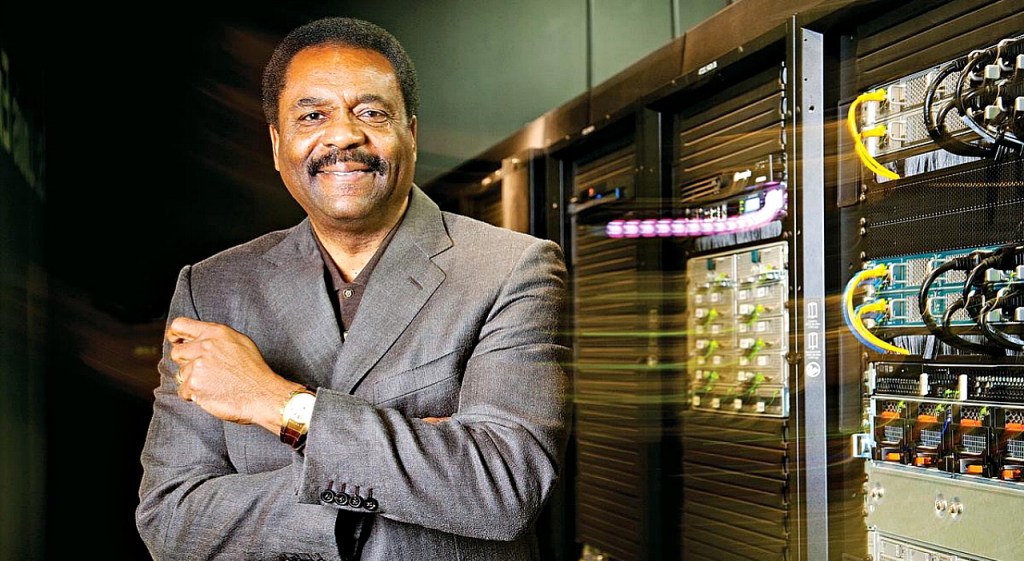
America’s technology sector often celebrates founders who build flashy consumer apps, but the real backbone of the digital economy lives elsewhere. Inside data infrastructure, cloud orchestration, systems integration, cybersecurity architecture, AI-ready networking, and enterprise-scale computing. That is the terrain where David Steward became a titan.

Long before “digital transformation” became a corporate buzzword repeated in every earnings call on Wall Street, Steward understood something many executives missed: the future would belong to companies capable of integrating complex technological ecosystems at scale. Not just creating software, but engineering entire operational environments where hardware, cloud services, cybersecurity layers, networking infrastructure, and logistics all function together with near-military precision.
That understanding became the foundation of World Wide Technology.
Founded in 1990, WWT evolved from a small systems integrator into one of the largest private technology firms in America. The company’s rise was not powered by viral consumer products or speculative hype. It was driven by enterprise architecture expertise and deep technical execution. WWT positioned itself at the center of critical infrastructure modernization, helping major corporations and federal agencies redesign their digital environments during the internet boom, the cloud revolution, and now the AI acceleration era.
Steward’s technical acumen distinguished him from traditional executives who merely manage balance sheets. His strength was understanding where infrastructure itself was moving. He recognized early that enterprise technology would become exponentially more complex as organizations adopted hybrid cloud systems, distributed networks, edge computing, and increasingly sophisticated cybersecurity requirements.
Instead of chasing trends, Steward built technical capability stacks.
WWT became known across the industry for advanced integration environments where customers could test large-scale deployments before implementation. That model reduced operational risk for massive enterprises handling sensitive workloads and mission-critical systems. In practical terms, Steward helped create an ecosystem where Fortune 500 firms and government clients could simulate entire digital transformations before spending billions on deployment.
That is not ordinary business strategy. That is systems engineering at enterprise scale.
The company’s influence expanded because Steward understood that modern computing is no longer about isolated devices or standalone software. It is about orchestration. Cloud-native infrastructure, automation pipelines, AI compute requirements, zero-trust security architecture, and high-performance networking must function together seamlessly across global operations.
This is where Steward’s genius becomes most visible.
Many executives can sell technology. Far fewer can anticipate how enterprise architecture evolves over decades. Steward built WWT around adaptability itself. As computing shifted from on-premise hardware to cloud ecosystems and now toward AI-centric infrastructure, WWT continuously repositioned itself at the center of technological transition rather than becoming obsolete.
That ability requires both strategic foresight and deep technical literacy.
The modern enterprise economy depends on invisible digital arteries. Data centers, fiber networks, cloud integrations, cybersecurity frameworks, automation systems, and edge infrastructure now determine whether governments, hospitals, banks, manufacturers, and logistics giants remain operational. Steward recognized early that controlling expertise in those areas would create long-term dominance.
And he was correct.
Today, WWT operates as a major force inside enterprise IT modernization, working with some of the largest organizations on Earth. The scale of those operations reflects extraordinary trust. Large enterprises do not hand over mission-critical infrastructure to firms lacking engineering sophistication. The technical demands are too high and the operational risks too severe.
Steward’s rise also carries broader significance for the technology sector itself. In an industry that often markets diversity while remaining structurally narrow at executive levels, Steward built a multibillion-dollar empire through engineering strategy, operational intelligence, and infrastructure mastery. His success disrupts simplistic narratives about who shapes the digital economy.
He did not become a billionaire through entertainment-adjacent branding or speculative startup theater. He built wealth through enterprise systems, network architecture, and technological scalability.
That distinction matters.
Because beneath every AI platform, streaming service, financial network, cloud environment, and defense system sits infrastructure. Someone has to design, integrate, secure, optimize, and scale it. David Steward built an empire by mastering exactly that layer of the modern world.
The layer most people never see.
—Travis Luyindama, B1Daily





Leave a comment