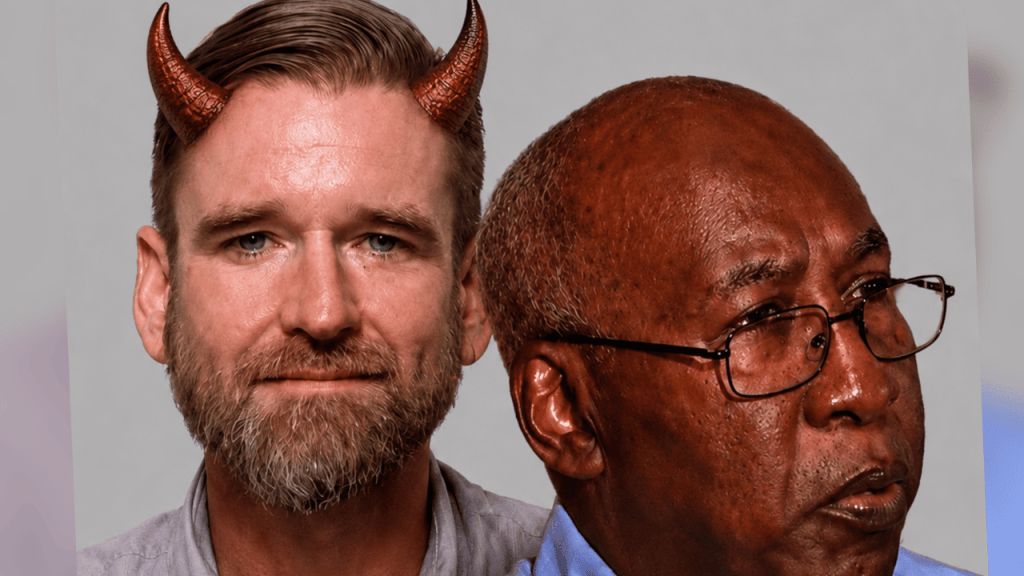
—Barrington Williams, B1Daily
An 80-year-old Black veteran answered his front door thinking maintenance had arrived.
Instead, investigators say he was met with violence.
Authorities in The Villages say Dr. Otis Lane, an elderly military veteran, was allegedly lured outside his home by a man posing as a worker before being punched in the face during what investigators are now considering a possible hate crime. The suspect, identified as Kyle Parrish, was arrested after the attack, which was reportedly captured on a doorbell camera.
According to reports, Lane initially believed Parrish was connected to neighborhood maintenance work when the man knocked on his door. But once outside, Lane says the encounter turned hostile almost immediately. Investigators say the suspect allegedly made a derogatory statement before attacking the elderly veteran.
One reported statement allegedly shouted before the assault was chillingly direct:
“We don’t want your kind living here.”
That sentence transformed the case from a simple battery investigation into something darker, something soaked in the old poison America keeps pretending it buried decades ago.
The image itself feels ripped from another century: an elderly Black veteran standing outside his own home in a retirement community, attacked after opening the door to a stranger.
But this is not archival footage from the Jim Crow South.
This happened in 2026.
And the fact that Lane is a veteran adds another layer of bitterness to the story. Men like him served a country that often denied them dignity even while demanding their sacrifice. Black veterans historically returned from war only to face segregation, housing discrimination, racial terror, and exclusion from benefits that helped build America’s white middle class after World War II.
Now, at 80 years old, Lane allegedly found himself staring into that same hatred again on his own doorstep.
Investigators say prosecutors will determine whether formal hate crime enhancements will be pursued. Under Florida law, hate crime classifications can increase criminal penalties when prosecutors prove a defendant intentionally targeted a victim based on race, religion, ethnicity, sexual orientation, or other protected characteristics.
That legal threshold matters.
Because hate crime cases are not simply about violence. They are about motive. Prosecutors must show the alleged assault was driven at least in part by racial animus rather than a random confrontation. Statements allegedly made during the incident often become critical evidence in establishing that intent.
And if the reported remarks are authenticated through witness testimony or video evidence, they could become central to the prosecution’s case.
Doorbell cameras, once marketed as suburban convenience gadgets, have increasingly become accidental witnesses to modern crime. In case after case, they capture the raw split second where ordinary life ruptures into violence. Here, investigators reportedly have footage of the suspect approaching the home before the alleged assault occurred.
Don’t expect Florida’s racist attorney’s to mark this as a hate crime.
For many Black Americans, though, the emotional reaction to the story goes beyond the courtroom.
Because there is something uniquely disturbing about the targeting of elderly Black citizens. It carries echoes of older racial terror campaigns where intimidation itself was the point. Not robbery. Not personal disputes. Fear.
Fear meant to remind people they were “out of place.”
That’s why hate crimes ripple far beyond the direct victim. The target may be one person, but the message is aimed at an entire community.
And in this case, the alleged victim was an 80-year-old veteran whose only “crime” appears to have been opening his front door.
—Barrington Williams, B1Daily





Leave a comment