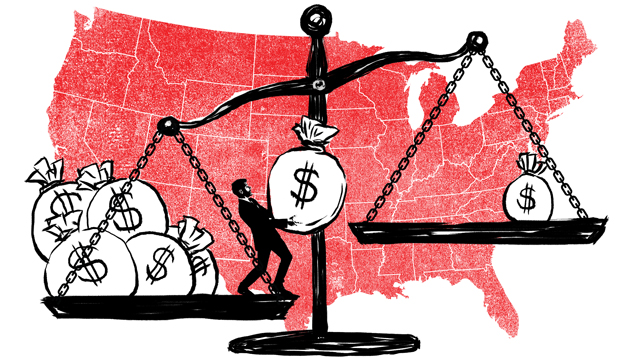
—Michael Lyles, B1Daily
America already uses the tax code as a political tool for everything from homeownership to electric vehicles, oil drilling, disaster relief, and foreign policy incentives. Entire industries survive because Congress quietly engineers economic behavior through deductions, credits, and exemptions buried inside federal tax law.
So a growing number of economists and reparations advocates are asking a provocative question:
If the government can use tax policy to reward corporations, subsidize wars, and compensate certain historical victims through specialized settlement programs, why couldn’t it create a long-term reparations tax framework for Black Americans descended from slavery and Jim Crow?
The idea is politically explosive, but economically it is far less radical than critics often pretend.
One proposal gaining traction in academic and policy circles involves annual federal tax write-offs or refundable credits targeted specifically toward descendants of enslaved Black Americans. Rather than issuing one-time lump-sum payments, the government could create recurring economic offsets designed to reduce the racial wealth gap over generations.
Supporters argue this model would be easier to administer than massive direct cash programs while integrating reparations into America’s existing financial infrastructure.
And importantly, the United States already has historical precedent for compensatory economic policy.
The federal government has previously provided restitution or compensation programs to groups harmed by government actions, including Japanese Americans interned during World War II through the Civil Liberties Act of 1988. There have also been various tax treatments connected to settlements involving genocide survivors and victims of historical persecution, including some Armenian and Holocaust-related compensation arrangements. However, contrary to some viral online claims, there is no blanket federal program that gives all Armenians automatic six-figure annual tax write-offs for the Armenian Genocide.
Still, the broader principle remains important:
Governments routinely use financial mechanisms to acknowledge historical harm.
The real debate is whether Black Americans deserve inclusion in that framework.
Economically, the argument for reparations is rooted less in morality alone and more in asset deprivation. Black Americans were systematically excluded from wealth-building mechanisms for centuries: slavery, land theft, redlining, exclusion from New Deal housing programs, discriminatory GI Bill implementation, labor exploitation, and segregation all suppressed intergenerational wealth accumulation.
Today the median white household still possesses dramatically higher net worth than the median Black household, a gap many economists argue cannot be explained solely by individual behavior or modern income differences.
A reparations tax credit system would attempt to address that structural imbalance gradually.
One proposed model could function similarly to the Earned Income Tax Credit, but specifically tied to descendants of enslaved Americans. Eligible individuals could receive:
- annual refundable tax credits
- homeownership deductions
- student debt relief credits
- business investment write-offs
- retirement contribution matching
- federally backed down payment assistance
Instead of a one-time check, the policy would create what some economists call “compound reparative growth,” where wealth-building opportunities accumulate over decades.
Think of it less like a stimulus payment and more like economic infrastructure.
Critics, however, warn such programs would trigger enormous legal and political challenges.
The biggest obstacle is constitutional scrutiny. Race-exclusive federal programs face increasing challenges under current Supreme Court interpretations of equal protection law. Policymakers would likely need to structure reparations eligibility around lineage and historical documentation rather than race alone, focusing specifically on descendants of enslaved persons in the United States.
There is also the question of cost.
Depending on scale, annual reparations tax credits could cost hundreds of billions over time. Opponents argue the federal deficit is already unsustainable and that modern taxpayers should not bear financial responsibility for historical crimes committed generations ago.
Supporters counter that America already spends trillions managing the downstream consequences of inequality through welfare systems, incarceration costs, housing instability, underfunded schools, and healthcare disparities. In their view, reparations are not merely compensation. They are long-term economic stabilization.
And politically, tax credits may actually be more viable than direct payments.
Why?
Because America loves hidden subsidies.
Direct reparations checks create dramatic headlines. Tax credits disappear into spreadsheets and IRS forms. One feels revolutionary. The other feels bureaucratic. Washington historically prefers the second approach because it generates less visible backlash while still moving money through the economy.
There is another reason the idea keeps resurfacing: demographics and economics are colliding.
Black Americans represent a massive consumer base and entrepreneurial population whose wealth accumulation has historically been constrained. Advocates argue that targeted tax incentives could stimulate business creation, housing investment, and local economic growth in historically disadvantaged communities.
In that sense, reparations supporters increasingly frame the issue not just as justice, but as economic expansion.
A nation that spent centuries extracting labor from Black Americans without compensation now faces the uncomfortable question of whether repairing that damage is morally necessary, economically beneficial, or both.
And as inequality continues widening across the United States, the once-taboo idea of reparations through the tax code is slowly shifting from activist rhetoric into mainstream economic discussion.
Not because America suddenly became morally enlightened.
But because even capitalism eventually notices when millions of people were locked out of wealth generation for centuries.
—Michael Lyles, B1Daily






Leave a comment