—Travis Luyindama, B1Daily
Artificial intelligence is rapidly reshaping the global economy, transforming industries ranging from healthcare and education to finance and manufacturing. But as the technology becomes increasingly powerful, one question is beginning to dominate political discussions:
Who should profit from AI?
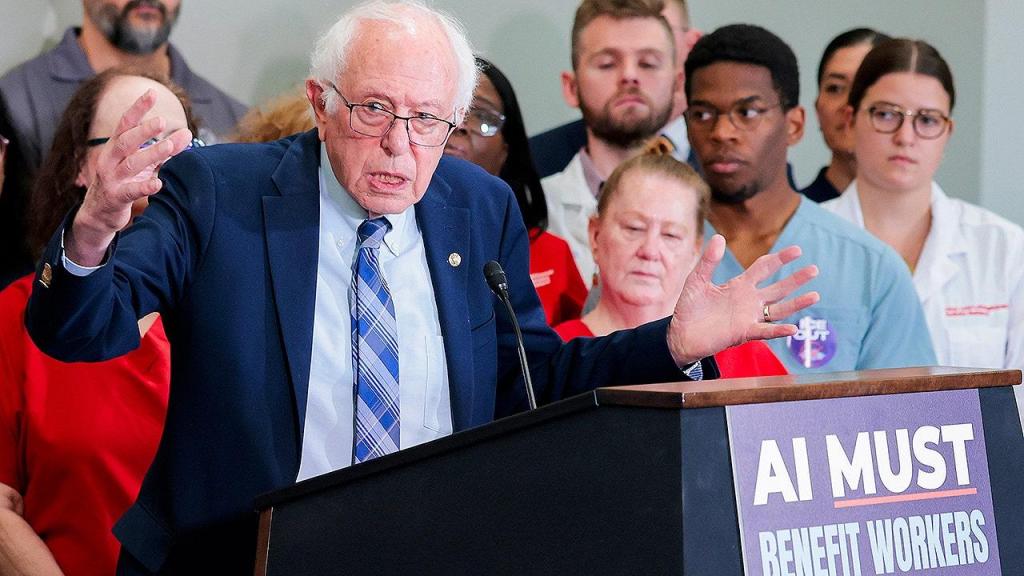
Senator Bernie Sanders believes the answer should not be limited to Silicon Valley executives and Wall Street investors.
Instead, Sanders is advancing one of the most ambitious technology policy proposals in modern American history: requiring the largest AI companies to transfer 50 percent of their stock into a public sovereign wealth fund, giving every American a stake in the industry’s future.
Why Sanders Says AI Belongs to Everyone
Sanders argues that artificial intelligence did not emerge in a vacuum.
Modern AI systems were trained using enormous amounts of publicly available information, academic research, government-funded innovation, books, websites, images, and human-generated content. Public investments also helped lay the foundation for the computing power and internet infrastructure that made today’s AI revolution possible.

His argument is straightforward: if society helped create the conditions that made AI possible, society should share in its financial rewards.
The Proposal
Under Sanders’ proposed American AI Sovereign Wealth Fund Act, the country’s largest AI companies would contribute a one-time transfer equal to 50 percent of their stock into a federally managed sovereign wealth fund.
Rather than immediately selling those shares, the fund would hold them as long-term investments, allowing the American public to benefit from future growth. According to Sanders, the fund could eventually provide annual dividend payments to citizens while also supporting investments in priorities such as healthcare, education, housing, and workforce development.
The Fear Behind the Plan
The proposal comes as economists and business leaders warn that AI could automate millions of jobs over the coming decades.
From customer service representatives and accountants to software developers and truck drivers, advances in generative AI and robotics are expected to reshape employment on a scale not seen since the Industrial Revolution.
Supporters of Sanders’ proposal argue that if machines increasingly perform work once done by humans, then workers should receive a share of the wealth those machines generate.
Critics Say It Goes Too Far
Not everyone agrees.
Opponents argue that forcing companies to surrender half their ownership would discourage investment, reduce innovation, and weaken America’s competitive position in the global AI race.
Some business groups contend that private investors assumed enormous financial risks to build these companies and should not be required to give up ownership after achieving success. Others worry such a precedent could discourage entrepreneurs from launching the next generation of transformative technologies.
A Growing Conversation
Despite the controversy, the broader discussion about how AI’s wealth should be shared is gaining momentum.
Some analysts have proposed smaller public equity stakes, AI-specific taxes, or national AI dividend programs. Others have suggested that AI should be treated as critical infrastructure or a public utility because of its growing role in the economy. Public polling has also shown significant support for giving citizens a direct financial stake in AI’s success.
Bigger Than Politics
Whether Sanders’ proposal becomes law or not, it highlights a fundamental question that governments around the world will increasingly face.
If artificial intelligence dramatically increases productivity while replacing millions of jobs, who should receive the economic benefits?
Should AI remain primarily a privately owned technology generating enormous fortunes for a relatively small number of investors? Or should the public, whose knowledge, labor, and tax dollars helped build the modern digital economy, receive a direct share of its profits?
There are no easy answers.
But as AI continues to transform society, those questions are likely to become some of the defining political and economic debates of the twenty-first century.
—Travis Luyindama, B1Daily






Leave a comment