
—Sylvester Loving, B1Daily
For decades, Haiti struggled with political instability, poverty, and corruption. Today, it faces something even more alarming: the effective partitioning of large parts of the country by heavily armed criminal organizations.
What began as rival neighborhood gangs has evolved into a shadow state. Streets, ports, neighborhoods, and even entire towns have been divided into gang-controlled territories where the authority of the Haitian government has largely disappeared. At the center of this transformation stands Jimmy “Barbecue” Chérizier, the former police officer who became the country’s most recognizable gang leader and one of the architects of Haiti’s criminal empire.
A Country Divided Into Gang Territories
Haiti’s gangs no longer operate like traditional street crews fighting over isolated blocks.
Instead, they function more like rival militias controlling territory, collecting taxes through extortion, operating checkpoints, kidnapping civilians, and regulating who can enter or leave entire neighborhoods. Armed groups have seized key roads, ports, fuel depots, hospitals, prisons, and other strategic infrastructure, making it difficult for the Haitian government to project authority.
The capital, Port-au-Prince, has become the epicenter of this fragmentation.
According to the United Nations and multiple independent analysts, gangs now control roughly 70% to 80% of the city, with some estimates placing the figure even higher in certain districts.
The Rise of “Barbecue”
Jimmy Chérizier, better known as “Barbecue,” is a former Haitian police officer who rose to prominence by uniting several armed groups under the G9 Family and Allies, and later became a central figure in the broader Viv Ansanm coalition. His influence has made him arguably the most powerful gang leader in Haiti.
Barbecue has portrayed himself as a revolutionary fighting Haiti’s political elite, but governments, human rights organizations, and investigators have linked his network to massacres, kidnappings, extortion, and widespread violence.
The Collapse of State Authority
As gang influence expanded, the Haitian government steadily lost control over essential services.
Major highways became dangerous corridors controlled by armed checkpoints. Businesses began paying protection money simply to operate. Residents often found themselves subject to gang rules instead of state laws. In many neighborhoods, gangs effectively replaced the government by deciding who could travel, trade, or remain in the community.
The result has been one of the world’s worst humanitarian crises. Millions require humanitarian assistance, while gang violence has displaced more than a million people and left thousands dead.
A Criminal Economy
Territory means money.
Control over neighborhoods allows gangs to extort businesses, kidnap for ransom, tax commercial traffic, smuggle weapons and drugs, and dominate local markets. Criminal organizations have also expanded into rural areas and key transportation corridors, strengthening their grip on Haiti’s economy.
Every neighborhood captured becomes another source of revenue.
Every roadblock becomes another toll booth.
International Efforts Face an Uphill Battle
The Haitian National Police, supported by international security missions, continue operations against gang strongholds. Despite some localized successes, criminal organizations remain deeply entrenched, and analysts warn that restoring state authority will require far more than military operations alone.
Without stronger institutions, functioning courts, and economic opportunities, experts caution that gangs will continue filling the vacuum left by a weakened state.
A Nation Held Hostage
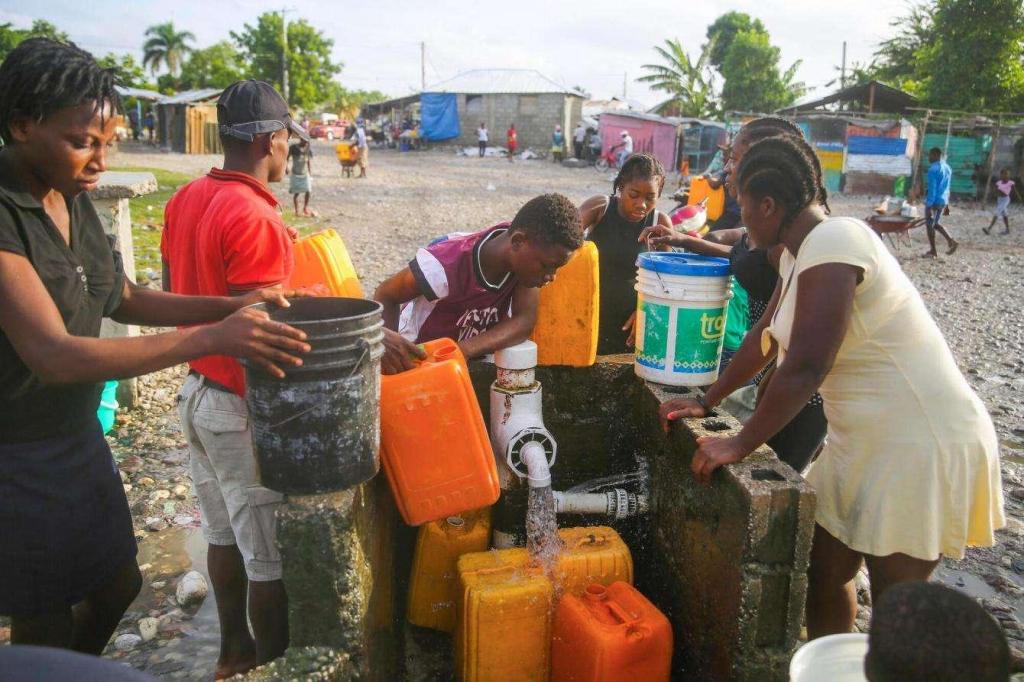
For ordinary Haitians, daily life has become a struggle to survive between rival armed groups.
Children are recruited into gangs. Families flee neighborhoods overnight. Businesses shut down. Schools and hospitals close.
Entire communities live under the constant threat of kidnapping or attack.
The tragedy is not simply that gangs have become powerful. It is that, in many parts of Haiti, they have become the de facto government. Until the state can reclaim territory and restore public institutions, millions of Haitians remain trapped in a country where criminal organizations wield more practical authority than elected officials.
—Sylvester Loving, B1Daily



Leave a comment