—Jermichael Evers, B1Daily
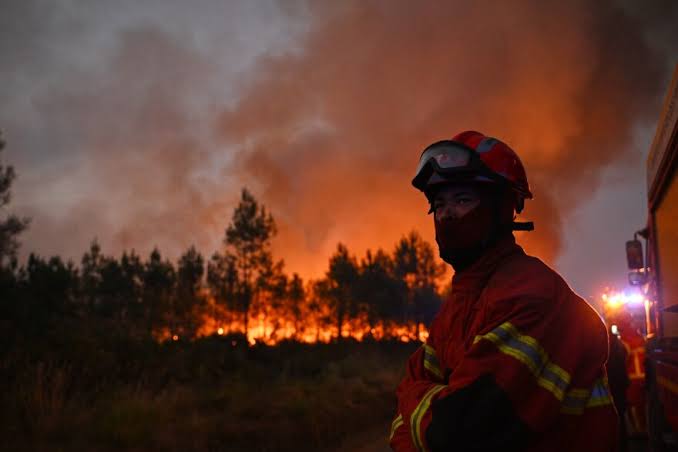
Europe is discovering an expensive truth written in smoke across its forests: it costs far more to fight a landscape after it catches fire than to prevent that landscape from becoming a giant box of matches.
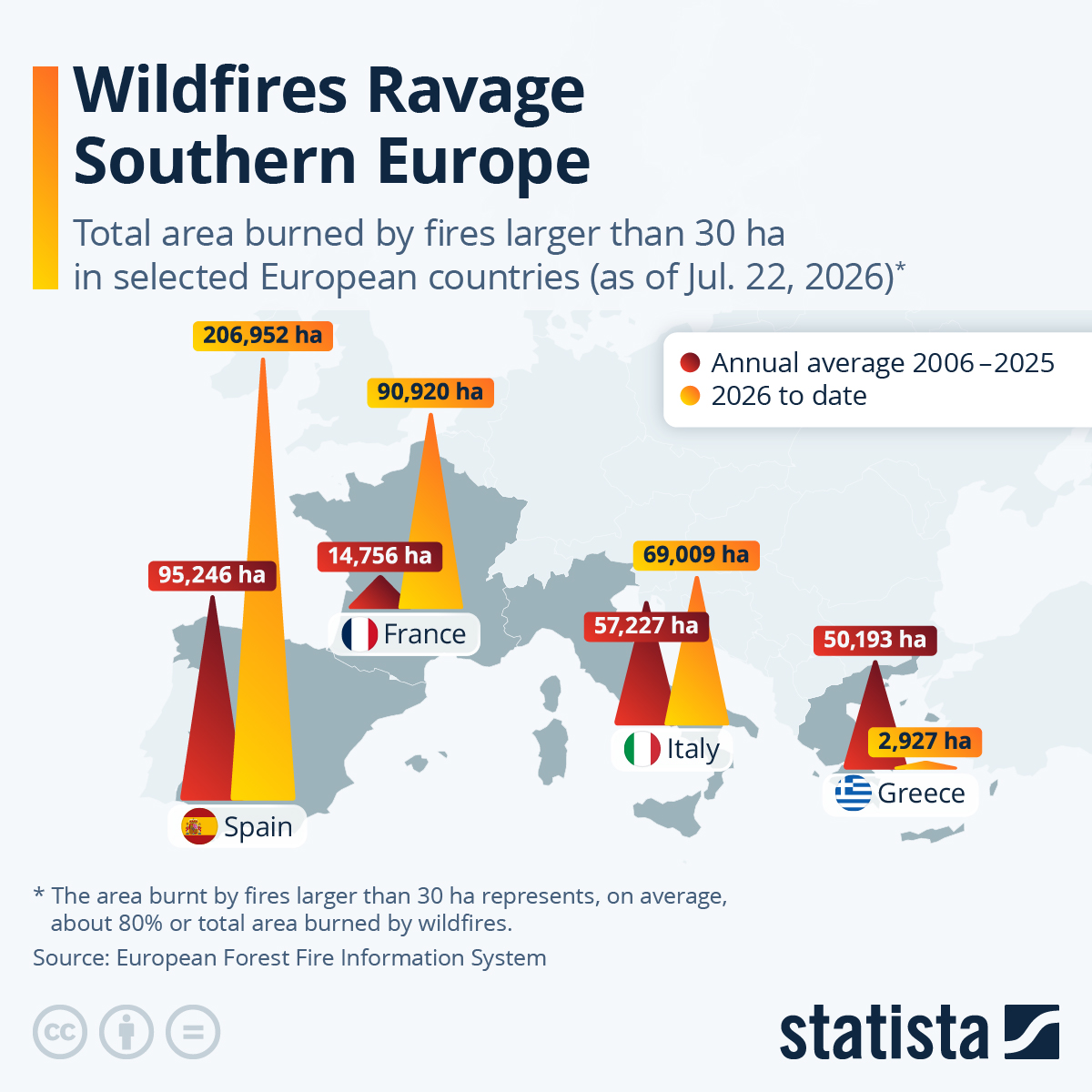
Wildfires across France, Spain, Greece and other parts of Europe have inflicted billions of euros in property losses, infrastructure damage, emergency-response expenses, agricultural destruction and insurance claims during the summer of 2026. Reuters reported that combined costs in several badly affected countries had already surpassed €15 billion, prompting the European Union to demand greater national investment in forest management, wetland restoration and other preventive measures.
Europe’s leaders can blame the weather, point to climate change and praise exhausted firefighters. All three responses contain truth. None of them excuses the political failure that allowed so much combustible vegetation, abandoned farmland and poorly managed forest to accumulate before the flames arrived.
Climate change is loading the gun. Bad land management is leaving it on the kitchen table.
Europe Can No Longer Treat Wildfires as Temporary Emergencies
For too long, European governments have approached wildfires as seasonal emergencies rather than permanent features of a warming continent.
The familiar ritual begins when temperatures soar. Aircraft are mobilized. Firefighters are deployed. Residents are evacuated. Political leaders tour burned communities and promise reconstruction funds.
Then autumn arrives, the smoke disappears from television screens and political attention drifts elsewhere.
That cycle is no longer sustainable.
The European Commission acknowledged the changing threat in March 2026 when it launched its first integrated strategy covering wildfire prevention, preparedness, emergency response and recovery. The strategy reflects a growing recognition that no firefighting fleet, regardless of its sophistication, can compensate for landscapes that have been allowed to become dangerously flammable.
Fire engines cannot reverse decades of rural abandonment.
Water-dropping aircraft cannot instantly restore dried wetlands.
Helicopters cannot thin every neglected forest during the middle of a wind-driven inferno.
By the time the flames are crowning through trees and jumping highways, many of the cheapest and most effective opportunities for intervention have already disappeared.
Climate Change Is Making the Fire Season More Dangerous
Europe’s wildfire problem cannot be honestly discussed without climate change.
Hotter temperatures dry vegetation. Longer droughts reduce moisture in soil and plants. Heatwaves create the conditions in which a spark that might once have produced a manageable ground fire becomes a fast-moving wall of flame.
The consequences are increasingly visible far beyond Europe’s traditionally fire-prone Mediterranean south. Northern and western countries that once considered major wildfires an occasional problem are now being forced to prepare for them as a recurring threat.
EU Environment Commissioner Jessika Roswall has warned that no European region can regard itself as immune from wildfire danger as climatic conditions change. The Commission is therefore urging governments to include nature restoration and fire prevention in their national spending plans rather than relying overwhelmingly on emergency suppression.
But climate change does not remove human responsibility.
It increases it.
A hotter climate should have triggered more aggressive fuel reduction, stronger building rules, better evacuation planning and faster restoration of natural firebreaks. Instead, too many governments continued operating as though the next fire season would resemble the previous century.
The climate changed faster than the bureaucracy.
The forests paid the price.
Rural Abandonment Has Created Vast Fields of Fuel
One of Europe’s lesser-discussed problems is the emptying of rural communities.
As younger residents move to cities, farming and grazing disappear from marginal lands. Fields that were once cultivated become covered in brush. Livestock that once consumed grass and undergrowth vanish. Traditional practices such as carefully managed seasonal burning decline.
The land does not remain frozen in its previous condition.
Vegetation grows.
Shrubs thicken.
Dead material accumulates.
Trees spread into abandoned agricultural areas, creating continuous corridors through which fire can travel.
What looks like untouched nature from a distance can become a densely packed reservoir of fuel.
Recent reporting on Europe’s fire crisis has emphasized how rural depopulation, declining controlled burning and the abandonment of traditional mosaic landscapes have intensified fire behavior. Fire experts increasingly argue that active land stewardship must return, particularly in areas where suppression-only policies have allowed vegetation to accumulate.
That does not mean forests should be bulldozed or stripped bare.
It means pretending humans can simply withdraw from centuries-old cultural landscapes without consequences is dangerously naive.
Many European environments were shaped by farming, grazing, forestry and periodic burning. Removing those activities without replacing them with modern ecological management can create conditions that are neither truly wild nor safely managed.
They become fire gardens waiting for lightning, machinery, power lines or human carelessness to provide ignition.
Not All Forests Are Equally Resilient
Forest composition also matters.
Dense plantations dominated by a single species can provide economic benefits, but they may be more vulnerable to disease, drought and wildfire than diverse natural forests.
France’s enormous Les Landes forest, for example, contains large areas of commercially valuable maritime pine. After destructive fires, experts renewed calls for more mixed forests, broader use of fire-resistant species and improved firebreaks. The challenge is considerable because the regional forest economy supports tens of thousands of jobs and generates billions in economic activity.
That is precisely why governments must move beyond simplistic arguments.
The choice is not necessarily between preserving jobs and protecting forests.
A forest that repeatedly burns with extreme intensity will eventually fail both goals.
Governments should support gradual diversification, compensate landowners for prevention work and create viable markets for vegetation removed during thinning. Land management becomes politically difficult when officials demand that rural communities carry the costs while urban taxpayers enjoy the benefits.
Prevention must become an economic sector in its own right.
Europe will need foresters, ecologists, prescribed-burn specialists, grazing programs, local cooperatives and workers maintaining firebreaks year-round.
That investment would create jobs before a catastrophe rather than merely financing reconstruction after one.
Fire Suppression Alone Can Make the Future Problem Worse
Europe has become highly capable of suppressing many small fires.
That success carries a hidden danger.
When nearly every fire is extinguished immediately, vegetation that might have burned in lower-intensity events continues accumulating. If a fire eventually escapes control during extreme heat and wind, it encounters years of stored fuel.
The resulting blaze can become too intense for firefighters to attack directly.
This does not mean governments should simply let fires burn near towns. It means suppression must be paired with prescribed burning, mechanical thinning, strategic grazing and other preventive measures.
Firefighters should be the final shield, not the entire strategy.
Sending crews into explosive forests without changing the conditions producing those explosions is not a plan. It is a recurring sacrifice.
Wetlands and Healthy Landscapes Are Infrastructure
The EU’s emphasis on nature restoration is significant because environmental protection is too often treated as aesthetic spending.
Wetlands, healthy soils and diverse forests perform practical economic functions.
Wetlands retain water and slow its movement across landscapes. Healthy soils absorb more rainfall. Restored river systems can reduce flood damage. Diverse forests may resist drought, pests and fire more effectively than stressed monocultures.
These ecosystems are not decorative wallpaper surrounding the “real” economy.
They are infrastructure.
A government will readily spend billions reinforcing highways, airports and power systems while treating forest restoration as an optional environmental project. Then a wildfire destroys electrical lines, roads, homes, farms and tourist economies, revealing that landscape management was part of economic protection all along.
Europe’s growing wildfire bill is the invoice for years of pretending ecology and economics were separate subjects.
The Insurance System Is Beginning to Crack
Wildfires also expose a widening insurance gap.
As fires become more frequent and destructive, insurers face mounting claims. Premiums rise. Coverage becomes harder to obtain in high-risk areas. Governments may eventually be forced to act as insurers of last resort when private companies retreat.
Reuters reported in August that Europe’s wildfire season was revealing significant weaknesses in the continent’s ability to insure homes and businesses against intensifying climate risks.
This creates a dangerous spiral.
A home may remain physically standing but lose market value because affordable insurance is unavailable.
A business may struggle to secure financing because lenders require coverage.
Local governments may lose tax revenue as residents leave high-risk communities.
The costs therefore continue long after the flames are extinguished.
Prevention spending should be measured against these cascading losses, not merely compared with the annual budget of a forestry department.
A firebreak looks expensive until an entire town has to be rebuilt.
Europe Must Stop Counting Only What Burned
Even the enormous damage estimates likely understate the real cost.
Official figures can count destroyed homes, burned vehicles and damaged infrastructure. They struggle to capture respiratory illness caused by smoke, psychological trauma, lost school days, interrupted tourism, reduced agricultural productivity and the long-term decline of affected communities.
Nearly half a million hectares had already burned during the early part of Europe’s 2026 fire season, with direct restoration costs estimated in the billions. Those estimates excluded many broader losses affecting agriculture, health, tourism and industry.
Smoke does not respect national borders.
Neither do supply disruptions.
A fire in a wine-producing region affects exports. A blaze near a tourist destination damages bookings across the surrounding economy. Destruction of forests can increase erosion and flooding when rains eventually return.
Europe is not simply losing trees.
It is losing economic stability.
Governments Must Reward Prevention Before Disaster Strikes
Wildfire prevention often suffers from a brutal political disadvantage: when it works, nothing happens.
A restored wetland does not produce dramatic television footage.
A prescribed burn conducted safely in February does not attract global attention.
A carefully maintained firebreak is rarely celebrated when it stops a blaze from reaching a village.
Politicians receive more visibility standing beside emergency crews than quietly funding forest management years in advance.
That incentive must change.
The European Union should tie agricultural, regional-development and climate funding to measurable wildfire-prevention plans. Governments should publish detailed information about fuel reduction, prescribed burning, evacuation routes and maintenance of firebreaks.
Communities should know whether prevention targets were met before the summer begins.
Landowners should receive financial assistance for maintaining safer landscapes. Shepherding and grazing programs should be expanded where they can reduce vegetation naturally. Building codes should require fire-resistant materials and defensible space in high-risk zones.
Most importantly, prevention funding should be protected from annual political whims.
Forests operate on ecological timelines.
They cannot be safely managed through last-minute emergency appropriations.
Climate Adaptation Is No Longer Optional
Europe cannot prevent every wildfire.
Lightning will strike. People will make mistakes. Equipment will fail. Heatwaves will create conditions in which some fires become extremely difficult to control.
The goal is not a continent with zero fire.
The goal is a continent in which fewer fires become uncontrollable disasters.
That requires acknowledging the new climate reality without using climate change as an excuse for institutional paralysis.
Europe knows what must be done.
Restore wetlands.
Manage forests.
Revive grazing.
Use prescribed fire carefully.
Diversify plantations.
Strengthen rural economies.
Protect communities.
Modernize detection systems.
Maintain evacuation routes.
The primary obstacle is no longer a lack of knowledge.
It is a lack of political courage to spend money before the smoke becomes visible.
Europe’s governments are now paying billions to rebuild landscapes they declined to protect. If they continue treating prevention as an expense and disaster recovery as an inevitability, the wildfire bill will continue climbing.
The continent’s leaders can invest in resilient forests today, or finance burned towns tomorrow.
Fire has already made the choice brutally clear.
—Jermichael Evers, B1Daily





Leave a comment