—Barrington Williams, B1Daily
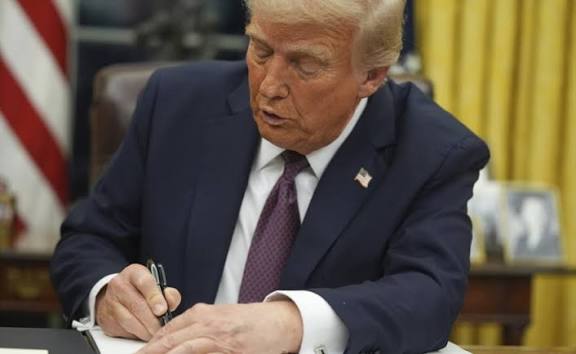
President Donald Trump has opened a new front in one of the most consequential constitutional fights of his second term, signing two executive orders on August 6 aimed at restricting birthright citizenship and cracking down on birth tourism, little more than a month after the Supreme Court rejected his administration’s broader effort to rewrite who automatically becomes an American at birth.
This time, however, the White House is using a scalpel instead of a sledgehammer.
Rather than attempting once again to deny citizenship broadly to children born in the United States to undocumented immigrants or parents temporarily present on visas, the administration has crafted narrower policies targeting particular categories of foreign nationals and people accused of deliberately traveling to the United States to obtain citizenship for their children.
The strategy appears designed to accomplish two things simultaneously: salvage as much of Trump’s birthright-citizenship agenda as possible while inviting the federal courts to define precisely how far the president can stretch the phrase at the center of the 14th Amendment:
“Subject to the jurisdiction thereof.”
That six-word constitutional phrase is about to return to the courthouse.
And Trump appears perfectly willing to find out where the Supreme Court draws the next line.
Trump Already Lost the Bigger Battle
The new orders cannot be understood without looking back to January 20, 2025.
On his first day back in office, Trump signed Executive Order 14160, “Protecting the Meaning and Value of American Citizenship.”
That order sought to deny automatic citizenship to certain children born in the United States when their mothers were unlawfully present or temporarily present and their fathers were neither U.S. citizens nor lawful permanent residents.
The administration’s constitutional theory focused on the opening sentence of the 14th Amendment.
The Citizenship Clause provides that people born or naturalized in the United States “and subject to the jurisdiction thereof” are citizens.
Trump’s administration argued that this language does not necessarily encompass every person physically born inside American territory.
The courts disagreed.
On June 30, 2026, the Supreme Court struck down Trump’s broader executive order and reaffirmed that the 14th Amendment protects birthright citizenship for nearly everyone born on American soil.
That should have ended any attempt to eliminate birthright citizenship through presidential decree.
Instead, Trump changed tactics.
Two Orders, Two Different Strategies
The first new executive order attempts to define additional circumstances in which a U.S.-born child would not automatically qualify for citizenship.
According to reporting on the orders, the administration is focusing partly on children whose parents have particular relationships with foreign governments, terrorist organizations or other categories that the administration argues fall outside complete American jurisdiction.
This is significant because the administration is no longer arguing simply that immigration status eliminates birthright citizenship.
It is trying to build outward from exceptions that already exist.
Children born in the United States to accredited foreign diplomats, for example, generally do not receive citizenship automatically because diplomatic immunity means their parents are not considered fully subject to American jurisdiction.
That exception is not particularly controversial.
Trump’s administration is now testing how far that principle can stretch.
Can it include additional foreign-government employees?
Can the government treat members of designated hostile organizations differently?
Can historical exceptions involving invading enemy forces be adapted to modern national-security circumstances?
Those are substantially narrower questions than the administration posed in its original executive order.
But narrower does not necessarily mean constitutional.
Federal judges will almost certainly be asked to decide whether Trump is legitimately applying established exceptions or manufacturing new ones that the 14th Amendment does not recognize.
The Second Order Goes After Birth Tourism
Trump’s other order takes a different route.
Instead of concentrating primarily on citizenship after a child is born, it targets the ability of foreigners to enter the United States for the purpose of giving birth.
“Birth tourism” generally describes the practice of traveling to the United States specifically so that a child will be born on American soil and consequently acquire American citizenship.
The federal government already has tools for combating the practice.
In 2020, the State Department changed visa rules to make obtaining a tourist visa for the primary purpose of giving birth in the United States impermissible.
Trump’s new action seeks tougher enforcement.
The order directs the Departments of State and Homeland Security toward preventing foreign nationals from entering the country when officials determine that obtaining U.S. citizenship for a child is the purpose of the trip. Reporting indicates that consequences could include visa cancellations and potentially severe future immigration penalties.
That distinction may prove extremely important legally.
Preventing someone from obtaining a visa to engage in birth tourism is one thing.
Allowing the person to enter the United States, give birth on American soil and then declaring the newborn isn’t an American citizen is another.
The president possesses substantial authority over immigration and entry.
His authority over the meaning of the Constitution is considerably more constrained.
How Big Is Birth Tourism?
This is where the political rhetoric becomes considerably murkier.
Trump has repeatedly portrayed birth tourism as a substantial abuse of American citizenship law.
But precise numbers are surprisingly difficult to establish because the federal government does not maintain a definitive count of every woman who enters the United States primarily to give birth.
FactCheck.org noted earlier this year that there is no official federal estimate of the practice, although outside estimates have placed the number above 20,000 births annually.
The Wall Street Journal reported estimates ranging from roughly 9,600 identifiable cases in 2024 to broader estimates reaching approximately 22,000 to 26,000 annually.
Even the upper estimates represent a relatively small share of annual U.S. births.
But politically, the numbers aren’t Trump’s strongest argument.
Intent is.
The administration can frame birth tourism differently from ordinary immigration because the person allegedly travels to the United States specifically to exploit the legal consequences of childbirth.
That makes it a far easier political target than attempting to deny citizenship to millions of children based on their parents’ immigration status.
But Citizenship Doesn’t Belong to the President
This is where Trump’s constitutional problem remains.
Federal law is remarkably direct.
Title 8 of the U.S. Code says that “a person born in the United States, and subject to the jurisdiction thereof” is a citizen at birth.
That language mirrors the 14th Amendment.
The president cannot rewrite either through executive order.
Trump can instruct executive agencies how to enforce immigration laws within the authority Congress has granted them.
He can direct immigration enforcement priorities.
He can influence visa policy.
He can ask Congress to change statutes.
He can appoint judges who share his constitutional philosophy.
What he cannot legitimately do is amend the Constitution with a Sharpie.
That distinction is the gravitational center of this entire fight.
Trump’s Strongest Ground May Actually Be Immigration Enforcement
Ironically, the birth-tourism order may prove more durable precisely because it does not necessarily require overturning birthright citizenship.
Congress and the executive branch already exercise broad authority over which foreign nationals may enter the United States.
Someone outside the United States does not possess an unrestricted constitutional right to obtain a tourist visa.
The government can impose eligibility requirements.
It can investigate fraud.
It can deny visas.
It can punish material misrepresentations made during the immigration process.
Consequently, the administration may have substantially greater legal room to prevent prospective birth tourism before entry than to deny citizenship after birth.
That could ultimately become the blueprint for Trump’s post-Supreme Court strategy.
If the Constitution prevents him from changing what happens after the baby is born, change who is permitted to enter before the pregnancy reaches that point.
The Foreign-Government Question Is More Complicated
The first executive order presents a more interesting constitutional test.
There are recognized exceptions to birthright citizenship.
Children born to foreign diplomats are the clearest modern example.
The reason isn’t that their parents are foreigners.
Millions of foreigners living in America are subject to U.S. law.
Diplomats occupy a different legal position because diplomatic immunity limits the jurisdiction American authorities exercise over them.
The administration’s challenge will therefore be demonstrating why whatever additional categories it creates should constitutionally resemble diplomats rather than ordinary noncitizens.
Simply working for a foreign government may not be enough.
Neither is being unpopular with the president.
The phrase “subject to the jurisdiction” cannot become an executive trapdoor through which presidents drop whichever groups they decide are insufficiently American.
If courts accept an expansive interpretation of the exception, future presidents could attempt to push it further.
That is precisely why civil-rights organizations are expected to challenge the new orders.
The “Alien Enemy” Theory Could Produce the Biggest Fight
The administration’s effort to connect citizenship restrictions with people classified as alien enemies or members of designated hostile organizations could generate particularly fierce litigation.
Historically, one recognized exception to birthright citizenship involved children born to members of hostile occupying forces.
The logic is straightforward.
An invading army occupying American territory has not submitted itself to ordinary American political authority merely because its soldiers happen to be physically standing inside the country.
But applying that ancient principle to modern immigration and terrorism cases is much more complicated.
A foreign national living inside the United States is generally subject to American criminal and civil law.
If that person commits murder, fraud or terrorism, American courts can prosecute them.
That fact makes it difficult to argue simultaneously that the person somehow exists outside American jurisdiction for purposes of the Citizenship Clause.
The administration will likely argue that allegiance and jurisdiction have historically been intertwined.
Opponents will answer that the 14th Amendment says jurisdiction, not presidential approval of a parent’s allegiance.
That could become the constitutional fault line.
Trump’s Strategy Is Becoming Clear
Trump’s first birthright-citizenship order attempted to kick down the front door.
The Supreme Court slammed it shut.
These new orders are looking for windows.
Instead of asking whether the president can abolish birthright citizenship for enormous categories of children, the administration is breaking the issue into smaller constitutional questions.
Diplomats.
Foreign-government personnel.
Alien enemies.
Birth tourism.
Visa fraud.
Territories if Congress changes federal law.
Each category creates a different legal argument.
That strategy is considerably more sophisticated than simply issuing the same unconstitutional order again.
It also creates the possibility that Trump could lose some provisions while preserving others.
The courts may reject attempts to deny citizenship after birth while allowing aggressive restrictions against birth-tourism visas.
They could uphold existing diplomatic exceptions while refusing to extend them to ordinary foreign-government employees.
The administration does not necessarily need a total victory to move citizenship law in its preferred direction.
Several smaller victories could accomplish part of the same objective.
The Supreme Court’s June Decision Changed the Battlefield
The significance of the June 30 Supreme Court decision cannot be overstated.
The Court reaffirmed the broad constitutional principle that nearly everyone born in the United States receives citizenship.
That dramatically limits what Trump can accomplish through executive action.
Trump subsequently argued that Congress could still legislate changes to birthright citizenship without going through the difficult process of amending the Constitution.
Legal scholars disputed that interpretation, arguing that the Court’s reasoning indicated a constitutional amendment would be necessary to eliminate the broader guarantee.
That leaves Trump with few easy options.
A constitutional amendment would require approval from two-thirds of both houses of Congress and ratification by three-fourths of the states.
Those numbers make changing the 14th Amendment extraordinarily difficult.
So the administration has returned to executive power.
There Is a Legitimate Debate Buried Under the Constitutional Fight
Birth tourism deserves a policy discussion separate from the broader argument over birthright citizenship.
Americans can reasonably ask whether the country should issue temporary visas to foreigners whose primary intention is to travel here, give birth and immediately obtain American citizenship for their child.
Congress could strengthen visa restrictions.
Federal agencies could prosecute organized birth-tourism operations involving fraud.
Consular officers could receive better investigative tools.
Hospitals could pursue unpaid bills.
None of those policies requires pretending the 14th Amendment doesn’t exist.
That distinction matters.
A government can aggressively enforce immigration laws while respecting the constitutional rights of children born inside the country.
The newborn did not commit visa fraud.
The newborn didn’t choose the hospital.
The newborn didn’t fill out the mother’s visa application.
Citizenship law has traditionally recognized that distinction.
Another Court Battle Is Almost Guaranteed
Civil-rights organizations and immigration advocates are already preparing to challenge the administration’s latest approach, and Democratic leaders have denounced the orders as unconstitutional.
The litigation could move quickly.
Plaintiffs will likely seek preliminary injunctions before disputed citizenship restrictions can take effect.
The administration will argue that the new orders differ fundamentally from the policy the Supreme Court rejected in June.
Lower courts will then have to decide whether those differences are constitutionally meaningful or merely clever packaging around the same prohibited objective.
And eventually, the Supreme Court may have to answer a question it thought it had largely settled weeks earlier.
Trump Hasn’t Ended Birthright Citizenship
That is the most important fact for Americans to understand.
Trump’s new executive orders do not simply abolish birthright citizenship.
The Supreme Court has already rejected the administration’s broader attempt.
The constitutional guarantee remains.
What Trump has done is considerably more targeted.
He is attempting to shrink the outer perimeter of the Citizenship Clause while using the government’s immigration authority to make birth tourism harder.
Some portions may survive.
Others could collapse almost immediately.
But the political significance is unmistakable.
Trump lost the largest battle over birthright citizenship and immediately returned with a narrower strategy designed to test the boundaries of the Supreme Court’s ruling.
The president is effectively asking the judiciary a new question:
If he cannot erase birthright citizenship, how much of its outer edge can he carve away?
The answer will determine far more than the fate of two executive orders.
It could determine how aggressively future presidents use executive power to define who qualifies as an American.
And with the ink barely dry on the Supreme Court’s June ruling, the constitutional fight over American citizenship has already begun again.
—Barrington Williams, B1Daily





Leave a comment