—Barrington Williams, B1Daily
Russell City did not disappear because its residents abandoned it. It did not vanish because the economy collapsed, a natural disaster swept through, or the community simply faded with time.
Government officials erased it.
And more than six decades later, Alameda County and the City of Hayward are finally preparing to put cash into the hands of some of the people who lost their homes when the predominantly Black and Latino East Bay community was dismantled.
On August 4, 2026, the Alameda County Board of Supervisors unanimously approved an agreement governing the Russell City Redress Fund and authorized an initial round of direct payments. The fund contains roughly $1.3 million, although some recent reports have rounded the overall effort to approximately $1.4 million. Eligible households in the first phase can receive up to $25,000.
That is genuine progress.
But there are catches.
Big ones.
A Black Community the Government Helped Isolate, Then Called “Blighted”
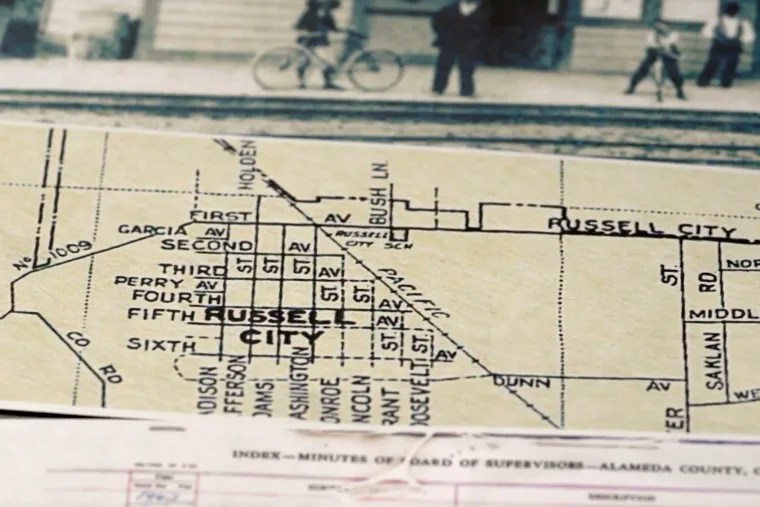
Russell City sat along the shoreline west of Hayward in Alameda County. During the World War II era and afterward, it became home to Black families arriving from the South, along with Latino residents and other working-class families.
It developed into the kind of community that racist housing practices elsewhere in the Bay Area made extraordinarily difficult for Black families to build.
Russell City had homes, churches, businesses and a cultural identity all its own. Its blues scene became particularly famous. Musicians including Etta James, Ray Charles and John Lee Hooker performed there.
But Russell City also suffered from something much uglier: government neglect.
Residents lacked many of the municipal services that surrounding communities enjoyed. Eventually authorities labeled the community “blighted,” setting the stage for redevelopment.
That sequence deserves scrutiny.
Government can neglect a neighborhood, deny it adequate infrastructure, watch conditions deteriorate and then point to those very conditions as justification for clearing the neighborhood away. It is a particularly cruel form of bureaucratic alchemy: neglect becomes evidence, evidence becomes condemnation, and condemnation becomes a bulldozer.
In the early 1960s, authorities used eminent domain to acquire hundreds of parcels. Alameda County’s own current account says approximately 1,400 residents were displaced through the acquisition of nearly 700 parcels. The land was redeveloped for commercial and industrial purposes and subsequently annexed into Hayward.
Homes disappeared.
Businesses disappeared.
Churches disappeared.
And with them went something no eminent-domain appraisal could properly price: generational wealth.
Imagine What That Land Is Worth Now
This is where the Russell City story becomes more than a historical tragedy.
Property is wealth.
A working-class family buying a modest home in California in the 1940s or 1950s wasn’t merely buying shelter. It was acquiring an asset that could appreciate, be borrowed against, sold to finance another home, or passed down to children and grandchildren.
When government takes that property, the economic damage doesn’t necessarily end with the person standing on the porch when the condemnation notice arrives.
The financial consequences can echo through generations.
A house taken in the 1960s cannot appreciate for the family that no longer owns it. A business that gets bulldozed cannot be handed to a son or daughter. Land cannot be inherited by grandchildren when the government has already converted it into an industrial district.
That is why simply asking, “What was the house worth in 1963?” misses the larger issue.
The better question is: What economic position might that family occupy today had the property never been taken?
The current redress program does not attempt to answer that question dollar for dollar.
In fact, Alameda County’s own earlier description of the fund explicitly stated that the payments were not intended as compensation reflecting the present-day value of the former property.
And that brings us to Catch No. 1.
Catch No. 1: The First Payments Are Capped at $25,000 Per Household
The first round provides eligible recipients with up to $25,000 per household.
Twenty-five thousand dollars.
For property seized more than 60 years ago.
There is something almost surreal about the number.
The payment certainly matters to elderly survivors. Twenty-five thousand dollars isn’t pocket change, and direct cash redress represents a meaningful acknowledgment that something concrete was taken from these families.
But $25,000 should not be confused with restoration of the wealth that disappeared.
One former resident told The Guardian during the earlier debate over the fund that the proposed money amounted to “pennies on the dollar” compared with the value of the land that was taken.
That criticism becomes difficult to dismiss when the program itself acknowledges that the payments aren’t calculations of today’s property value.
The government took real estate.
Six decades of California property appreciation followed.
The victims get up to $25,000.
That isn’t restoration. It is redress on a budget.
Catch No. 2: You Have to Still Be Alive for Phase One
Here lies perhaps the most painful limitation.
The first phase is aimed specifically at living people who personally owned and resided in residential property in Russell City that was acquired through eminent domain between January 1, 1961 and December 31, 1964.
Think about what that means.
The destruction occurred more than six decades ago.
A homeowner who was 40 years old in 1963 would be over 100 today.
A homeowner who was 30 would now be in their 90s.
The clock has done what bureaucracy so often does to reparations claims: dramatically shrink the pool of people who can personally collect.
Alameda County itself says the first phase is being prioritized because of the urgency created by the advanced age of surviving Russell City residents.
At least officials recognize the problem.
But recognition cannot bring back the people who died waiting.
Every former homeowner who passed away before August 2026 represents a person who lived through the displacement but never personally received this payment.
That is the bitter arithmetic of delayed justice.
Catch No. 3: Being From Russell City Isn’t Enough for the First Round
The eligibility criteria narrow things further.
For Phase One, merely having lived in Russell City isn’t sufficient.
The applicant must have personally owned and resided in residential property that was taken through eminent domain during the specified 1961-1964 period.
That distinction matters because Russell City wasn’t composed exclusively of homeowners.
There were renters.
There were business owners.
There were children growing up in households that lost their community.
There were families whose economic lives were damaged even if their names weren’t printed on a residential deed.
Their claims have not necessarily been rejected forever, but they aren’t the people receiving priority under the initial $25,000 homeowner phase.
Catch No. 4: Descendants Have to Wait
This may ultimately become the biggest issue surrounding the program.
The county says subsequent phases are expected to address additional categories, including descendants. Recent reporting likewise says future payments will include descendants of people harmed by the redevelopment project.
But those payments aren’t authorized yet.
The county’s August 4 documentation states plainly that future Board action will be required to approve subsequent phases of eligibility and disbursements.
In other words, descendants aren’t simply standing in the same line behind the surviving homeowners.
Another political decision has to occur.
Another phase has to be approved.
Eligibility rules have to be finalized.
Funding has to stretch far enough, or additional money has to be found.
That’s a promise with paperwork attached.
And considering that the central economic argument for reparations involves the destruction of intergenerational wealth, descendants cannot be treated as an afterthought.
They are part of the economic story.
Catch No. 5: $1.3 Million Has to Address a Community-Wide Destruction
The current official county document puts the fund at approximately $1.3 million, consisting of $950,000 contributed through Alameda County’s Vision 2036 allocations along with contributions from Hayward and the Alameda County Office of Education. Some contemporary reports describe the total as $1.4 million.
Either way, compare that pool of money with the scale of what happened.
Approximately 1,400 people displaced.
Nearly 700 parcels acquired.
An entire community eliminated.
Businesses and churches gone.
Land converted to industrial use.
Six decades of potential appreciation and inheritance interrupted.
Suddenly $1.3 million doesn’t sound enormous.
It sounds remarkably small.
This Wasn’t Ancient History
There is another reason Russell City matters.
Americans often discuss reparations as though every relevant injustice occurred in a sepia-toned world populated entirely by people who died a century ago.
Russell City demolishes that argument.
Some of the victims are still alive.
This wasn’t slavery in 1850.
This wasn’t Reconstruction.
This was California in the 1960s, during the lifetime of millions of Americans living today.
The Beatles were becoming international stars.
Televisions were sitting in American living rooms.
NASA was preparing to send human beings to the moon.
And government officials in California were using eminent domain to dismantle a predominantly Black and Latino community.
Hayward formally apologized for its role in 2021. Alameda County followed with its own apology in 2023, acknowledging the county’s role in Russell City’s seizure and destruction.
Apologies matter.
Cash matters more.
But the amount matters too.
Reparations Should Be About What Was Lost
There is a legitimate reason to praise Alameda County and Hayward.
Unlike governments that issue historical apologies and then close the folder, these governments have created a mechanism for direct payments.
That distinction shouldn’t be minimized.
A check can pay a medical bill. It can eliminate debt. It can help an elderly survivor remain financially secure. It can be passed to family. Symbolism cannot do those things.
But praise shouldn’t require pretending the current program makes the victims whole.
It doesn’t.
The first phase is capped at $25,000 per household. It is restricted to living former resident-homeowners whose qualifying property was acquired during a defined period. Descendants must wait for subsequent phases requiring additional government action. And the overall fund is tiny compared with the economic footprint of an entire destroyed community.
Russell City wasn’t simply a collection of deteriorating structures on land officials wanted to redevelop.
It was somebody’s hometown.
It was somebody’s first house.
Somebody’s church.
Somebody’s business.
Somebody’s backyard.
Somebody’s inheritance.
Government erased the physical community in a matter of years.
Sixty-plus years later, government has finally arrived carrying a check.
The surviving families have every right to take it.
They also have every right to ask why it took so long, why the first payment tops out at $25,000, why descendants must wait for another phase, and what the land stolen from their families would actually be worth today.
Because $25,000 may be an acknowledgment of what happened to Russell City.
It should never be mistaken for the full price of what was taken.
—Barrington Williams, B1Daily





Leave a comment