—Michael Lyles, B1Daily
Before “shareholder value” became a phrase capable of determining whether a factory stayed open, whether workers received raises, whether a company bought back its own stock or whether thousands of employees survived the next restructuring, American corporations operated under a somewhat different philosophy.
Companies certainly wanted profits.
Shareholders certainly wanted returns.
But the corporation was widely understood as an institution with multiple constituencies: investors, employees, customers, suppliers and the communities surrounding its factories and offices.
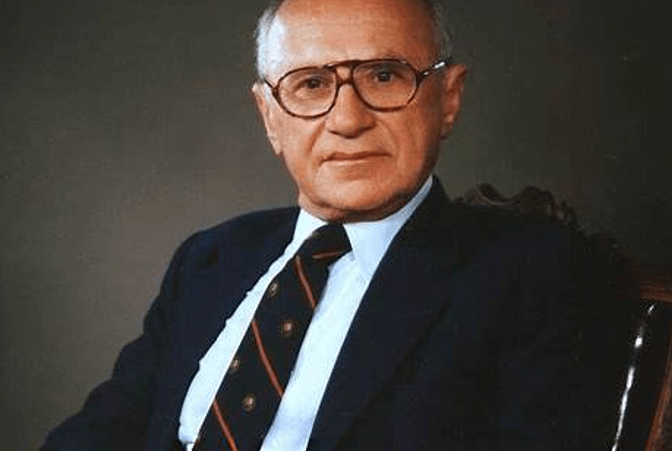
Then came Milton Friedman.
Friedman did not create shareholder primacy from nothing. Ideas about shareholders as corporate owners had existed for decades, and scholars have correctly warned against turning one economist and one newspaper essay into the sole cause of a transformation that involved financial markets, hostile takeovers, executive compensation, deregulation and changing corporate governance.
But Friedman gave the movement something extraordinarily powerful:
a philosophy.
And in 1970, he gave that philosophy a sentence that would haunt American capitalism for the next half-century.
The Corporation Before Friedman
To understand Friedman’s impact, it is necessary to understand what he was arguing against.
Mid-century American corporate capitalism was hardly socialist. General Motors, Ford, IBM, General Electric and America’s other corporate giants existed to make money.
But executives often exercised considerable discretion over how corporate wealth was distributed and how companies related to workers and communities.
The corporation wasn’t always imagined as a machine belonging exclusively to shareholders.
Business Roundtable itself acknowledges that its early statements on corporate purpose argued companies should consider employees, customers and shareholders, rather than treating investors as the corporation’s sole constituency.
That philosophy complemented the broader architecture of postwar capitalism.
Large corporations employed workers for decades.
Unions negotiated wages and benefits.
Companies funded defined-benefit pensions.
Executives frequently rose through corporate hierarchies rather than arriving primarily as financial engineers.
Factories anchored towns.
Businesses sometimes viewed their reputation within a community as an asset worth protecting.
None of this meant corporations were benevolent institutions. Companies polluted, discriminated, fought unions and pursued profits aggressively.
But management had greater latitude to balance competing interests.
Friedman considered that latitude dangerous.
September 13, 1970
Friedman’s intellectual grenade arrived in The New York Times Magazine under the title “The Social Responsibility of Business Is to Increase Its Profits.”
The argument was more sophisticated than the slogan it became.
Friedman reasoned that corporate executives were agents working for the owners of a business. If executives spent shareholders’ money pursuing social objectives unrelated to the business, they were effectively deciding how somebody else’s money should be spent.
Individuals could donate their own money to charity.
Shareholders could support whatever causes they desired.
Governments could impose taxes and regulations through democratic processes.
But corporate executives, Friedman argued, weren’t elected social planners.
The business executive’s responsibility was to conduct the enterprise according to the owners’ interests while obeying the law and the basic rules of market competition.
This distinction is important because Friedman is sometimes caricatured as arguing that corporations should pursue money through absolutely any means available.
He didn’t.
His argument assumed functioning markets, laws and rules governing competition. Later scholarship has emphasized that Friedman regarded profit maximization as a mechanism for generating broader social welfare, not simply the accumulation of money for its own sake.
But corporate America would eventually embrace the profit portion of the philosophy with extraordinary enthusiasm.
The Friedman Doctrine Is Born
The idea became known as the Friedman Doctrine.
Its beauty was its simplicity.
What is management supposed to accomplish?
Increase shareholder value.
How do we determine whether a CEO is succeeding?
Look at profits and shareholder returns.
Should management maintain an inefficient factory because closing it would devastate a town?
Not if keeping it open destroys shareholder value.
Should a company employ more workers than necessary?
Not if automation or outsourcing produces better returns.
Should management spend corporate resources solving social problems?
Only when doing so ultimately benefits the business or shareholders.
Suddenly corporate decision-making had a North Star.
Return on capital.
That clarity was enormously attractive.
It was also potentially ruthless.
Friedman Didn’t Do It Alone
The mythology surrounding Friedman sometimes gets ahead of the history.
Corporate America did not read his essay on Monday morning in 1970 and begin firing workers by Tuesday afternoon.
Legal historian Brian Cheffins argues that Friedman’s essay had considerably less immediate influence than later accounts suggest. According to Cheffins, the shareholder-first mentality didn’t truly dominate corporate America until the mid-1980s, when hostile takeovers and changes in executive compensation transformed managerial incentives.
That distinction matters.
Friedman supplied intellectual architecture.
Wall Street supplied enforcement.
Then Came the Corporate Raiders
By the 1980s, American corporations faced a new predator.
The hostile takeover.
Companies sitting on valuable assets but producing mediocre shareholder returns became targets for corporate raiders armed with borrowed money.
A company’s factories, real estate, divisions and cash reserves could suddenly be worth more broken apart than management was generating by keeping the corporation intact.
The consequences were profound.
Executives could no longer comfortably tell shareholders:
“Be patient. We’re taking care of our workers, our community and the company’s long-term future.”
If the stock price remained weak enough, somebody could buy the company.
Management itself could be replaced.
Assets could be sold.
Workers could be dismissed.
The company could be loaded with debt.
Shareholder value was no longer merely an academic theory.
It had acquired teeth.
Executive Compensation Changes the Game
Another transformation cemented the revolution.
Executives increasingly became shareholders themselves.
Stock options and equity-based compensation were designed to align managers’ interests with investors.
The logic was compelling.
If executives owned stock, they would have enormous personal incentives to increase the stock price.
The old principal-agent problem suddenly appeared solvable.
Want the CEO to think like an owner?
Pay the CEO like one.
But incentives have consequences.
When executive wealth becomes heavily connected to share prices, decisions that boost the stock can become personally lucrative.
Cost cutting becomes attractive.
Layoffs can improve margins.
Selling divisions can unlock value.
Mergers can create enormous compensation opportunities.
Share repurchases can increase earnings per share by reducing the number of shares outstanding.
Financial engineering begins competing with industrial engineering for management’s attention.
The American CEO gradually became less of a corporate steward and more of a portfolio manager overseeing an enormous bundle of assets.
Workers Became a Cost Center
This transformation changed the language of capitalism.
Workers produce products.
Workers develop technology.
Workers maintain machines.
Workers sell services.
Workers cultivate customer relationships.
But on an income statement, labor is also an expense.
And shareholder primacy encourages management to examine expenses relentlessly.
If a company can manufacture something for $30 per hour in America or $5 per hour abroad, the shareholder-value calculation becomes uncomfortable.
The community may lose.
Workers may lose.
The local tax base may lose.
But shareholders may gain.
Under the Friedman framework, management isn’t necessarily authorized to sacrifice shareholder returns simply because preserving local employment would produce a desirable social outcome.
That is government’s problem.
Or society’s problem.
Or the workers’ problem.
The corporation’s problem is profitability.
Wall Street Becomes the Scoreboard
Once shareholder value became the central measurement of corporate success, financial markets gained enormous cultural power.
Quarterly earnings mattered.
Analyst expectations mattered.
Margins mattered.
Return on equity mattered.
Share price mattered.
Companies could announce thousands of layoffs and see their stocks rise because investors expected lower costs.
A factory closure could simultaneously represent tragedy in one ZIP code and efficiency on a Bloomberg terminal.
Both perspectives could be economically rational.
That contradiction became one of the defining tensions of modern capitalism.
The Triumph of Shareholder Primacy
By 1997, what had once been a controversial economic argument had effectively entered corporate orthodoxy.
Business Roundtable adopted a corporate-governance statement declaring that management’s “paramount duty” was to stockholders, with other stakeholders’ interests considered through their relationship to that shareholder duty.
Twenty-seven years had passed since Friedman’s famous essay.
The revolution was complete.
Corporate America had moved from debating shareholder primacy to institutionalizing it.
The Financialization of the American Corporation
Shareholder primacy also coincided with a broader financialization of the economy.
Companies increasingly became evaluated not merely by what they produced but by what returns they generated on invested capital.
Factories could become liabilities.
Employees could become excess headcount.
Real estate could become monetizable assets.
Corporate divisions could be spun off.
Debt could finance acquisitions.
Cash could finance stock repurchases.
The corporation increasingly became something that could be optimized financially.
This produced genuine benefits.
Capital could move away from inefficient businesses.
Poorly managed companies could face discipline.
Investors received stronger protections.
Managers had less freedom to build corporate empires merely for prestige.
Retirement funds and ordinary investors benefited when companies became more profitable.
Shareholder primacy wasn’t simply a conspiracy by wealthy investors.
Millions of Americans indirectly own corporate stock through retirement plans, pensions and investment funds.
But ownership isn’t distributed equally.
That becomes enormously important.
When Shareholders Win, Which Americans Win?
The benefits of shareholder primacy depend heavily upon who owns shares.
A worker receiving most household income through wages experiences capitalism differently from someone receiving substantial income through stocks, dividends and capital gains.
If a corporation cuts 5,000 jobs and distributes the savings to shareholders, economic value hasn’t simply disappeared.
It has moved.
From labor toward capital.
A household owning substantial stock may benefit.
A household depending primarily upon wages may not.
And because wealth ownership is considerably more concentrated than employment, policies maximizing returns to capital can distribute gains differently from policies maximizing wages or employment.
This is where a corporate-governance philosophy becomes a question about wealth distribution.
Stock Buybacks Become the Perfect Symbol
Few practices symbolize shareholder capitalism more vividly than the stock buyback.
Instead of using excess cash to build another factory, hire additional workers or increase wages, a corporation can purchase its own shares.
That reduces shares outstanding and can increase earnings per share while returning capital to investors who sell.
Buybacks aren’t inherently sinister.
Sometimes a company’s best investment really is its own undervalued stock.
Sometimes management has no productive use for additional cash.
Returning money to shareholders can be more responsible than wasting it on bad acquisitions.
But the scale and symbolism matter.
The corporation once celebrated primarily for building things increasingly became celebrated for returning capital.
That is shareholder primacy distilled into financial form.
Friedman Won, Then Corporate America Began Having Second Thoughts
In August 2019, something remarkable happened.
Business Roundtable announced a new Statement on the Purpose of a Corporation signed by 181 CEOs.
The organization explicitly described the statement as moving away from shareholder primacy and committed corporations to delivering value to customers, employees, suppliers, communities and shareholders.
Corporate America had spent decades walking toward Friedman.
Now some of its most powerful executives were publicly walking backward.
Business Roundtable later acknowledged that its 1997 shareholder-first statement had become a target for critics who believed corporations had abandoned employees and communities in favor of short-term investors.
Whether the 2019 declaration represented genuine structural change or sophisticated public relations remains fiercely debated.
But its existence reveals something important.
Even corporate America recognized that shareholder primacy had developed a legitimacy problem.
Was Friedman Wrong?
That question doesn’t have a clean answer.
Friedman identified a genuine governance problem.
Corporate executives aren’t elected governments.
Allowing CEOs unlimited discretion to spend shareholders’ money pursuing whatever social objectives personally interest them can create enormous accountability problems.
Managers need measurable objectives.
Investors deserve protection.
Profitable companies are essential to a functioning market economy.
A business that permanently loses money eventually stops employing anybody.
Friedman understood all of that.
But critics argue that shareholder primacy can become dangerous when the pursuit of measurable financial returns overwhelms difficult-to-measure obligations to employees, communities and long-term institutional health.
A company can maximize this quarter while damaging the next decade.
A corporation can save millions by eliminating experienced workers while quietly destroying institutional knowledge.
A factory closure can improve corporate margins while devastating the community that educated and housed its workforce.
Pollution can become an externality.
Worker insecurity can become an externality.
Community decline can become an externality.
The spreadsheet improves.
Society absorbs the invoice.
The Most Important Thing Friedman Changed Was the Question
Perhaps Friedman’s greatest influence wasn’t convincing every executive to become greedy.
It was changing the question executives were expected to answer.
The old question was something like:
“What is good for the corporation?”
That could include employees, customers, communities, reputation, market share, technological leadership and shareholders.
The shareholder-primacy question became narrower:
“What creates value for shareholders?”
That subtle change reorganized corporate priorities.
Once the question changes, measurements change.
Once measurements change, incentives change.
Once incentives change, behavior changes.
And once thousands of corporations change behavior simultaneously, an economy changes.
The Legacy of Milton Friedman
More than half a century after his 1970 essay, Friedman remains impossible to remove from debates over corporate purpose.
Even scholars who argue that he receives too much blame acknowledge the enormous symbolic importance his essay acquired. Cambridge research notes that Friedman’s intervention remains a central milestone in histories of the shareholder-value movement and has continued to shape management debates for generations.
He didn’t invent shareholders.
He didn’t invent profit.
He didn’t invent hostile takeovers.
He didn’t invent outsourcing, stock options, layoffs or corporate raiders.
And he didn’t personally order American executives to abandon their workers.
What Friedman provided was something potentially more influential.
He provided a coherent intellectual argument explaining why putting shareholders first could be considered morally legitimate rather than merely financially advantageous.
The corporate raiders supplied pressure.
Wall Street supplied capital.
Executive stock compensation supplied incentives.
Business schools supplied managers.
Corporate boards supplied authority.
And eventually the philosophy migrated from economics departments into boardrooms.
By the end of the twentieth century, shareholder primacy had become so deeply embedded in American business culture that many executives treated it not as one theory of capitalism but as capitalism itself.
That may be Milton Friedman’s most consequential financial legacy.
He didn’t just create the machine. He helped write its operating system.
He helped write its operating system.
—Michael Lyles, B1Daily





Leave a comment