—Michael Lyles, B1Daily
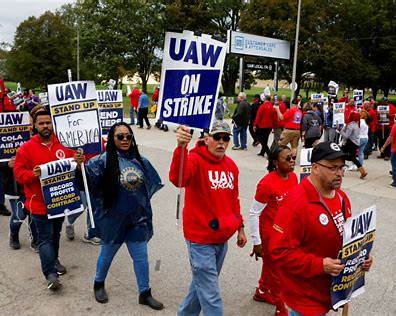
There was a period in American economic history when a man or woman without a bachelor’s degree could walk into a factory, warehouse, mine or transportation company, work hard, join a union and realistically expect that job to support a middle-class life.
Not a luxurious life.
A house. A car. Health insurance. A pension. Vacations occasionally. Children who might attend college. Enough stability to believe that 30 years of work would leave you better off than when you started.
That version of the American economy has been badly wounded.
Factories moved or automated. Defined-benefit pensions disappeared from much of the private sector. Healthcare costs rose. Housing became dramatically more expensive in many markets. Globalization subjected American workers to new competition. Technology transformed entire occupations.
But another pillar was quietly being removed at the same time:
the labor union.
The collapse of organized labor cannot explain every difficulty confronting America’s middle class. Yet dismissing its role requires ignoring one of the clearest economic transformations of the last half-century.
In the 1950s, roughly one-third of American workers belonged to unions. By 1983, when the Bureau of Labor Statistics’ directly comparable modern series begins, membership had already fallen to 20.1%. In 2025, it stood at just 10.0%, representing about 14.7 million workers. Private-sector union membership was an extraordinary 5.9%.
The American workforce became larger.
The American economy became vastly richer.
But organized labor became smaller.
That change fundamentally altered who possessed leverage at the bargaining table.
The Forgotten Architecture of the Middle Class
The postwar American middle class is often remembered through imagery: suburban houses, automobiles in driveways, family vacations and fathers coming home from factories with lunch boxes.
But those material comforts didn’t simply descend from the sky after World War II.
They were supported by an extraordinary combination of economic growth, expanding industrial production, government policy, relatively affordable housing, rising educational opportunities and powerful labor organizations.
Unions converted productivity into bargaining power.
A single worker could ask the company for a raise.
Thousands of workers could demand one.
That difference changed American capitalism.
Collective bargaining allowed workers to negotiate not merely wages but healthcare, pensions, overtime, scheduling, seniority protections, grievance procedures and workplace safety.
A union contract effectively transformed labor from millions of isolated sellers into organized economic blocs.
That mattered enormously in factories where management otherwise possessed most of the negotiating power.
When Detroit Paid Enough to Build a Life
The American automobile industry became perhaps the ultimate symbol.
The United Auto Workers didn’t invent America’s postwar prosperity, but organized autoworkers became some of its most recognizable beneficiaries.
Factory employment could provide workers without elite educational credentials access to compensation capable of supporting homeownership and family formation.
Those wages then circulated.
A well-paid factory worker didn’t bury his paycheck beneath the mattress.
He bought furniture.
He bought appliances.
He bought automobiles.
He hired contractors.
He ate at restaurants.
He paid property taxes.
He supported local stores.
His children attended schools and sometimes colleges.
The union paycheck therefore didn’t stop at the factory gate.
It became consumer demand.
That is one reason the debate over unions has always been larger than labor versus management. It is ultimately a debate over how the proceeds of economic production are distributed.
Then the Balance of Power Shifted
Union membership began its long retreat.
The causes were numerous.
American manufacturing employment faced intense international competition. Automation reduced the number of workers necessary to produce goods. Employment shifted toward service industries that historically had lower unionization rates. Companies increasingly moved production to regions and countries with cheaper labor.
Labor law and political attitudes toward organized labor changed as well.
The 1981 PATCO strike became a defining cultural moment when President Ronald Reagan fired more than 11,000 striking air-traffic controllers who ignored an order to return to work.
Whatever one’s opinion of that confrontation, its symbolism was unmistakable.
Corporate America received the message that unions were no longer politically untouchable.
Organized labor increasingly found itself fighting defensively.
And the numbers tell the story.
The BLS reports that union membership among wage and salary workers fell from 20.1% in 1983 to 10.0% in 2025. Manufacturing unionization stood at only 7.7% in 2025.
Private-sector unions are now a thin shadow of their mid-century presence.
The Great Economic Divorce
Something else happened while unions declined.
Workers continued becoming more productive.
Companies became larger.
Technology became vastly more powerful.
Financial markets generated extraordinary wealth.
Yet the economic security associated with middle-class employment became increasingly difficult for many households to achieve.
The U.S. Treasury Department’s analysis of organized labor concluded that unions strengthen middle-class workers by raising incomes and improving working conditions and job satisfaction. Treasury also noted that union membership and income inequality have moved in opposite directions over much of the past century.
Academic research points in a similar direction.
An NBER study examining unionism and the middle class found union workers disproportionately located in the middle-income group or above and concluded that some workers reach middle-income status because of the union wage premium. Researchers also found an association between parental union membership and higher incomes among their children, particularly among lower-skilled families.
Another long-term NBER analysis found that union density and income inequality have historically moved inversely and estimated a persistent union household income premium across decades.
Correlation isn’t proof that unions alone created the middle class or that declining unionization single-handedly caused inequality.
But the historical relationship is difficult to ignore.
The Middle Class Isn’t Literally Dead, But Its Old Bargain Is
It would be inaccurate to say America’s middle class no longer exists.
Millions of households remain middle-income. Millions own homes, retirement accounts and businesses.
What has deteriorated is the old economic bargain that allowed ordinary employment to provide a relatively straightforward route into that class.
Today’s worker may have to personally navigate retirement investing through a 401(k).
Healthcare may consume a substantial portion of compensation.
Housing in economically productive metropolitan areas can require an enormous share of household income.
College can produce substantial debt.
Childcare can rival a mortgage payment.
And employment itself can be increasingly fragmented through contracting, gig work and temporary arrangements.
The worker didn’t disappear.
The protective economic shell surrounding the worker became thinner.
When Workers Lose Bargaining Power, Somebody Else Gains It
Economics doesn’t tolerate a vacuum for long.
When employees lose collective bargaining power, negotiating leverage doesn’t simply evaporate.
It shifts.
Management has greater freedom over compensation.
Shareholders have greater claims on profits.
Executives can structure compensation around equity appreciation.
Companies can outsource work.
Individual workers negotiate alone against organizations with human-resources departments, lawyers, compensation analysts and access to detailed labor-market information.
That doesn’t make corporations inherently villainous.
A corporation is doing precisely what its incentives encourage: controlling costs and maximizing returns.
The economic question is therefore not whether companies should voluntarily become charitable organizations.
They shouldn’t.
The question is what counterweight workers possess when negotiating with them.
Historically, unions were one answer.
The Union Wage Premium Still Exists
The idea that unions are merely nostalgic remnants of smokestack America doesn’t survive contact with the wage data.
In 2025, BLS reported that full-time union members had median usual weekly earnings of $1,404, compared with $1,174 for nonunion workers. BLS cautions that this raw difference doesn’t control for occupation, industry, age, geography and other characteristics, so it should not be interpreted as the pure causal effect of union membership.
Still, the broader research literature consistently finds a union wage premium.
That premium matters because wages are the foundation from which most working families build wealth.
A higher paycheck can become a down payment.
A pension becomes retirement security.
Better health insurance can prevent medical expenses from destroying savings.
Predictable schedules make childcare and second incomes easier to manage.
Those seemingly mundane employment benefits accumulate across decades.
That is how a working class becomes a middle class.
The Damage Travels Across Generations
The decline of unions isn’t merely about today’s paycheck.
It can affect tomorrow’s inheritance.
Consider two workers earning different compensation for 30 years.
One receives higher wages, strong health insurance and a pension.
The other receives lower wages, pays more healthcare expenses out of pocket and must independently fund retirement.
The difference doesn’t end when they retire.
One may enter retirement owning a paid-off house and financial assets.
Those assets can eventually pass to children.
The other may reach old age with limited savings and become financially dependent upon family members.
The economic difference can therefore cross generations.
That is why research linking union households with intergenerational mobility deserves attention.
Labor policy can quietly become wealth policy.
Unions Were Never Perfect
Romanticizing organized labor would be another historical mistake.
Some unions became bureaucratic.
Some protected incompetent workers.
Corruption infected portions of the labor movement.
Rigid work rules could reduce efficiency.
Some unions resisted technological changes necessary for companies to remain competitive.
And one of the ugliest chapters of American labor history involved unions that excluded or discriminated against Black workers and other minorities.
A modern labor movement cannot simply resurrect 1955.
Nor should it.
The challenge is building worker representation appropriate for an economy dominated by logistics, healthcare, technology, retail, hospitality, professional services and increasingly artificial intelligence.
A New Labor Movement Would Look Different
The factory union doesn’t have to be the only model.
Workers could organize across entire industries rather than individual workplaces.
Gig workers could develop new collective bargaining structures.
Employee ownership could give workers equity rather than wages alone.
Profit-sharing could connect compensation directly to productivity.
Portable benefits could follow workers between employers.
Works councils and sectoral bargaining, already used in various forms abroad, could provide alternative models of employee representation.
The underlying principle matters more than the organizational logo:
workers need mechanisms that allow them to capture a meaningful portion of the economic value they help create.
Otherwise technology may magnify the imbalance.
Artificial Intelligence Could Make the Problem Explosive
America is entering another technological transformation.
Artificial intelligence promises enormous productivity gains.
But productivity isn’t synonymous with broadly shared prosperity.
If AI allows one company to accomplish with 500 workers what previously required 5,000, enormous economic value may be created while thousands of salaries disappear.
Who receives that value?
Workers?
Consumers through lower prices?
Shareholders?
Executives?
Technology owners?
That distribution will help determine whether AI expands the middle class or accelerates its erosion.
The union debate is therefore not an antique argument from the industrial age.
It may become one of the defining economic questions of the automated age.
America Needs a Counterweight Again
The middle class was never created by unions alone.
Its decline cannot be blamed entirely on their disappearance either.
Globalization, technology, housing shortages, healthcare costs, educational expenses, tax policy, monetary policy and changing family structures all belong in the conversation.
But America’s economic history suggests something uncomfortable.
When organized labor was powerful, ordinary workers commanded a larger institutional voice in the economy.
When that power declined, income inequality rose and the path from ordinary employment to lasting economic security became harder for many families. Treasury and academic research both identify important connections between unions, middle-class incomes, inequality and economic mobility.
The lesson isn’t that every American must join a twentieth-century-style union.
The lesson is that capitalism functions differently when workers possess bargaining power.
America spent decades dismantling one of the institutions that gave them that power.
Now we look around at shrinking economic security, soaring wealth concentration and workers wondering why increasingly productive labor doesn’t automatically produce increasingly comfortable lives.
Perhaps the mystery isn’t so mysterious.
The middle class didn’t merely lose factories.
It lost leverage.
And until American workers regain some form of collective economic power, rebuilding the broad, durable middle class that once defined the country’s economic ambitions may remain one of America’s unfinished projects.
—Michael Lyles, B1Daily





Leave a comment