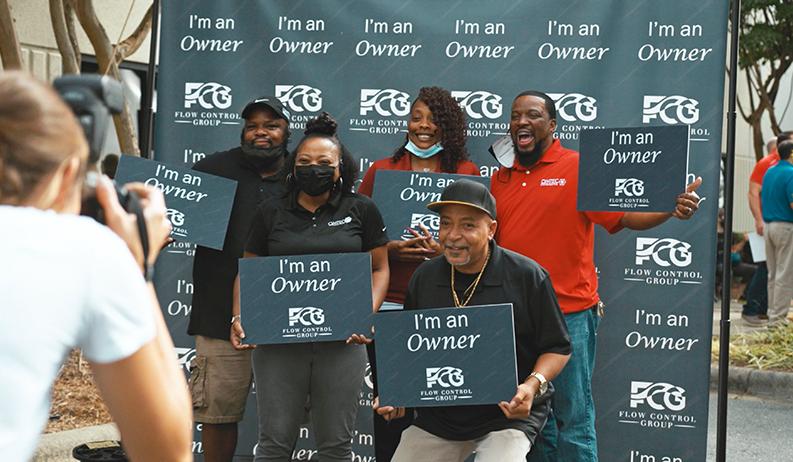
—Michael Lyles, B1Daily
For millions of Americans, going to work creates wealth for somebody else.
Employees receive wages. The company generates profits. Investors accumulate equity. When the business becomes substantially more valuable, the largest rewards generally flow toward the people who own it.
Employee ownership attempts to rewrite that equation.
Through Employee Stock Ownership Plans, or ESOPs, worker cooperatives and other broad-based equity programs, employees can acquire a financial stake in the companies where they work. Instead of leaving retirement with only the wages they managed to save, workers can potentially leave with an ownership asset accumulated alongside their paycheck.
For Black workers, that distinction could be particularly important.
Turning a Job Into an Asset
The racial wealth gap isn’t simply an income problem. Wealth comes from ownership, including homes, businesses, stocks and other appreciating assets.
Employee ownership provides another doorway into that world.
Research summarized by Rutgers found that employee-owners ages 28 to 34 had 92% higher median household wealth than comparable non-employee-owners. Among workers of color, employee-owners had 79% greater net household wealth and 30% higher wage income than non-employee-owners of color in the dataset. The relationships remained after researchers controlled for several demographic factors, although observational research cannot prove employee ownership alone caused every difference.
That is precisely why employee ownership deserves attention in discussions about Black wealth.
A worker who owns part of the company isn’t simply selling labor.
That worker is accumulating capital.
What an ESOP Can Do
An ESOP generally allows qualifying employees to accumulate shares in their employer through a retirement plan. Unlike buying stocks through a brokerage account, traditional ESOP structures can provide employees with ownership without requiring workers to purchase those shares with their ordinary disposable income.
That feature is particularly powerful for households that don’t have thousands of dollars available to invest every year.
A Rutgers study of nearly 200 employees at 21 employee-owned companies found a median ESOP account value of $165,000 among the low- and moderate-income workers studied. Researchers concluded that ESOP ownership substantially narrowed, although certainly did not eliminate, racial and gender wealth disparities within the sample.
Think about what $100,000 or $150,000 in additional assets can represent for an ordinary worker.
It can mean retirement security.
It can become part of an inheritance.
It can reduce dependence on Social Security alone.
And, depending on the particular plan and circumstances, accumulated wealth can provide families with greater financial resilience.
That’s how a paycheck can begin becoming generational wealth.
Employee Ownership Isn’t a Magic Wand
There are important limitations.
A 2025 Rutgers/Aspen analysis found substantial racial disparities even within employee-ownership programs. Black employees in its data had considerably lower average ownership values than White employees in both ESOPs and other equity plans.
And concentrating retirement wealth in the same company providing your paycheck creates risk. If the business performs poorly, both employment and accumulated company wealth can be threatened.
Employee ownership therefore shouldn’t replace fair wages, diversified retirement savings or opportunities for independent investing.
It should complement them.
From Workers to Worker-Owners
For Black America, the larger idea deserves serious consideration.
Closing the wealth gap cannot depend exclusively on increasing salaries. Higher wages matter enormously, but lasting wealth generally requires acquiring assets.
Homes are assets.
Stocks are assets.
Businesses are assets.
And ownership in the company where someone spends 20 or 30 years working can become an asset too.
The Aspen Institute has argued that expanding employee ownership could provide working people with greater participation in the economic gains their companies generate while strengthening wealth-building opportunities for workers historically excluded from significant business ownership.
America has spent generations teaching workers how to earn money.
Perhaps the next chapter should focus more heavily on helping workers own what their labor helps build.
For Black workers attempting to transform employment into lasting family wealth, that small change in vocabulary, from employee to employee-owner, could carry enormous financial consequences.
—Michael Lyles, B1Daily





Leave a comment