—Sylvester Loving, B1Daily
The popular image of the Berlin Conference is unforgettable: European diplomats sitting around a table, drawing lines across a map of Africa and dividing a continent whose inhabitants had no seat in the room.
The basic injustice of that image is accurate, but the history surrounding it is more complicated.
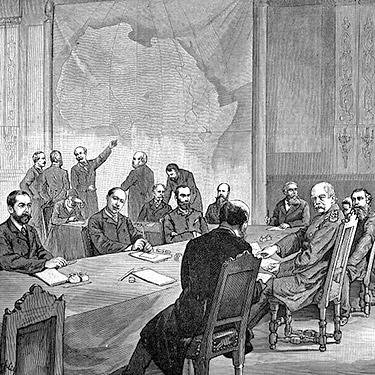
There were no African rulers at the Berlin Conference. Fourteen states participated in the negotiations held from November 1884 through February 1885, and the German government’s own historical archive acknowledges that African representatives were never consulted. Even the Sultan of Zanzibar’s attempt to participate was rejected.
But that does not mean Africans were completely absent from the political maneuvering surrounding the Scramble for Africa.
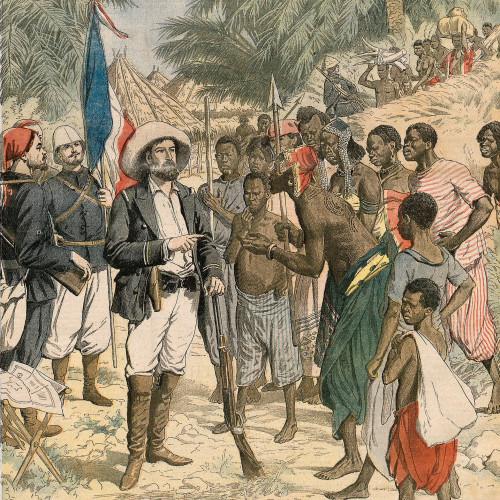
Across the continent, Europeans were signing agreements with African kings, chiefs and commercial leaders. Some African rulers willingly negotiated because they wanted trade, weapons, diplomatic allies or protection against regional enemies. Others believed they were signing limited commercial or friendship agreements. Some tried to manipulate European rivalries for their own political purposes.
And in many cases, Europeans subsequently interpreted those agreements far more expansively than the African signatories ever intended.
The tragedy was not simply that Europe conquered Africa.
It was that pieces of paper often arrived before the soldiers.
The Berlin Conference Did Not Invite Africa
First, an important historical correction.
There weren’t “Africans at the Berlin Conference making deals with Europeans.”
Africans weren’t invited.
Representatives of Britain, France, Germany, Belgium, Portugal and other powers negotiated rules governing European claims, Congo Basin commerce and navigation of the Congo and Niger rivers. The conference’s General Act also established rules concerning future European occupation.
The German Foreign Office now states plainly that African interests played no role in those negotiations.
That exclusion makes what happened outside Berlin particularly important.
European powers needed more than colorful maps to turn theoretical claims into functioning empires.
They needed relationships on the ground.
And treaties with African rulers became one of their most valuable weapons.
African Treaties Became Colonial Currency
Treaty-making was already occurring before Berlin, but it accelerated dramatically during the Scramble.
UNESCO’s General History of Africa notes that European powers had previously established influence through settlements, exploration, commercial posts, missionaries, strategic occupation and agreements with African rulers. Following the Berlin Conference, treaties became one of the most important instruments in the “paper partition” of Africa.
These documents could become geopolitical ammunition.
If Britain produced a treaty signed by a local ruler, Britain could point to it when challenging French or German claims.
If Germany obtained agreements with rulers along a coastline, Berlin could use them to strengthen its assertion that the territory belonged within the German sphere.
African signatures were therefore being inserted into a European diplomatic system that African rulers themselves had been excluded from designing.
That created a devastating imbalance.
King Bell and the German Takeover of Cameroon
One revealing example came from what became German Kamerun.
European merchants had traded along the Cameroon coast for years. Local Duala elites were not politically irrelevant spectators. They controlled important commercial networks and negotiated with European merchants from positions of local authority.
In July 1884, immediately before the Berlin Conference, German representatives obtained treaties with Duala leaders that helped establish Germany’s claim to Cameroon.
From the perspective of Germany, such agreements could help demonstrate legitimate acquisition.
From the African perspective, the meaning of “protection” could be very different.
That linguistic distinction appeared repeatedly across colonial Africa.
An African ruler might understand a treaty as establishing friendship, commercial access or an alliance with a powerful foreign government.
Europeans could interpret the same document as surrendering sovereignty.
One word could swallow a kingdom.
Makoko and Pierre Savorgnan de Brazza
The Congo provides an even more consequential example.
In 1880, French explorer Pierre Savorgnan de Brazza negotiated a treaty with Makoko Iloo I, ruler of the Teke.
The agreement became a foundation for French territorial claims north of the Congo River and eventually contributed to the establishment of French Congo.
But Makoko wasn’t sitting helplessly waiting for Europeans to explain politics to him.
African rulers had their own strategic interests.
They confronted neighboring rivals, commercial pressures and regional conflicts. An alliance with France could appear useful within that existing African political environment.
This is one of the most important corrections to simplistic histories of colonization.
African leaders possessed agency.
But agency does not mean equality of power or information.
A ruler could make a rational decision based upon his immediate circumstances without understanding that European governments thousands of miles away would later use that agreement to justify permanent colonial sovereignty.
Jaja of Opobo: When Cooperation Had Limits
Perhaps no story better illustrates the danger than King Jaja of Opobo, in today’s Nigeria.
Jaja was not some powerless village chief.
He was an extraordinarily successful merchant and political leader who built Opobo into an important commercial state in the Niger Delta.
Palm oil was enormously valuable to European industry, and African middlemen such as Jaja controlled access between European merchants on the coast and producers farther inland.
That made him wealthy.
It also made him an obstacle.
During the scramble, Britain sought treaties of protection with rulers throughout the Niger Delta. Jaja signed a British protection treaty but deliberately struck out a provision concerning unrestricted trade.
That detail matters enormously.
Jaja wasn’t simply handing Britain everything it wanted.
He was negotiating.
Cambridge scholarship examining these treaties notes that Jaja continued asserting control over commerce in his rivers despite Britain’s increasingly expansive interpretation of its authority. The British eventually removed him and sent him into exile.
The lesson was brutal.
African leaders could sign treaties.
But Europeans increasingly reserved the right to decide what those treaties meant.
Nana Olomu Learned the Same Lesson
Nana Olomu, an influential Itsekiri chief and palm-oil merchant, encountered a remarkably similar fate.
Nana controlled important commercial networks around the Benin River. Like Jaja, he operated in a world where African merchants served as intermediaries between European traders and inland producers.
And like Jaja, he signed a British protection agreement.
But European technological and political power was changing the economics of trade.
Steamships and improved transportation increasingly allowed European merchants to bypass African intermediaries and penetrate farther inland.
Britain no longer merely wanted access to the commercial system.
It increasingly wanted control over it.
Cambridge research notes that Nana was among several Niger Delta rulers who signed British protection treaties but later resisted British attempts to expand their authority. He was eventually defeated and exiled.
The economic pattern is unmistakable.
First came trade.
Then came treaties.
Then came demands for “free trade.”
Then African middlemen became inconvenient.
Then political sovereignty followed commercial penetration.
Some African Rulers Tried to Play Europe Against Europe
It would be historically unfair to portray every African leader as simply duped.
Some understood that European powers were rivals and attempted to exploit those rivalries.
African rulers could seek alliances with one European country to protect themselves against another European power or an African rival.
Historical research into Africa’s colonial borders has found evidence of genuine African political agency during the partition process. Europeans needed intelligence about local political boundaries, hierarchies and rulers, creating opportunities for African leaders and intermediaries to influence colonial negotiations.
Some treaties were genuine agreements regarded as binding by both sides. Scholars have also documented cases in which African rulers entered European alliances specifically to advance their own political interests.
That nuance matters.
African history shouldn’t be written as though Africans suddenly stopped being political actors the moment Europeans appeared.
Kings remained kings.
Merchants remained businessmen.
Rival states remained rivals.
African governments continued pursuing their own interests.
The problem was that they were playing a regional political game while European empires were playing a global imperial game.
The Treaty Trap
The fundamental problem was the unequal understanding of sovereignty.
Imagine an African ruler agreeing:
“You may trade here, and I accept the protection of your government.”
The ruler might understand that to mean:
You are my powerful ally.
The European government might record it as:
This territory is now our protectorate.
Those interpretations are worlds apart.
And once European governments began negotiating with one another, African treaties could become evidence supporting European territorial claims.
The Berlin framework made control increasingly important. Articles 34 and 35 of the General Act established principles surrounding notification and effective occupation of new territorial claims along the African coast.
European explorers and agents consequently rushed to obtain agreements, establish posts, raise flags and demonstrate authority.
The signature of an African ruler could become one component of that imperial machinery.
Africans Were Negotiating Without Knowing Europe’s Rules
That may be the most important point.
African rulers weren’t invited to Berlin.
They didn’t participate in writing the General Act.
They didn’t collectively decide what constituted “effective occupation.”
They didn’t establish the European diplomatic rules governing recognition of colonial claims.
Yet treaties signed with those rulers could subsequently be used within that system.
It was a geopolitical card game where Africans sometimes supplied the cards but weren’t allowed to sit at the table.
And Europeans possessed another overwhelming advantage.
Military technology.
If diplomacy failed, gunboats remained.
The Myth That Africans Simply “Sold Africa”
There is a dangerous oversimplification that occasionally appears in discussions of colonialism:
Africans signed treaties, therefore Africans voluntarily gave Africa to Europeans.
History does not support such a sweeping conclusion.
Some rulers undoubtedly collaborated with Europeans.
Some sought economic advantage.
Some sought military protection.
Some miscalculated.
Some made alliances against African rivals.
Some probably understood more about European intentions than others.
Others resisted fiercely.
And still others signed documents whose legal implications Europeans interpreted far beyond what the African participants believed they had accepted.
The fact that Europeans later relied upon treaties doesn’t transform imperial conquest into a consensual real-estate transaction.
Britain’s treatment of Jaja of Opobo demonstrates the contradiction perfectly.
When an African ruler’s interpretation of economic sovereignty collided with Britain’s imperial objectives, his treaty did not protect him.
Britain removed him.
The African Collaborators Still Matter
None of this means African collaboration should be erased from history.
It should be studied.
African rulers who assisted colonial powers made choices that sometimes had catastrophic consequences for neighboring peoples and future generations.
Local rivalries occasionally helped Europeans penetrate regions they could not easily have conquered without African intelligence, translators, soldiers, merchants and political partners.
European empires were extraordinarily skilled at exploiting existing divisions.
If two kingdoms were enemies, Europeans could ally with one.
If succession was disputed, Europeans could support a preferred claimant.
If merchants competed over trade routes, Europeans could favor one network.
If a ruler wanted weapons, Europeans could exchange military assistance for political concessions.
Colonialism didn’t require Europeans to eliminate African politics immediately.
It often required them to weaponize African politics against Africa.
Then the Deals Stopped Being Deals
Once colonial control became sufficiently strong, Europeans had less reason to negotiate as equals.
That is the cruel endpoint of the treaty era.
African rulers initially possessed something Europeans needed: political legitimacy, commercial access, territorial knowledge and influence over local populations.
But once colonial administrations established soldiers, roads, bureaucracies and direct commercial networks, those rulers became less indispensable.
The balance changed.
An African king who had once negotiated with a European consul could eventually find himself answering to a colonial administrator.
A merchant who once controlled European access to inland markets could discover European companies bypassing him.
A ruler who thought he had acquired an ally could discover that he had acquired a governor.
The partnership disappeared because it had never been a partnership between equals.
Berlin’s Real Legacy
The Berlin Conference didn’t literally sit down and draw every modern African border in three months. That popular description compresses a much more complicated historical process. Even Germany’s Foreign Office emphasizes that the conference primarily established a framework for European territorial claims rather than determining every individual boundary.
But Berlin accelerated and legitimized something enormous.
Europe had established rules among Europeans for claiming African territory.
Treaties with African rulers then became one of the instruments used to transform those claims into colonial empires.
That distinction gives us a much richer understanding of the Scramble for Africa.
Africans weren’t absent from their own history.
They negotiated.
They resisted.
They collaborated.
They calculated.
They miscalculated.
They manipulated Europeans and were manipulated by Europeans.
Some sought protection.
Some sought profits.
Some fought until their kingdoms were destroyed.
But the ultimate system was fundamentally unequal because European powers possessed military superiority and recognized one another’s territorial claims while denying African states an equal voice in the international order being constructed around them.
No African king signed the Berlin General Act.
No African delegation sat beside Britain, Germany or France.
No African government received an equal vote on how European occupation would be recognized.
The continent’s rulers could negotiate individual deals.
Europe decided what those deals would ultimately mean.
—Sylvester Loving, B1Daily





Leave a comment