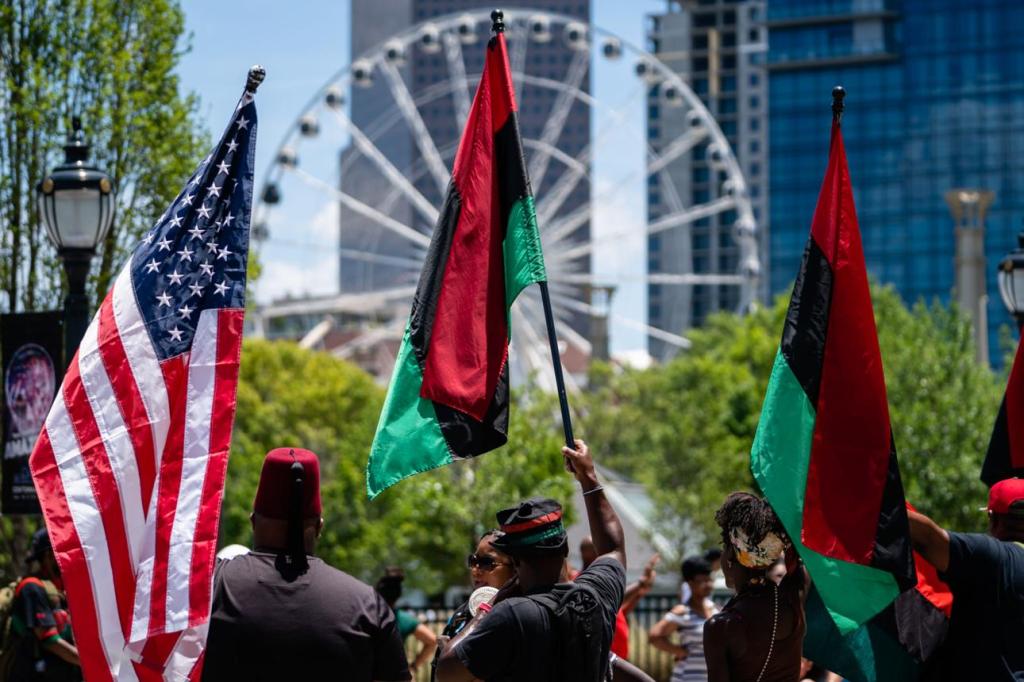
—Matt Gwinta, B1Daily
Pan-Africanism carries one of the most emotionally powerful ideas in Black political history: people of African descent, scattered across countries and continents, possess enough shared history and common interests to cooperate politically, economically and culturally.
It is a beautiful idea.

But beauty doesn’t settle political disagreements.
In 2026, the central challenge facing Pan-Africanism may no longer be convincing Black people that they share historical connections. It is figuring out what solidarity means when Black Americans, continental Africans, Afro-Caribbeans and other Black populations increasingly have political interests that don’t perfectly overlap.
That distinction matters because ancestry can create kinship.
It does not automatically create a common political agenda.
Black Americans Have a Specifically American Claim
Black Americans descended from people enslaved in the United States have developed a political agenda shaped by a very particular history: American slavery, Reconstruction, Jim Crow, segregation, redlining and discrimination inside American institutions.
That produces demands aimed directly at the United States government.
Reparations are the clearest example.
California’s reparations legislation and task-force process has specifically wrestled with eligibility based on descent from enslaved people and free Black people living in the United States before the end of the 19th century.
That is fundamentally different from a generic program benefiting everyone who happens to be Black.
For descendants of American slavery, reparations are based upon a particular debt owed by particular American institutions to a particular population.
Pan-African rhetoric can become politically troublesome when it blurs those distinctions.
A Black immigrant from Ghana can experience anti-Black discrimination in America.
A Nigerian immigrant can encounter racism.
A Jamaican American can experience racial profiling.
Those experiences deserve attention.
But experiencing American racism today doesn’t retroactively give every Black population the same historical claim arising from centuries of American slavery and Jim Crow.
Shared race does not mean identical lineage, history or political claims.
Africans Have Their Own Priorities
The reverse is equally important.
Africans shouldn’t be expected to reorganize their national interests around Black American political priorities.
A Ghanaian voter may care about inflation, electricity, employment and government corruption.
A Nigerian voter may prioritize security, infrastructure and economic development.
A South African voter may be thinking about unemployment, electricity, land reform or crime.
Those aren’t betrayals of Pan-Africanism.
They’re politics.
African governments also operate as sovereign states. They negotiate with China, the United States, Europe, Russia, Gulf countries and one another according to national interests that won’t necessarily correspond with the racial politics of Black America.
The African Union itself emphasizes continental integration, economic development, peace, governance and greater African influence internationally through its Agenda 2063 project.
Those goals can overlap with diaspora interests.
They aren’t identical to them.
The Internet Blew Up the Romantic Version
Earlier generations of Pan-Africanists didn’t have millions of Black Americans and Africans arguing with one another on TikTok, YouTube and X every afternoon.
The internet changed the relationship.
People can now encounter one another directly, and sometimes what they discover isn’t automatic brotherhood.

There are cultural misunderstandings.
Arguments about slavery.
Arguments about immigration.
Arguments about identity.
Arguments about who gets to speak for whom.
Arguments about whether Black Americans are “African.”
Arguments about whether Africans understand American racism.
Arguments about African involvement in historical slave trades.
And occasionally enough digital tribal warfare to make Marcus Garvey throw his phone into the Atlantic.
Some of that conflict is algorithmic garbage engineered for engagement.
But not all of it is imaginary.
The internet has exposed a reality Pan-Africanism sometimes prefers to romanticize: Black populations developed distinct cultures during centuries of geographic separation.
Black Americans aren’t simply Africans living far away.
They developed their own ethnicity, political traditions, music, cuisine, dialects, religious traditions and historical memory inside the United States.
Likewise, “African” isn’t a single ethnicity. Africa contains thousands of ethnic and linguistic communities spread across more than 50 countries.
Treating all those populations as one political organism was always going to become complicated.
Immigration Creates Another Fault Line
Immigration makes the disagreement more concrete.
Many African immigrants understandably want easier immigration pathways, family reunification and opportunities to study or work in the United States.
Some Black Americans, meanwhile, increasingly view immigration through the lens of domestic labor competition, housing shortages and whether immigration policy benefits descendants of American slavery.

Those positions can collide.
Pan-Africanism cannot solve that disagreement by shouting “diaspora unity” louder.
If two populations have conflicting interests on a policy, pretending the conflict doesn’t exist isn’t solidarity.
It’s avoidance.
Pan-Africanism Doesn’t Need to Die
None of this means Pan-Africanism has become useless.
It means Pan-Africanism needs an upgrade.
The strongest version for the 21st century may be cooperation without political homogenization.
Black Americans can support African nations receiving fair prices for minerals without surrendering their distinct American political agenda.
African governments can cooperate with Black American businesses without pretending Black Americans are simply another African ethnic population.
Historically Black colleges can deepen relationships with African universities.
Black American investors can participate in African manufacturing and infrastructure projects.
African businesses can invest in Black American communities.
Diaspora populations can cooperate against racial discrimination internationally.
Cultural exchange can flourish without anybody surrendering their identity.
That model doesn’t require everybody to want the same thing.
Countries cooperate constantly despite conflicting interests.
Black populations can do the same.
Solidarity Shouldn’t Mean Political Self-Sacrifice
This is where modern Pan-Africanism needs firmer boundaries.
No Black population should be expected to sacrifice its concrete interests to demonstrate racial authenticity.
Black Americans shouldn’t abandon lineage-based reparations because somebody argues that benefits should extend universally across the African diaspora.
Africans shouldn’t prioritize American racial politics over problems confronting their own countries.
Caribbean nations shouldn’t subordinate their reparations claims against European colonial powers to American politics.
Different histories produced different debts.
Different countries produced different political realities.
Different populations therefore developed different agendas.
That’s not a failure of Black unity. That’s adulthood.
Real coalitions don’t require everyone to become identical.
They require participants to identify where their interests overlap and cooperate there.
Maybe Pan-Africanism Needs Fewer Family Reunions and More Business Meetings
The old romantic vision sometimes imagined a gigantic global Black family separated by colonialism and slavery but destined for political reunification.
The modern world suggests something more practical.
Perhaps Black America and Africa don’t need to become one people politically.
Perhaps they need to become reliable partners.
Partners can disagree.
Partners maintain boundaries.
Partners negotiate.
Partners don’t pretend their interests are identical.
But when interests overlap, partners can become extraordinarily powerful.
Imagine stronger commercial networks connecting Black American capital with African markets. More direct relationships between historically Black institutions and African universities. Greater tourism in both directions. Joint technology ventures. Media collaborations. Agricultural investment. Cultural exchanges.
That’s Pan-Africanism with spreadsheets.
And frankly, spreadsheets might accomplish more than slogans.
Unity Without Uniformity
Pan-Africanism still has something valuable to offer, but only if it abandons the assumption that shared African ancestry automatically produces shared politics.
It doesn’t.
Black Americans have developed their own historical identity and political claims.
Africans belong to dozens of nations and thousands of communities with their own interests.
The Caribbean has another set of histories.
Brazil has another.
Europe’s African diaspora has another.
Those differences shouldn’t frighten Pan-Africanists.
They should become the foundation of a more realistic movement.
Black solidarity doesn’t have to mean pretending we’re interchangeable.
Black Americans can be Black American first and still cooperate with Africa. Africans can prioritize their own nations and still build relationships with Black America.
Perhaps that is what Pan-Africanism needs to survive.
Not one enormous political identity stretching across the Atlantic.
But a network of distinct Black peoples capable of recognizing when cooperation makes all of them stronger.
—Matt Gwinta, B1Daily





Leave a Reply