—Michael Lyles, B1Daily
Wall Street has found its newest obsession, and this time it comes wrapped in artificial intelligence, humming servers, and an almost insatiable appetite for electricity. Banks, private lenders, and institutional investors are pouring enormous amounts of financing into data centers, betting that the AI revolution will generate enough revenue to justify the staggering costs of building the infrastructure behind it.
But beneath the technological excitement sits an uncomfortable financial question: What happens if the AI boom doesn’t produce enough money to repay the debt financing it?
Wall Street’s Newest Debt Machine
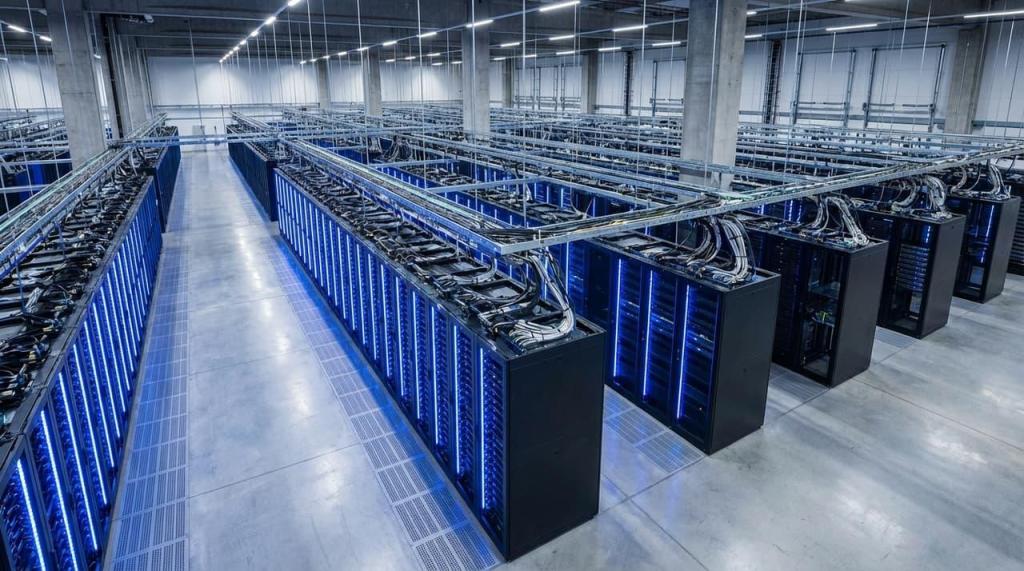
Building a modern hyperscale data center is extraordinarily expensive. Developers must acquire land, secure electrical connections, install cooling systems, construct specialized buildings, and sometimes finance billions of dollars’ worth of computing infrastructure.
Much of that expansion is being supported by borrowed money.
Commercial banks provide construction loans and credit facilities, while private credit funds, insurers, and other investors supply additional financing. Some loans are eventually refinanced or packaged into securities, spreading exposure throughout the financial system.
This means the financial risk is not necessarily concentrated on one bank’s balance sheet. Instead, it can travel through an increasingly complicated network of lenders, investment funds, and institutional investors.
And the entire arrangement depends on one critical assumption: demand for computing power will continue growing fast enough to support the financing.
The AI Gold Rush Has a Very Expensive Catch
Technology companies are spending aggressively to develop AI models and the infrastructure required to operate them. Developers and lenders see that demand as an opportunity to build facilities backed by long-term leases and commitments from major technology companies.
Those agreements can provide substantial protection. A data center leased to a financially strong customer is not the same investment as an empty speculative office building.
Nevertheless, even long-term contracts cannot eliminate every risk.
Data centers face rising construction costs, electrical-grid delays, changing hardware requirements, and the possibility that future computing technology will require less infrastructure than today’s forecasts anticipate.
There is also a basic economic problem that Silicon Valley would rather not discuss: Rapid adoption of AI does not automatically guarantee rapid profitability.
Companies may generate impressive user growth while struggling to turn that activity into sufficient cash flow. If the industry’s revenue projections fall short, the consequences could extend far beyond technology stocks.
Could Banks Be Financing the Next Commercial Real Estate Problem?
America’s banking industry has already experienced the financial consequences of troubled commercial real estate loans, particularly those connected to office buildings suffering from reduced demand.
Data centers are different. Their current demand is stronger, and many projects have financially substantial tenants. But they still share a dangerous characteristic with other real estate investments: enormous upfront costs supported by financing that depends on future income.
A data center can be technologically impressive and still become a poor investment if its financing costs, operating expenses, or projected revenues do not work out.
If developers struggle to refinance maturing loans, lenders could face restructuring negotiations, losses, or pressure to extend repayment schedules. Investors exposed through private credit and securitized debt could also suffer.
That does not mean a banking crisis is inevitable. It means the industry’s enthusiasm deserves more scrutiny than the familiar promise that artificial intelligence will change everything.
Who Gets Stuck With the Bill?
The greatest concern is not simply whether wealthy technology investors lose money. Financial institutions increasingly connect large infrastructure projects to retirement funds, insurance capital, investment portfolios, and other pools of money that ultimately serve ordinary Americans.
If the data center market experiences a significant downturn, losses could reach investors who never personally decided to gamble on the future profitability of AI.
Regulators should therefore be asking difficult questions about loan concentrations, collateral valuations, refinancing assumptions, and how much exposure banks retain after arranging these deals.
The public deserves to know whether financial institutions are carefully evaluating the risks or simply chasing another lucrative lending boom.
Artificial intelligence may genuinely transform the economy. Data centers may remain valuable infrastructure for decades. But neither possibility makes every loan sensible, every construction project profitable, or every forecast believable.
Wall Street has a remarkable talent for turning promising industries into heavily leveraged financial experiments. The danger emerges when excitement becomes a substitute for disciplined lending.
The question is no longer whether America can afford to build an AI-powered future. It is whether the financial institutions funding that future can afford to be wrong.
—Michael Lyles, B1Daily





Leave a Reply