—Jermichael Evers, B1Daily
New Zealand has spent millions of years building one of the strangest and most delicate ecosystems on Earth. Its isolation produced flightless birds, ground-foraging species, unusual reptiles and native bats that evolved without the mammalian predators common elsewhere.
Then humans brought cats.
Today, feral cats are spread across New Zealand, from farmland to forests, and the government has formally added them to its Predator Free 2050 target list. The goal is extraordinarily ambitious: eradicate feral cats alongside rats, possums and mustelids to give native wildlife a chance to recover.

The reason is simple.
Cats are magnificent predators. Unfortunately, New Zealand’s wildlife is magnificent prey.
New Zealand’s Wildlife Never Signed Up for Cats
Domestic cats (Felis catus) aren’t native to New Zealand. Native species therefore didn’t spend millions of years evolving alongside small feline predators.
That evolutionary mismatch can be catastrophic.
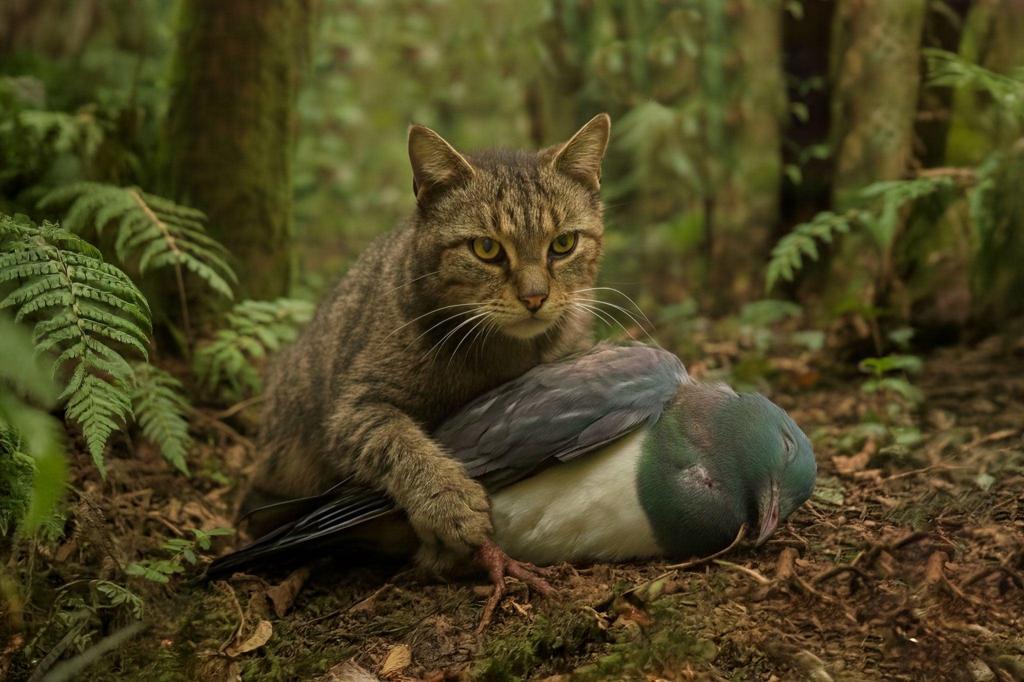
New Zealand’s Department of Conservation says feral cats prey upon birds, eggs, bats, lizards, wētā and other insects, in addition to introduced mammals such as rabbits, rats and mice.
Some individual cases are staggering.
In 2010, a single feral cat near Ohakune killed 107 short-tailed bats in one week. In 2020, conservationists found 17 skinks inside the stomach of one feral cat captured in Canterbury. Research from 2019 to 2021 also found feral cats responsible for the deaths of up to 20% of monitored kea in one study area.
That’s the ecological problem with cats in miniature.
One cat doesn’t need to be hungry enough to threaten a species. Cats are highly efficient hunters, and vulnerable wildlife populations can absorb only so many losses before reproduction stops keeping pace.
New Zealand has already moved all remaining kākāpō away from Stewart Island/Rakiura in part to protect them from cat predation, while endangered black stilts and southern New Zealand dotterels remain vulnerable to introduced predators.
This Isn’t Just a New Zealand Problem
New Zealand is an extreme example, but the underlying problem is global.
Domestic cats have followed humans around the planet. Where they roam freely outside their native evolutionary context, they can function as invasive predators.
A landmark Nature Communications study estimated that free-ranging cats kill between 1.3 billion and 4 billion birds every year in the contiguous United States alone, along with approximately 6.3 billion to 22.3 billion mammals. Unowned cats accounted for most of the estimated mortality.
Even more sobering, researchers noted that free-ranging cats on islands have contributed to 33 modern bird, mammal and reptile extinctions recorded by the IUCN Red List.
So when conservationists call free-ranging cats an ecological problem, they’re not declaring war on somebody’s fluffy couch goblin.
They’re describing predator ecology.
A Pet Cat and a Feral Cat Aren’t the Same Thing
This distinction matters.
New Zealand recognizes companion cats, stray cats that remain partly dependent on people, and genuinely feral cats living independently of humans. The country’s Predator Free 2050 target specifically concerns feral cats, not someone’s properly managed house cat.
Responsible pet ownership can actually be part of the conservation solution.
Keeping cats indoors or otherwise contained prevents hunting. Desexing reduces the creation of unwanted kittens and future feral populations. Microchipping helps distinguish owned pets from unowned animals. New Zealand’s government has explicitly emphasized responsible ownership as it expands feral-cat control.
The enemy isn’t the existence of cats.
It’s uncontrolled cats roaming ecosystems where wildlife has little defense against them.
New Zealand Is Escalating the Fight

New Zealand’s current Predator Free 2050 strategy includes feral cats alongside rats, mustelids and possums among the introduced predators targeted for eradication. DOC says introduced predators collectively kill an estimated 25 million native birds annually, although that figure covers the targeted predator groups rather than cats alone.
Scientists are consequently experimenting with new control technologies. A 2025 DOC field trial tested a specialized meat bait across 5,000 hectares in North Canterbury. Nine of ten GPS-collared feral cats monitored within the trial area found the bait and were killed, suggesting another potential tool for protecting wildlife across enormous landscapes where conventional trapping becomes difficult.
New Zealand has already successfully eradicated feral cats from several offshore islands. The vastly harder challenge is translating localized success into control across an entire country.
Cats Don’t Have to Be Villains to Be Invasive
The feral-cat debate becomes emotional because humans adore cats.
But ecology doesn’t assign moral guilt.
Cats aren’t evil for killing birds any more than hawks are evil for catching mice. They’re predators doing exactly what evolution designed them to do.
The responsibility belongs to humans.
We transported domestic cats across oceans and released or abandoned them into environments that never evolved to withstand them. When those populations become self-sustaining and begin hammering native species, controlling them isn’t cruelty toward nature.
It’s repairing damage humans created.
New Zealand’s feral-cat crisis should therefore serve as a warning far beyond its shores. Australia, the United States and other countries face their own problems with free-ranging cats and wildlife.
A purring animal asleep on a sofa can be a wonderful companion.
Release enough of those same predators into the wild, however, and the ecological equation changes dramatically.
To humans, a cat may be a pet. To a tiny native bird that evolved without mammalian predators, it’s a four-legged extinction machine.
—Jermichael Evers, B1Daily






Leave a Reply