—Michael Lyles, B1Daily
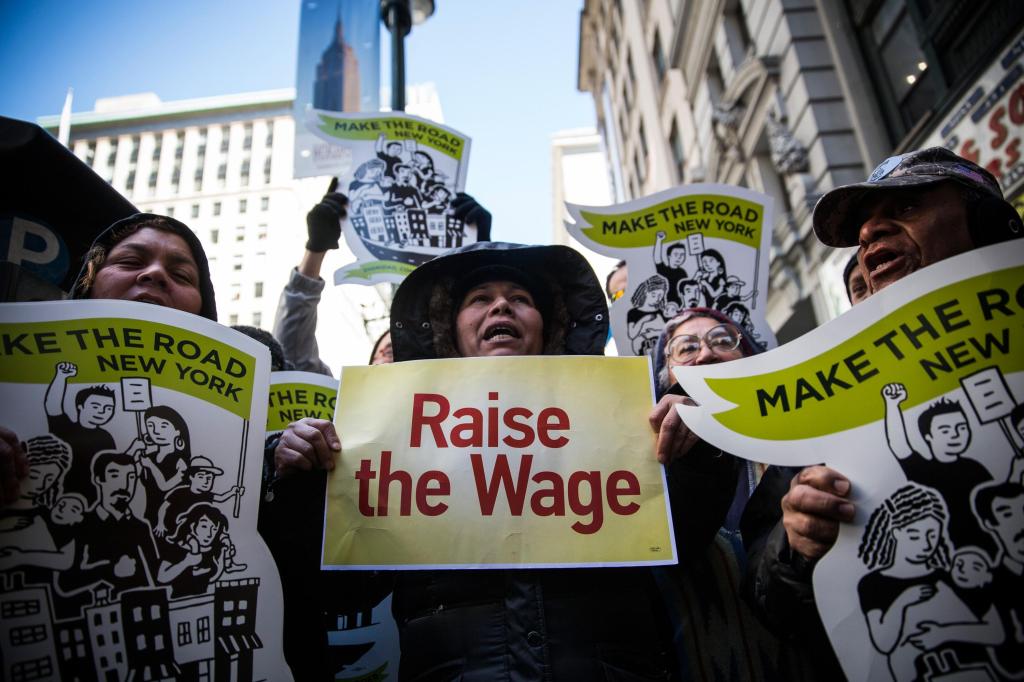
A minimum-wage worker in Washington can earn more than twice the hourly minimum available to a worker just a few states away.
That is the increasingly strange reality of America’s minimum-wage system in 2026. While states including Washington, California, Connecticut and New York have pushed their wage floors well beyond $15 an hour, another group remains anchored to the $7.25 federal minimum wage, a figure that has not changed since 2009.

The result is a national wage map that looks less like one labor market and more like two Americas separated by state lines.
Some States Have Blown Past $15
As of July 1, 2026, Washington’s statewide minimum wage is $17.13 an hour, while California stands at $16.90 and Connecticut at $16.94. New York requires $17 in New York City, Long Island and Westchester County and $16 elsewhere in the state.
Several states that once sat much closer to the federal floor have also climbed substantially.
Missouri and Nebraska are now at $15 an hour. Illinois, Delaware, Maryland and Massachusetts are also at $15. Maine has reached $15.10, New Jersey $15.92, Hawaii and Rhode Island $16, and Arizona $15.15.
Even states that haven’t joined the $15 club have moved upward. Florida is at $14, Michigan $13.73, Virginia $12.77 and South Dakota $11.85.
Then there’s Washington, D.C., where the minimum reached $18.40 on July 1, higher than every state.
The contrast becomes striking when translated into annual earnings.
At 40 hours per week for 52 weeks, $17.13 an hour amounts to roughly $35,630 before taxes. At $7.25, the same schedule produces only about $15,080.
That’s a difference of more than $20,000 a year before considering overtime, taxes or benefits.
And Then There Is the $7.25 America
The federal minimum remains $7.25 an hour for covered workers. When federal and state minimum-wage laws both apply, workers generally receive whichever applicable minimum is higher.
But a sizable collection of states has never established a substantially higher floor.
Iowa, Idaho, Indiana, Kansas, Kentucky, New Hampshire, North Carolina, North Dakota, Oklahoma, Pennsylvania, Texas, Utah and Wisconsin remain at the federal $7.25 level according to the Labor Department’s July 2026 table.
Other states, including Alabama, Louisiana, Mississippi, South Carolina and Tennessee, have no state minimum-wage law, meaning federally covered employees fall back on the $7.25 federal requirement. Georgia and Wyoming technically have state rates below $7.25, but federally covered workers must still receive the federal minimum.
That distinction matters. Saying every worker in those states earns $7.25 would be misleading. Many employers voluntarily pay more because labor markets demand it, while exemptions and different coverage rules complicate the picture.
What these laws determine is the legal wage floor, not what every employee actually receives.
Iowa and Washington Show How Wide the Gap Has Become
Few comparisons illustrate the divide better than Iowa and Washington.
Iowa’s minimum wage remains $7.25. Washington’s is $17.13.
That means Washington’s legal minimum is approximately 136% higher.
And this didn’t happen overnight. Labor Department historical data show Washington’s minimum at $9.32 in 2014, $11 in 2017 and $13.50 by 2020. Iowa, meanwhile, remained tied to $7.25.
Washington essentially built a moving escalator while Iowa stayed on the same floor.
The Federal Minimum Has Become Less of a National Standard
The federal minimum wage was once capable of establishing a meaningful common baseline across much of the country. Its prolonged freeze has gradually transferred much of that power to states.
The Department of Labor now counts 30 states plus the District of Columbia with minimum wages above the federal level.
Some states have also adopted automatic adjustment mechanisms. Washington, Maine, New Jersey, Minnesota, Montana, South Dakota and Vermont are among states whose minimum wages are adjusted annually according to formulas or inflation-related mechanisms.
That creates an important structural difference.
In a state with automatic adjustments, lawmakers don’t necessarily have to wage another political battle every time prices rise. The wage floor can move according to the formula already written into law.
States without such mechanisms can leave the same nominal wage in place indefinitely.
Higher Wages Don’t Erase Cost-of-Living Differences
There is an important caveat to any state-by-state comparison: $15 in one state does not purchase exactly what $15 buys somewhere else.
Housing, transportation, food, taxes and other expenses vary enormously. A worker in rural Iowa and a worker in Seattle face very different budgets.
That means simply comparing nominal minimum wages cannot tell us which worker enjoys the higher standard of living.
But cost of living doesn’t make the legal divide meaningless either.
A $7.25 minimum is not merely lower than Washington’s $17.13. It is less than half of it.
And some states with $15 minimum wages aren’t confined to famously expensive coastal markets. Missouri and Nebraska both reached $15 in 2026.
That makes the old argument that dramatically higher state minimum wages are exclusively a California-New York phenomenon increasingly difficult to maintain.
Your ZIP Code Now Helps Determine America’s Wage Floor
The biggest story isn’t that every state should necessarily have an identical minimum wage. Regional economic differences are real, and economists continue debating the employment, price and income effects of different minimum-wage policies.
The remarkable part is just how enormous the legal gap has become.
A federal minimum-wage worker can cross state lines without changing occupations and encounter an entirely different statutory wage floor.
Washington: $17.13.
California: $16.90.
New Jersey: $15.92.
Missouri: $15.
Nebraska: $15.
Iowa: $7.25.
Texas: $7.25.
Pennsylvania: $7.25.
The federal government still technically establishes America’s national minimum wage.
Increasingly, however, $7.25 looks less like a national wage standard and more like the basement that some states decided to leave behind while others never climbed the stairs.
—Michael Lyles, B1Daily




Leave a Reply