—Kerry Hill, B1Daily
America’s housing crisis is no longer simply about whether rent is too high or mortgage rates are painful. It is increasingly about which generation gets to accumulate wealth, put down roots, raise families, and participate in the economic security that homeownership has historically provided. That makes housing more than an economic problem. It is becoming a political fault line.
The numbers help explain the frustration. According to the Federal Reserve’s 2025 household survey, 63% of American adults owned their homes, but ownership varied dramatically with income. Only 33% of adults earning less than $50,000 owned their homes, compared with 86% of those earning $100,000 or more. The Fed also identifies housing costs and availability as continuing challenges, particularly for lower-income Americans. Federal Reserve
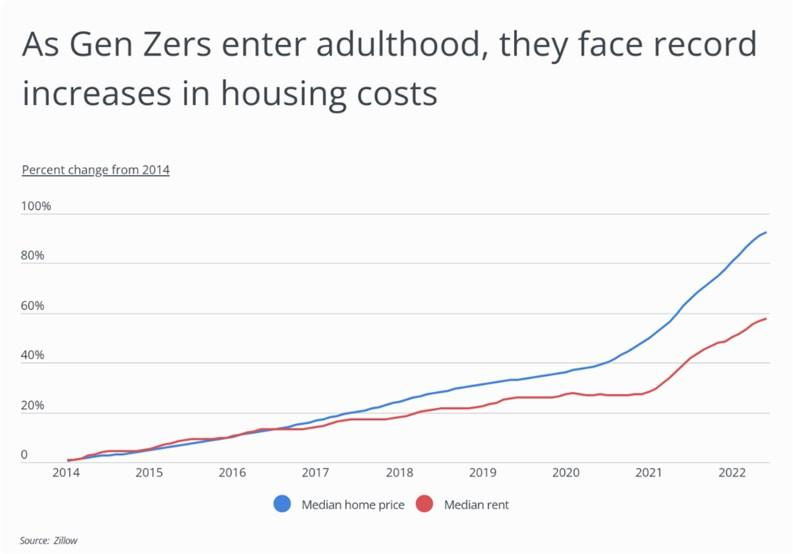
Age makes the divide even more striking. Research from the Federal Reserve Bank of Minneapolis estimates that only 22% of adults under 35 owned their homes in 2024 when ownership is measured at the individual rather than household level. Meanwhile, homeownership among Americans over 70 has risen over the past two decades. Federal Reserve Bank of Minneapolis
The National Association of Realtors reported another eyebrow-raising statistic: among people who actually bought homes between July 2024 and June 2025, first-time buyers represented only 21% of buyers, the lowest share in its survey’s history. Its survey put the median first-time buyer at 40 years old, although other datasets produce younger estimates, so that figure should not be treated as the single definitive measure of first-time buyers nationwide. National Association of REALTORS®
The Wealth Escalator Is Moving Without Them
This matters because buying a house isn’t merely about getting a backyard and somewhere to argue with a lawn mower.
Housing has traditionally been one of America’s biggest engines of household wealth. Owners can build equity as they pay down mortgages and, when prices appreciate, gain wealth simply by remaining in the market. People locked outside that market don’t receive the same benefit.
That creates a nasty feedback loop. Existing homeowners can accumulate equity while prospective buyers watch the price of admission climb. Some owners can later use that wealth to help their children with down payments, potentially extending the advantage into another generation.
The racial dimension makes the problem even sharper. Federal Reserve data show persistent disparities in homeownership, and the Fed’s 2025 survey found Black adults substantially less likely to own homes than white adults. Federal Reserve
For younger Black Americans trying to become first-time homeowners, therefore, the housing squeeze can collide with an older wealth gap rather than starting from an equal financial baseline.
And Then Housing Becomes Politics
This is where the economics begin spilling into elections and public policy.
A 28-year-old paying rapidly rising housing costs can experience the economy very differently from a 68-year-old homeowner sitting on decades of accumulated equity. Neither experience is imaginary. They are simply standing on opposite sides of the same housing market.
That puts pressure on politicians across ideological lines to answer increasingly difficult questions: Should cities loosen zoning restrictions and permit denser construction? Should governments subsidize first-time buyers? Should more public or affordable housing be built? Should institutional investors face restrictions when purchasing single-family homes? Should permitting rules be streamlined so builders can increase supply faster?
Those policies involve genuine tradeoffs. Subsidizing buyers without increasing supply, for example, can increase purchasing power while potentially putting additional pressure on prices. Building substantially more housing can improve supply but provoke fights over zoning, infrastructure, neighborhood density and local control.
And those fights frequently divide people who already own valuable property from people desperately trying to acquire some.
The American Dream Has a Waiting Room
The most politically dangerous part of the housing crisis may therefore be psychological.
A generation can tolerate an expensive housing market if people believe affordability is temporary and eventually they’ll get their turn. The political equation changes when younger adults begin believing the ladder itself has been pulled upward.
Harvard’s Joint Center for Housing Studies says a large and growing share of American households cannot find housing they can afford. Harvard Joint Center for Housing Studies
Housing consequently touches nearly everything else younger Americans worry about: marriage, children, savings, retirement, neighborhood stability and whether working harder actually produces greater economic security.
America doesn’t merely have a shortage of affordable houses.
It increasingly has a generational argument over who gets access to the wealth-building machinery of America.
And once an economic problem becomes a question of whether the system offers younger generations the same opportunities their predecessors enjoyed, housing stops being merely a market story.
It becomes political.
—Kerry Hill, B1Daily






Leave a comment