—Barrington Williams, B1Daily
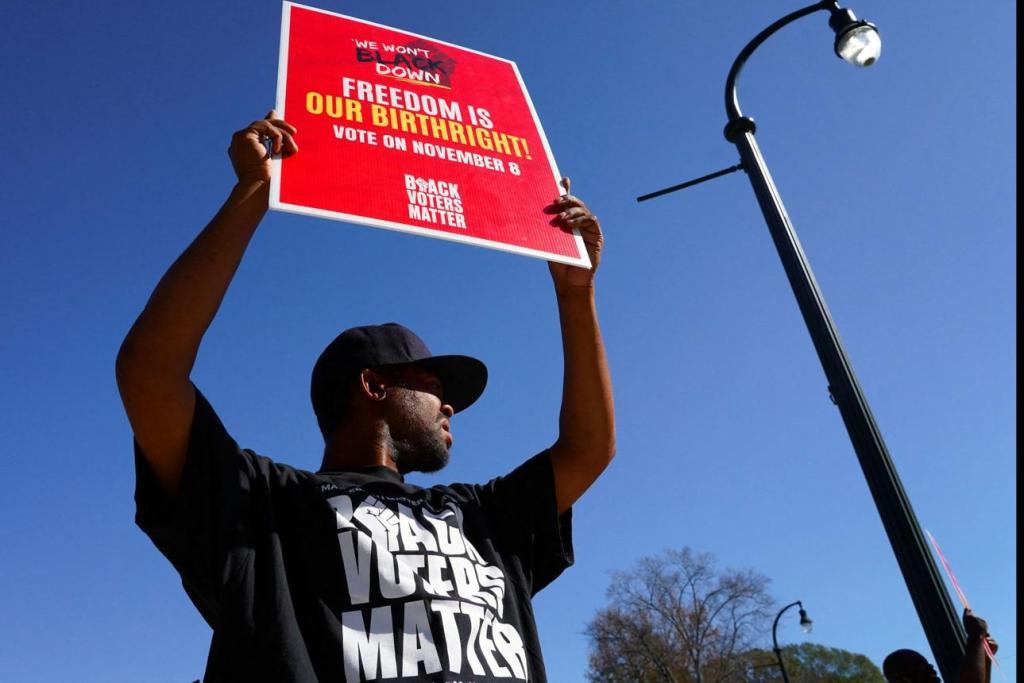
WASHINGTON is once again discovering Black voters.
With the 2026 midterm elections approaching, Democratic campaigns are returning to Black churches, Republicans are trying to preserve the gains Donald Trump made with Black voters, and political organizations are pouring millions into turnout operations.
But beneath all the speeches, advertisements and voter-registration drives sits a considerably more uncomfortable question:
What is either party actually offering Freedmen Black Americans?
Not what Democrats say Republicans will do to them.
Not what Republicans say Democrats have done to them.
Not another celebrity endorsement, church visit or election-season lecture about how historically important Black voters are.
What policies are actually sitting on the table?
That distinction matters because Black voters remain overwhelmingly Democratic, but their allegiance cannot simply be treated as political inheritance. A July Pew Research Center survey found 68 percent of Black registered voters preferred the Democratic congressional candidate, compared with only 8 percent supporting the Republican candidate. Another 25 percent either supported someone else or were unsure.
That is still an enormous Democratic advantage. But that undecided or alternative-vote bloc should make Washington pay attention.
The 2026 fight for Black America increasingly looks less like a traditional competition between two parties and more like a negotiation over whether either party intends to address the specific historical and economic circumstances of descendants of Americans enslaved in the United States.
Democrats: Protection, Programs and the Unfinished Reparations Question
Democrats enter the midterms with the more extensive collection of policies explicitly addressing racial disparities.
Voting rights remain central.
Following major battles over the Voting Rights Act, redistricting and election rules, Democrats have made protection of ballot access a major component of their appeal to Black voters. Democratic organizations have challenged Republican-backed voting restrictions in court and are campaigning heavily around Black political representation.
That is not insignificant.
For Freedmen communities across the South, congressional districts created under the protections of the Voting Rights Act helped produce Black representation in places where political power had historically been deliberately denied.
But protecting the vote raises another question:
Protecting the vote for what?
Voting rights provide political power. They do not themselves determine what politicians do with that power.
That is where Democrats face growing pressure.
The Congressional Black Caucus Foundation and Joint Center for Political and Economic Studies have developed a Black Policy Playbook addressing voting rights, economic opportunity, employment, education, healthcare, criminal justice and technology.
Democratic politicians are also increasingly talking about Black wealth.
Maryland Sen. Angela Alsobrooks recently argued that Democrats need to speak more directly about creating generational wealth for Black Americans rather than framing every election primarily around stopping Republicans.
That shift could be important.
Black homeownership, business capitalization, inheritance, land ownership and access to investment capital strike much closer to the economic foundation of the Freedmen question.
But towering above all of these issues is one word Washington has spent generations carefully walking around:
Reparations.
H.R. 40 remains alive in Congress. The legislation would establish a commission to study slavery and subsequent discrimination and recommend potential remedies for African Americans.
Rep. Ayanna Pressley, who currently leads the House legislation, has continued pushing Congress toward a federal reparative-justice framework.
The Congressional Black Caucus also convened lawmakers and advocates this summer to discuss reparative-justice strategy.
That means reparations have not disappeared from Democratic politics.
But there is an enormous gulf between having legislation introduced and making that legislation a central party priority.
H.R. 40 has existed in various forms for decades.
A commission is still not reparations.
A study is not compensation.
A hearing is not legislation delivering assets to descendants.
And that distinction increasingly matters to Freedmen activists who are not merely asking Washington to acknowledge slavery. They are asking whether the federal government recognizes a specific debt arising from slavery, Reconstruction’s collapse, Jim Crow, discriminatory federal housing policies and other government-sanctioned barriers that affected generations of Black Americans.
Going into 2026, Democrats contain the strongest congressional constituency supporting federal reparations.
But the Democratic Party has not made a comprehensive Freedmen reparations program the centerpiece of its national midterm platform.
That is the uncomfortable reality.
Republicans: Opportunity Without Reparations
Republicans are offering something very different.
The Republican economic pitch generally rejects race-specific government remedies and instead argues that Black Americans benefit from policies designed to increase economic opportunity for Americans broadly.
The Trump administration points to Opportunity Zones, tax reductions, HBCU funding, school choice, savings accounts for children and criminal-justice reforms such as the First Step Act as examples of policies capable of benefiting Black communities.
The administration has also emphasized expanding housing construction in Opportunity Zones and reducing regulations it argues restrict new homebuilding.
Education is another major Republican offering.
Trump has championed a federal tax-credit scholarship program scheduled to begin in 2027, alongside charter schools and broader school-choice initiatives. Republicans argue these policies give families trapped in poorly performing school districts greater control over their children’s education.
For Black parents frustrated with urban public-school systems, that argument may have appeal.
Republicans can therefore point to an identifiable philosophy:
economic growth, ownership, lower taxes, school choice, deregulation and individual opportunity.
But Republicans run directly into the mirror image of the Democratic problem.
Their programs generally do not recognize Freedmen as a distinct historical claimant.
Opportunity Zones aren’t reparations.
School vouchers aren’t reparations.
Tax cuts aren’t reparations.
A Black entrepreneur and a white entrepreneur may both benefit from lower taxes. A struggling Black family and struggling white family may both benefit from cheaper housing.
Those policies can still materially benefit Black Americans.
But universal economic policy answers a different question from lineage-based redress.
If the argument is that descendants of American slavery suffered specific government-inflicted economic injuries, then a policy available equally to everybody does not directly compensate that injury.
Republicans largely reject the premise that government should structure economic benefits around racial ancestry in the first place.
That creates perhaps the clearest philosophical divide between the parties.
Democrats generally accept targeted government intervention to address racial disparities.
Republicans generally emphasize race-neutral policies intended to expand opportunity.
Yet neither approach currently amounts to a fully developed federal Freedmen agenda.
The Immigration Question Nobody Wants to Touch
There is another issue complicating the conversation: immigration.
Republicans have increasingly argued that tighter immigration enforcement protects American workers, including Black workers, from labor competition and pressure on wages.
Democrats generally argue that immigrants are being scapegoated for larger structural economic problems and emphasize both worker protections and immigrant rights.
But a distinctly Freedmen-centered labor policy would ask a different question:
What does American immigration policy mean specifically for descendants of the American working class whose ancestors were enslaved here?
That could involve examining wage competition in low-income labor markets, apprenticeship access, federal contracting, union participation and whether employers use vulnerable immigrant labor to weaken bargaining power.
It could also distinguish enforcement against undocumented employment from hostility toward immigrants themselves.
Neither party has developed that into a comprehensive Freedmen labor doctrine.
Republicans talk about immigration.
Democrats talk about racial equity.
The intersection between immigration, Black labor and historical economic disadvantage remains politically radioactive.
What About Black Wealth?
This may be the biggest battlefield of all.
The median wealth gap between Black and white households didn’t appear from thin air. It developed through generations of differences in property ownership, access to mortgages, inheritance, business capital and government policy.
A serious Freedmen economic agenda could therefore revolve around assets rather than assistance.
Homeownership.
Land.
Business ownership.
Retirement assets.
Investment accounts.
Inheritance.
Access to capital.
Federal contracting.
Infrastructure investment in historically Black communities.
Support for Black farmers.
Protection of heirs’ property.
Programs helping families retain homes and land across generations.
That approach would represent a major philosophical change from treating Black economic policy primarily as poverty policy.
A Freedmen family earning $100,000 can still possess dramatically less inherited wealth than another household earning the same salary.
Income asks what you earn this year.
Wealth asks what your family has accumulated across generations.
For descendants of people who spent centuries legally prevented from accumulating property and another century navigating discriminatory institutions, that distinction is enormous.
Democrats increasingly acknowledge the racial wealth gap.
Republicans increasingly emphasize ownership and entrepreneurship.
There is potentially overlapping territory here.
But neither party has transformed that overlap into a national Freedmen wealth-building program.
Democrats Have Another Problem: Black Voters Know They’re Important
The Democratic Party’s challenge may ultimately be more complicated because Black voters constitute such an important part of its coalition.
A new Congressional Black Caucus Institute initiative is spending millions attempting to increase participation among Black, rural and younger voters before November.
Campaigns are visiting Black businesses and churches.
Candidates are hiring Black political consultants.
The machinery is humming.
But voter mobilization and policy delivery aren’t the same thing.
Every election cycle creates a familiar ritual.
Politicians arrive.
Black voters are told democracy itself is on the ballot.
The election happens.
Then another election approaches.
That strategy can remain effective when voters believe the opposing party represents a serious threat to their interests.
But fear of the alternative is not the same thing as enthusiasm for what your own coalition is offering.
That distinction could become increasingly important as younger Black voters encounter politics without the same emotional attachment to the Democratic Party that their parents or grandparents possessed.
Republicans Have Their Own Black-Voter Ceiling
Republicans shouldn’t mistake Democratic frustration for automatic Republican conversion.
Trump improved Republican performance among Black voters in 2024, but Republicans still face substantial skepticism.
The party’s opposition to DEI programs, support for restrictions Democrats say weaken minority voting power, resistance to reparations and broader rejection of race-conscious policymaking place Republicans fundamentally at odds with many Black political organizations.
Republicans may successfully persuade some Black voters on taxes, entrepreneurship, immigration, crime, religious values or education.
But attracting dissatisfied Black Democrats requires more than saying, “Democrats failed you.”
Eventually Republicans face the same question:
What are you offering instead?
If the answer is simply that Black Americans should benefit from policies designed for everyone, some voters will accept that philosophy.
Others will ask why a population subjected to explicitly race-based government discrimination should receive only race-neutral remedies.
That debate isn’t going away.
The Freedmen Question Scrambles the Traditional Political Map
This is precisely why Freedmen politics could become uncomfortable for both parties.
A Freedmen agenda doesn’t fit neatly inside America’s current ideological boxes.
It could demand reparations and stronger voting protections while simultaneously supporting tougher immigration enforcement against employers exploiting unauthorized labor.
It could support Black business development while criticizing corporate DEI bureaucracy.
It could demand government investment while emphasizing property ownership, entrepreneurship and family wealth.
It could support criminal-justice reform while demanding aggressive prosecution of violent crime in Black neighborhoods.
It could defend civil rights while rejecting political terminology that treats every population classified as “Black” as possessing the same historical claim against the United States.
That combination would scramble Washington’s preferred categories.
And perhaps that’s precisely why neither party has fully embraced it.
The Midterm Question Is Becoming Transactional
Black Americans don’t have to abandon either party to demand more from both.
Politics is supposed to be transactional.
Farmers demand agricultural policy.
Unions demand labor protections.
Businesses demand tax policy.
Gun owners demand Second Amendment protections.
Environmental organizations demand climate legislation.
Retirees defend Social Security and Medicare with extraordinary political discipline.
Nobody asks these constituencies to vote indefinitely based solely on gratitude for what a political party did 60 years ago.
Freedmen Black Americans can similarly ask:
What legislation are you putting on the table now?
Will you support H.R. 40?
Will you support lineage-based reparations if a commission recommends them?
What is your plan for the Black wealth gap?
What are you doing about Black homeownership?
How will you protect Black-owned farmland?
What will you do for HBCUs?
How will you increase Black access to federal contracts and business capital?
What is your plan for historically Black neighborhoods?
How will your immigration and labor policies affect Black workers?
What are you doing about voting rights?
And perhaps most importantly:
What are you willing to put into law rather than merely into a campaign speech?
That is where the 2026 midterms become interesting.
Democrats currently offer more policies explicitly framed around racial disparities, voting rights and reparative justice.
Republicans offer a different package centered more heavily on broad economic opportunity, tax policy, school choice, deregulation and ownership.
Neither party, however, has placed a comprehensive Freedmen-specific national program at the center of its 2026 congressional campaign.
And that leaves millions of descendants of American slavery staring at two political parties competing fiercely for power while asking a surprisingly simple question:
What’s in the deal for us?
—Barrington Williams, B1Daily


Leave a comment