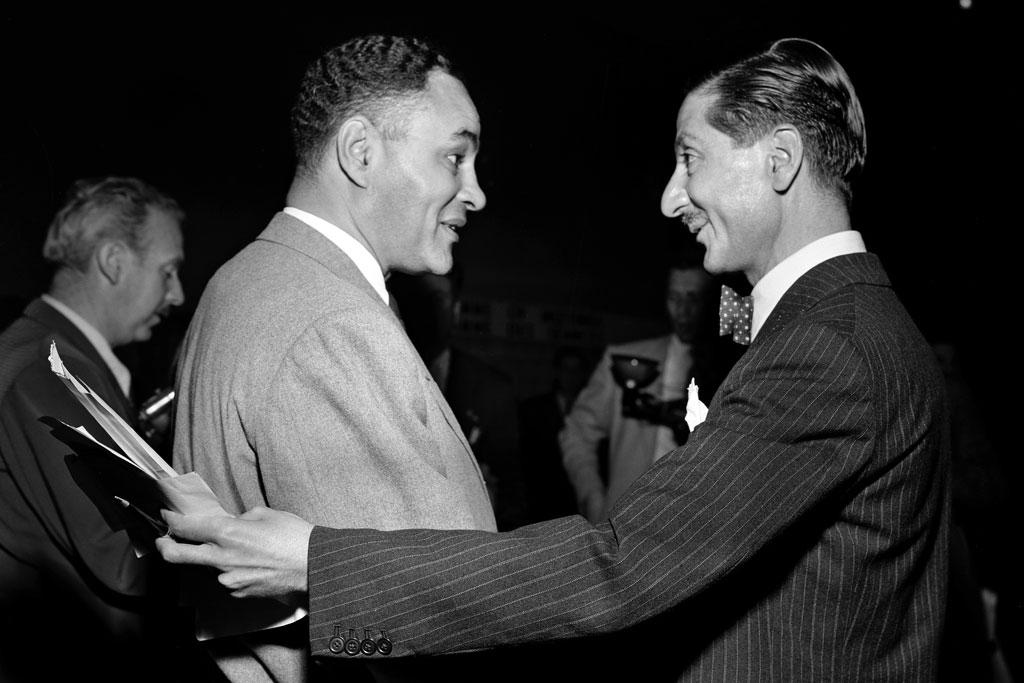
—Sylvester Loving, B1Daily
Before Henry Kissinger became synonymous with shuttle diplomacy, before modern American presidents spent careers trying to broker agreements in the Middle East, a Black American grandson of an enslaved woman walked into one of the world’s most explosive conflicts and helped get the guns to fall silent.
His name was Ralph Bunche.
And his story deserves far more attention in Black American history.
In 1948, the creation of Israel was followed by war between Israel and neighboring Arab states amid the broader unresolved conflict over Palestine. Hundreds of thousands of Palestinians were displaced during the war, creating a refugee crisis whose consequences remain central to the conflict today.
The United Nations initially appointed Swedish diplomat Folke Bernadotte as mediator, with Bunche serving as his principal aide.
Then everything changed.
Bernadotte was assassinated in Jerusalem in September 1948.
Bunche inherited the job.
A Black American born in Detroit in 1904, living in an America still governed by Jim Crow segregation, suddenly found himself responsible for helping negotiate between governments fighting one of the most consequential wars of the twentieth century.
And somehow, he pulled it off.
The Negotiator From Jim Crow America
Bunche wasn’t simply an accidental diplomat.
He was a Harvard-trained political scientist who had studied colonialism, worked on Gunnar Myrdal’s landmark research into American racial inequality, served in the Office of Strategic Services and State Department, participated in the development of the United Nations and became deeply involved in questions of colonial independence.
He understood power.
He understood nationalism.
He understood colonialism.
He understood racial hierarchy.
And unlike many diplomats discussing oppression as an abstraction, Bunche came from a people living through a version of it at home.
The United States could send a Black diplomat abroad to negotiate international disputes while restaurants, hotels and public institutions within his own country could still discriminate against Black Americans.
That contradiction was impossible to miss.
Yet Bunche transformed that experience into diplomatic discipline rather than bitterness.
The Nobel Committee later quoted Bunche explaining that his experiences as a Black American had made him intensely opposed to prejudice while teaching him the importance of fighting for rights without surrendering objectivity.
That is an extraordinary statement.
Because Bunche wasn’t claiming oppression automatically made him correct.
He was saying that experiencing prejudice helped teach him something about human conflict.
Rhodes Became His Diplomatic Laboratory
Bunche eventually brought representatives together for negotiations on the Greek island of Rhodes.
The negotiations were painstaking.
Distrust was enormous.
The political questions surrounding Palestine were nowhere near resolved.
But Bunche wasn’t trying to solve centuries of history over lunch.
He was trying to accomplish something more immediate:
Stop the war.
Between February and July 1949, Israel signed separate armistice agreements with Egypt, Lebanon, Jordan and Syria under United Nations mediation.
These were not peace treaties establishing a Palestinian state or permanently resolving borders, refugees, Jerusalem or competing national claims.
That distinction matters enormously.
Bunche didn’t solve the Israeli-Palestinian conflict.
Nobody should rewrite history to pretend that he did.
What he accomplished was still remarkable: he helped transform an active interstate war into negotiated armistices.
For that achievement, Ralph Bunche received the 1950 Nobel Peace Prize, becoming the first African American and first person of color awarded the prize.
Black America Has Been Training Diplomats for Centuries
There is a larger lesson in Bunche’s story.
Black Americans have spent centuries negotiating power.
Sometimes internationally.
Sometimes politically.
Sometimes simply to survive.
Frederick Douglass understood diplomacy.
W.E.B. Du Bois thought internationally about colonialism and race.
Ralph Bunche became one of the architects of modern international diplomacy.
Andrew Young became U.S. ambassador to the United Nations.
Civil-rights leaders built relationships with independence movements across Africa and Asia.
That history suggests something important about what Black Americans can contribute to international affairs.
A community shaped by slavery, Reconstruction, Jim Crow, disfranchisement and the long struggle for civil rights possesses a historical archive of experience with questions that appear repeatedly in global politics:
Who belongs?
Who controls territory?
What happens when one group possesses dramatically more political power than another?
How do societies emerge from institutionalized discrimination?
How do minorities obtain meaningful political representation?
How do oppressed populations pursue justice without producing endless cycles of retaliation?
How do governments acknowledge historical wrongs?
How do people who profoundly distrust one another eventually negotiate?
Those aren’t exclusively Black questions.
They’re human questions.
But Black American history provides unusually rich experience with them.
Experience With Oppression Can Create Credibility, But Not Automatic Authority
There is an important distinction here.
Being Black American doesn’t automatically make someone a good diplomat.
Skin color isn’t a foreign-policy credential.
Nor does experiencing discrimination mean a person automatically understands Israelis, Palestinians, Africans, Europeans or anybody else’s history.
Every conflict has its own actors, history and political realities.
But a diplomat who comes from a community with direct historical experience of oppression can sometimes enter conversations about minority rights, colonialism or racial hierarchy with a different reservoir of credibility.
Bunche demonstrated what that could look like.
He didn’t enter negotiations demanding that Israelis or Arabs accept his interpretation of their history.
He listened.
He negotiated.
He maintained relationships.
He separated immediate achievable objectives from larger unresolved disputes.
That is diplomacy.
Bunche Also Understood Colonialism
Bunche’s Middle East work shouldn’t overshadow another important part of his career.
He was deeply involved in international debates over colonial territories and self-government.
The State Department’s National Museum of American Diplomacy describes him as a major advocate for independence for colonized peoples. He later worked extensively through the United Nations on decolonization, human rights and peacekeeping.
That placed a Black American intellectual directly inside one of the twentieth century’s defining transformations: the dismantling of European colonial empires.
Again, his background mattered.
America had produced a diplomat capable of discussing colonial domination abroad who belonged to a population still fighting racial domination at home.
The contradiction gave Black American diplomacy a peculiar moral vocabulary.
From Selma to the United Nations
Bunche never completely separated international diplomacy from civil rights.
He participated in the 1963 March on Washington and later joined civil-rights demonstrations, including the Selma-to-Montgomery movement.
Think about that image.
A Nobel Peace Prize-winning international diplomat who had negotiated between governments in the Middle East was marching in Alabama demanding basic democratic rights for Black Americans.
That’s not a footnote.
That’s the story.
The man trusted to mediate international conflict still lived in a country where people sharing his ancestry had to fight for equal citizenship.
America Should Remember Its Black Diplomatic Tradition
Ralph Bunche complicates the way Black American history is usually taught.
Black history isn’t solely domestic history.
It isn’t confined to slavery, segregation and the civil-rights movement.
Black Americans have participated in shaping the international order.
They have been diplomats, soldiers, scholars, ambassadors, anti-colonial thinkers and negotiators.
And Bunche stands near the top of that tradition.
His greatest diplomatic achievement didn’t create permanent peace in the Middle East. The Israeli-Palestinian conflict continued, wars followed, Palestinian statelessness remained unresolved and the region would experience generations of bloodshed.
But diplomacy should not be judged only by whether an agreement lasts forever.
Sometimes diplomacy’s achievement is stopping people from killing each other today so politics has another chance tomorrow.
Ralph Bunche accomplished that.
And perhaps his broader legacy is something Black America should reclaim.
A people who spent centuries negotiating freedom inside a country that repeatedly denied it to them developed more than protest traditions.
They developed political instincts.
Coalition-building traditions.
International perspectives.
An understanding of power.
And, in figures such as Ralph Bunche, an extraordinary diplomatic tradition.
Before America lectures the world about conflict resolution, it might remember that one of the greatest negotiators it ever produced emerged from the very population America once refused to treat as equal citizens.
Ralph Bunche didn’t merely make Black history.
He made diplomatic history.
—Sylvester Loving, B1Daily



Leave a comment