—Barrington Williams, B1Daily
When thousands of newly arrived migrants began entering America’s major cities, local governments faced an immediate challenge: Where would everyone live? But in historically Black neighborhoods, another question quickly emerged: Why do communities already struggling with poverty, housing shortages, and decades of government neglect appear to be absorbing so much of the burden?
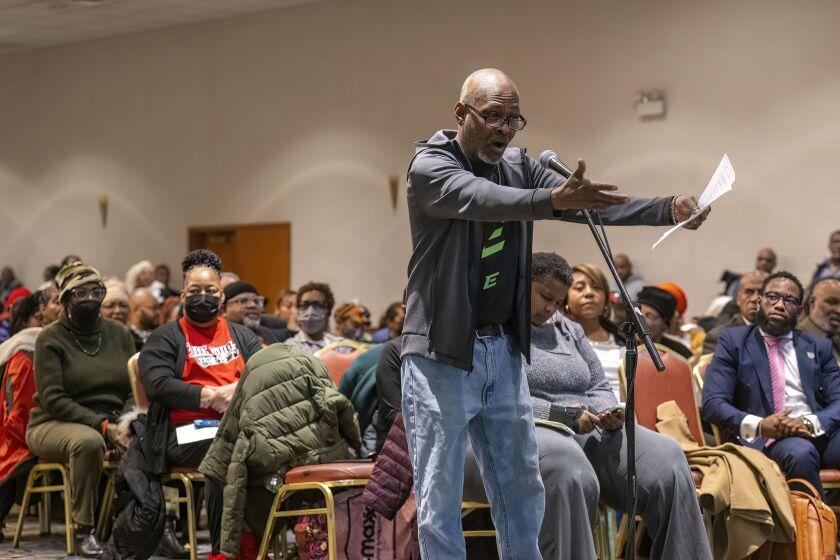
From Chicago’s South Side to parts of New York City, the placement of migrant shelters and resettlement programs has generated controversy among Black American residents who argue that their neighborhoods are being asked to accommodate major population changes without adequate resources or meaningful public consultation.
Some critics have gone further, suggesting that these policies amount to an effort to displace or politically marginalize Black Americans. That allegation deserves scrutiny, but it is important to distinguish documented unequal burdens from an unproven coordinated plan of demographic replacement.
Chicago: The Numbers Raise Serious Questions
Chicago provides one of the clearest examples of how migrant resettlement has intersected with longstanding racial inequality.
A 2024 Chalkbeat investigation found that nearly 60% of approximately 5,000 migrant families participating in an Illinois rental assistance program had found housing in predominantly Black, low-income communities on Chicago’s South and West sides.
Those neighborhoods already faced serious challenges involving underfunded schools, limited affordable housing, and insufficient public investment.
Meanwhile, city officials converted the former Wadsworth Elementary School in the predominantly Black Woodlawn neighborhood into a migrant shelter. The decision generated considerable opposition among residents who complained that their community had not been adequately consulted.
For many longtime residents, the controversy was not simply about immigration. It was about political priorities.
How could government officials mobilize substantial emergency resources for newly arrived families while Black residents had spent years demanding better housing, schools, and neighborhood services?
The frustration reflected a broader concern that disadvantaged communities were being asked to shoulder responsibilities without receiving comparable investment.
Are White Neighborhoods Receiving the Same Treatment?
This is where the debate becomes particularly important.
If municipal governments are disproportionately placing migrant shelters in lower-income Black neighborhoods while wealthier, predominantly white communities receive fewer facilities, residents have legitimate grounds to demand an explanation.
However, national evidence does not establish that migrants are systematically being placed in Black neighborhoods more frequently than white-majority neighborhoods across the country.
New York City’s experience illustrates the complexity. In March 2024, Manhattan and Queens accounted for the largest shares of asylum seekers in city-operated emergency shelters. Facilities were distributed unevenly, but not exclusively in predominantly Black communities.
Shelter locations can reflect available buildings, hotel contracts, zoning, transportation, costs, and political opposition. Those factors may produce racially unequal outcomes even without an explicitly discriminatory policy.
The proper test is to compare actual shelter placements, neighborhood demographics, public spending, and the decision-making records of city officials.
Without that evidence, claims of deliberate racial replacement remain allegations rather than established facts.
Black American Freedmen and the Fear of Displacement
The concerns expressed by Black American Freedmen cannot be separated from the country’s history of discriminatory housing policies.
Redlining, urban renewal, highway construction, and redevelopment projects have repeatedly disrupted established Black communities. Residents have experienced displacement, lost property wealth, and watched neighborhood institutions disappear.
Against that history, sudden changes in housing policy can understandably generate distrust, especially when officials fail to explain their decisions or include residents in planning.
But demographic change does not automatically mean displacement, and the presence of immigrant families does not establish that Black Americans are being intentionally replaced.
The more concrete concern is whether local governments are protecting existing residents from rising housing costs, overcrowded services, and unequal distribution of public resources.
Black residents and newly arrived immigrants can both face housing insecurity. Their needs should not be treated as mutually exclusive.
The Political Accountability Question
Government officials have a responsibility to explain why particular neighborhoods are selected for shelters and resettlement assistance.
That means publishing neighborhood-level data, consulting residents before opening large facilities, assessing school and infrastructure capacity, and ensuring that historically underserved communities receive adequate investment.
It also means confronting an uncomfortable reality: neighborhoods with less political influence may find it harder to resist decisions made elsewhere.
A policy does not need to be designed around racial hostility to produce racially unequal consequences.
If officials repeatedly choose disadvantaged neighborhoods because property is cheaper, buildings are readily available, or political resistance is weaker, the resulting burden can reinforce existing inequality.
That is a serious governance problem worthy of investigation.
Black Neighborhoods Should Not Be an Afterthought
America’s immigration and housing debates often become arguments between vulnerable populations while the institutions making the decisions escape scrutiny.
The important questions concern who controls public resources, how housing decisions are made, and whether residents have a meaningful voice in changes affecting their communities.
Black American Freedmen have every right to demand transparency, equitable investment, and protection against displacement. Newly arrived migrants likewise deserve humane treatment and lawful access to available services.
Those principles are not contradictory.
The evidence from cities such as Chicago shows that migrant resettlement can place disproportionate pressure on historically Black, under-resourced neighborhoods. What it does not establish is a nationwide conspiracy to replace Black Americans.
The responsibility now rests with public officials to demonstrate that housing decisions are equitable, transparent, and responsive to the communities expected to live with their consequences.
—Barrington Williams, B1Daily



Leave a Reply