—Barrington Williams, B1Daily
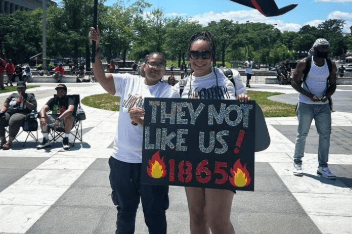
WASHINGTON, D.C. | A growing conversation within Black American political discourse is challenging one of America’s most familiar racial assumptions: that everyone classified as Black shares the same historical experience, political interests, and relationship to the United States.
Known as the Black American delineation movement, this lineage-centered approach emphasizes the distinct historical identity of Black Americans descended from people enslaved in the United States. Supporters argue that their ancestors’ experiences under American chattel slavery, Reconstruction, Jim Crow, racial terrorism, and government-sanctioned discrimination establish specific historical claims that cannot simply be absorbed into a broad racial category.

The movement has become particularly visible through discussions involving Freedmen, Foundational Black Americans (FBA), and American Descendants of Slavery (ADOS). Although these communities do not necessarily agree on every political position or definition, they share an emphasis on ancestry and historical specificity.
The debate is no longer confined to internet discussions. It intersects with questions about reparations eligibility, government data collection, immigration, coalition politics, and how Black Americans identify themselves in the twenty-first century.
Race Is Not the Same as Lineage
One of the movement’s central arguments is that racial classification alone cannot explain the different histories of Black populations living in America.
A Black American whose family endured American slavery and Jim Crow possesses a different ancestral relationship to the United States than a first-generation immigrant from Nigeria, Ghana, Jamaica, or Haiti. Both may experience anti-Black racism, but their family histories and potential claims for historical redress are not identical.

Delineation advocates argue that this distinction becomes especially important when discussing reparations. A policy designed to compensate descendants of people enslaved under American law requires a historically defined eligible population rather than a racial category encompassing every Black resident.
This is not necessarily a rejection of broader Black solidarity. For many supporters, it is an insistence that solidarity should not require erasing distinct ancestral experiences.
The Debate Over Tethers and Political Opposition
One of the more controversial expressions associated with online delineation discourse is the term tether.
Within some FBA discussions, the label is used to describe Black immigrants or their descendants who are perceived as undermining lineage-based political advocacy, particularly campaigns for reparations or recognition of Freedmen identity.
Importantly, the term does not inherently refer to every Black immigrant. In the narrower definition used by some advocates, it concerns individuals whose actions are viewed as opposing specific Freedmen political interests.
Nevertheless, the term remains contentious. Critics argue that its application can become subjective, allowing disagreements over policy, identity, or political strategy to escalate into accusations of disloyalty. Supporters counter that identifying opposition to lineage-specific demands is different from expressing hostility toward immigrants as a group.
That distinction is significant because criticism of an individual’s political conduct is not the same as assigning collective responsibility to an entire immigrant population.
Reparations Are at the Center of the Movement
Perhaps the most consequential effect of delineation politics is its influence on the national reparations conversation.

Lineage-based advocates maintain that reparations for American slavery and its aftermath should address a particular historical injustice committed and perpetuated by American institutions.
Their argument is that compensation requires identifying both the responsible government and the population directly connected to the injury. In this framework, reparations are not a general poverty program or a universal benefit for everyone who experiences racial discrimination.
This approach has appeared in public policy debates, including California’s reparations task force, which recommended a lineage-based eligibility framework focused on descendants of enslaved people or free Black people living in the United States before the end of the nineteenth century.
The policy implications are substantial. Governments considering reparations must confront questions of genealogy, documentation, eligibility, and the relationship between historical harm and contemporary inequality.
Critics of narrowly defined eligibility standards warn that such policies could exclude people who have also experienced American anti-Black discrimination. Supporters respond that remedies for different historical injustices can coexist without treating every injustice as interchangeable.
A New Challenge to Traditional Black Coalition Politics
For much of modern American political history, Black voters have been discussed as a relatively unified constituency. Delineation challenges that assumption by asking whether shared racial classification necessarily produces identical political priorities.
Advocates argue that immigration policy, reparations, historical recognition, and economic development should be evaluated with specific attention to the descendants of American slavery.
This has implications for both major political parties. Politicians who promise policies benefiting Black Americans may increasingly encounter demands to explain which populations their proposals are intended to serve and which historical injustices those proposals address.
Yet lineage-based politics also introduces tensions within existing coalitions. Some scholars argue that emphasizing ancestry can weaken cooperation among Black populations facing overlapping forms of discrimination. Others maintain that clearly defining the beneficiaries of a particular remedy need not prevent cooperation on broader issues.
Social Media Has Accelerated the Conversation
Platforms such as YouTube, X, and independent Black media outlets have allowed delineation advocates to bypass traditional political organizations and develop their own terminology, historical arguments, and policy demands.
The movement has also generated disputes over cultural ownership, representation, and whether prominent Black public figures adequately understand the experiences of American Freedmen.
These disagreements can become intensely personal, particularly when discussions shift from policy to ancestry or accusations of political betrayal.
Still, the underlying conversation concerns a legitimate question of political representation: Can a population with a distinct historical experience organize around its own interests while participating in broader coalitions?
The Future of Black American Political Identity
The Black American delineation movement represents an evolving debate over ancestry, identity, and political recognition. Its most concrete policy influence can be seen in the growing attention paid to lineage-based reparations eligibility, particularly in California.
Its wider political consequences remain uncertain. The movement could encourage more precise discussions of historical responsibility and targeted remedies. It could also deepen disagreements over immigration, racial identity, and coalition-building.
Much will depend on whether its advocates emphasize clearly defined policy goals, historical documentation, and political organization or whether online disputes continue to dominate public perceptions.
Delineation is ultimately about more than determining who belongs to a particular ancestral community. It asks whether American institutions can recognize distinct historical injustices without reducing every Black population to a single political identity.
That question is becoming an increasingly visible part of America’s conversation about race, history, and reparative justice.
—Barrington Williams, B1Daily




Leave a Reply