—Barrington Williams, B1Daily
The Democratic Party has become remarkably skilled at celebrating history. The first Black president. The first Black woman vice president. The prospect of the first Black speaker of the House. Every milestone arrives with speeches about progress, soaring rhetoric about representation, and another opportunity to declare that America has turned a corner.
But critics of the party’s racial justice agenda have a question: How many historic firsts does it take before historic legislation follows?
Following the Democrats’ sweeping victory in the 2026 midterm elections, which delivered control of both chambers of Congress, that question has renewed significance. For advocates of reparations for descendants of American slavery, representation alone cannot substitute for federal legislation addressing generations of government-sanctioned discrimination.
The Politics of Being First
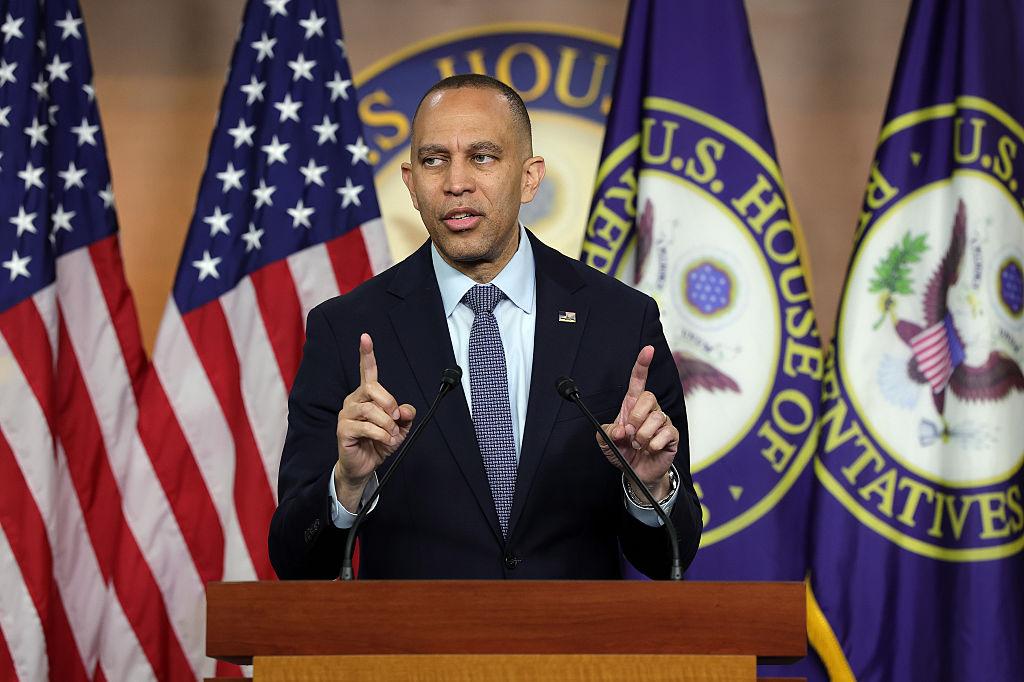
Barack Obama’s election in 2008 represented an extraordinary achievement in American political history. Kamala Harris’s election as vice president in 2020 broke another formidable barrier. And Hakeem Jeffries could soon become the first Black speaker of the House.
These accomplishments carry genuine historical significance. They also raise a difficult distinction between descriptive representation, which concerns who holds power, and substantive representation, which concerns what policies those officials advance.
The presence of Black officials does not automatically guarantee support for every policy advocated by Black constituencies. Nor should their achievements be dismissed simply because particular legislative goals remain unfinished.
Nevertheless, critics argue that Democrats have often emphasized the symbolism of racial progress without making lineage-based reparations a central, binding party commitment.
Reparations Remain an Unfinished Promise
Congress has repeatedly considered H.R. 40, legislation establishing a commission to study slavery’s continuing effects and develop reparations proposals. Representative Ayanna Pressley introduced the measure again in January 2025, while Representative Summer Lee and other lawmakers supported a separate resolution recognizing a federal obligation to provide reparations.
These efforts demonstrate that some Democrats have made explicit commitments to reparative justice. What remains absent is an enacted federal reparations program or a unified Democratic commitment to direct compensation for eligible descendants of American slavery.
For Freedmen reparations advocates, this distinction matters enormously. They argue that broad diversity initiatives, general anti-poverty programs, and symbolic recognition cannot necessarily remedy specific historical injuries tied to slavery, Jim Crow, redlining, and discriminatory federal policy.
The opposing argument emphasizes the legal, financial, and administrative challenges of determining eligibility and implementing compensation, alongside disagreement over whether broader economic programs would produce more equitable outcomes.
Those questions remain unresolved, and congressional leadership has not established a comprehensive reparations package as a central legislative priority.
What About an Anti-Black Hate Crime Bill?
The demand for a specifically anti-Black hate crime bill raises another issue.
Federal hate crime laws already protect victims targeted because of race, including Black Americans. The 2009 Matthew Shepard and James Byrd Jr. Hate Crimes Prevention Act expanded federal enforcement authority.
However, advocates for a more targeted law argue that Congress should consider additional measures addressing anti-Black violence, intimidation, underreporting, victim protection, and accountability for failures to investigate racially motivated offenses.
Such a proposal would need to establish precisely what existing law fails to address and how new federal powers or resources would improve enforcement.
A dedicated bill could be one approach. Strengthening existing statutes, improving federal data collection, and increasing enforcement funding are alternatives that lawmakers could also consider.
The Difference Between Representation and Results
The Democratic Party’s relationship with Black voters extends well beyond reparations. Democratic administrations and congressional lawmakers have supported civil rights enforcement, healthcare expansion, anti-discrimination protections, and economic programs that affect Black communities.
Those achievements complicate any claim that the party has delivered nothing.
Yet the absence of a federal reparations program remains a substantial and distinct criticism. Economic policies that benefit millions of Americans are not necessarily equivalent to remedies specifically designed for descendants of people enslaved under American law.
The distinction also matters politically. Black Americans are not a single-issue voting bloc, and support for reparations does not automatically translate into agreement about eligibility, payment structures, or legislative strategy.
Still, supporters of a defined Black agenda argue that a party capable of making historic representation a central campaign message should be equally willing to explain its legislative position on these unresolved questions.
A New Congress, an Old Question
Democrats’ 2026 victory gives them new control over congressional committees, hearings, and legislative scheduling when the next Congress convenes in January 2027. President Donald Trump will remain in office, however, and Senate procedural rules could complicate passage of major legislation.
That political reality does not prevent lawmakers from introducing proposals, holding hearings, debating their merits, or recording votes.
The coming Congress will therefore provide a clearer measure of how Democrats intend to approach reparations and anti-Black hate crime legislation. Supporters can examine which bills receive hearings, which proposals leadership endorses, and whether those measures advance beyond symbolic resolutions.
America’s historic firsts deserve recognition. But the debate over reparations and targeted civil rights protections illustrates why political representation and legislative outcomes must be evaluated separately.
Making history by winning office is one achievement. Changing federal law is another.
—Barrington Williams, B1Daily





Leave a Reply