—Barrington Williams, B1Daily
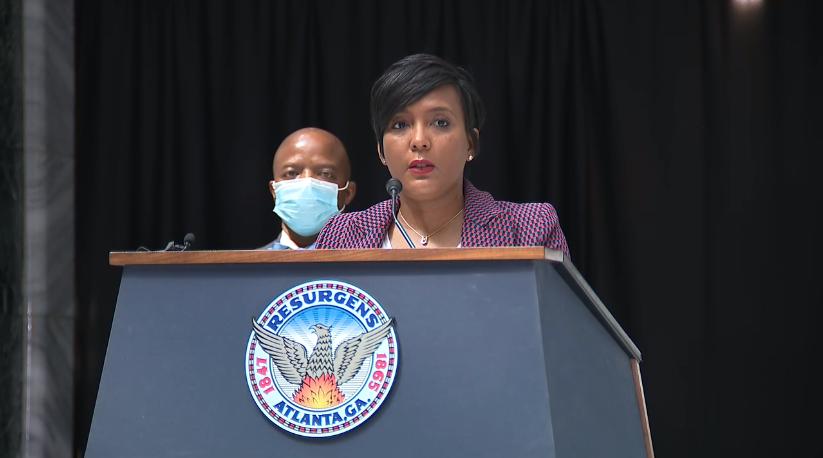
Keisha Lance Bottoms entered City Hall in January 2018 carrying the hopes of a city whose political identity had been shaped by generations of Black leadership. Her election was celebrated as another milestone in Atlanta’s history as a center of Black political and economic power.
But by the time she announced in May 2021 that she would not seek reelection, her administration had become the subject of fierce criticism over policing, violent crime, public safety, and its relationship with Atlanta’s neighborhoods.
For critics who believed Bottoms had promised a more responsive city government, her departure raised a painful question: What happens when a mayor becomes a national political figure while her constituents are still waiting for answers at home?
Rayshard Brooks and the Crisis of Police Accountability
On June 12, 2020, Atlanta police officer Garrett Rolfe fatally shot 27-year-old Rayshard Brooks outside a Wendy’s restaurant.
The killing occurred amid nationwide demonstrations following George Floyd’s murder and intensified demands for police accountability in Atlanta.
Bottoms responded by calling for Rolfe’s termination and accepting the resignation of Police Chief Erika Shields. Rolfe was subsequently charged, although prosecutors later dismissed the charges after concluding that the use of force was legally justified.
The Atlanta Civil Service Board also reversed Rolfe’s dismissal because the city had not afforded him adequate procedural protections.
For police reform advocates, the episode exposed the limitations of reacting to a highly publicized killing without achieving durable changes to departmental accountability.
Bottoms defended her response, arguing that swift action was necessary during a period of extraordinary unrest. Her critics questioned whether the administration had developed a sufficiently consistent strategy for reforming policing before the crisis erupted.
The result was a city divided between demands for stronger accountability and concerns about the stability of its police department. The Washington Post
The Death of Secoriea Turner
The tragedy that most sharply exposed Atlanta’s public safety crisis came weeks later.
Eight-year-old Secoriea Turner was fatally shot while riding in a vehicle near the Wendy’s where Brooks had been killed.
Armed individuals had erected barricades around the area, and authorities later described serious criminal activity near the protest site.
Secoriea’s death devastated her family and raised urgent questions about why the city had not restored safe access to the neighborhood sooner.
Bottoms subsequently acknowledged that she would have acted differently if doing so could have saved the child’s life.
The killing also illustrated the competing obligations confronting city leaders. Residents had a right to protest police violence, while families living and traveling through the neighborhood had an equally urgent right to safety.
For critics, the episode demonstrated the consequences of delayed intervention. For Bottoms, it became one of the most painful events of her administration. ajc
A Crime Crisis That Exposed Deep Divisions
Atlanta’s violent crime rose sharply during the COVID-19 pandemic, with homicides reaching 157 in 2021, the highest annual total in decades.
The violence affected neighborhoods already confronting poverty, disinvestment, and strained relationships with law enforcement.
Bottoms frequently described the surge as part of a nationwide pandemic-era crime wave. That explanation had merit: violent crime increased in numerous American cities during the same period.
But local critics argued that national trends did not absolve Atlanta’s leadership of responsibility for developing an effective response.
Former City Council member Howard Shook publicly accused the administration of offering insufficient solutions while residents demanded action.
The dispute exposed a difficult political reality: Black Atlanta was not united behind a single approach to public safety. Some residents demanded stronger police accountability and reduced enforcement budgets. Others wanted more officers, faster emergency responses, and immediate action against shootings.
Bottoms attempted to navigate both demands, but her administration struggled to satisfy either constituency. ajc
Cop City: The Controversial Legacy She Left Behind
One of the most enduring controversies associated with Bottoms’ administration was the proposed Atlanta Public Safety Training Center, later dubbed Cop City by opponents.
In September 2021, the City Council approved leasing 85 acres of city-owned land to the Atlanta Police Foundation for a training complex originally estimated to cost $90 million.
Bottoms supported the project, arguing that modern training facilities would improve officer preparation, recruitment, retention, and community relations.
Opponents objected to the environmental impact, the involvement of a privately funded police foundation, and the decision to expand police infrastructure during a period of intense demands for reform.
The council heard approximately 17 hours of public comment before approving the proposal 10–4, with much of the testimony opposing construction.
For critics, the decision represented a failure to meaningfully incorporate community objections. Supporters maintained that Atlanta needed modern facilities for police and firefighters.
The controversy continued long after Bottoms left office, becoming a defining dispute over policing, environmental protection, and local democracy. Atlanta, GA+1
The National Spotlight and the Decision to Leave
As Atlanta confronted these crises, Bottoms’ national political profile continued to grow.
Her criticism of Donald Trump, response to the pandemic, and public statements during racial justice demonstrations made her a prominent Democratic voice.
She was considered for a position on Joe Biden’s 2020 presidential ticket and became an important ally of his administration.
Some Atlanta officials questioned whether her increasing national visibility had come at the expense of attention to local government.
Then, in May 2021, Bottoms announced that she would not seek a second mayoral term, despite having already launched a reelection campaign.
She rejected suggestions that she was fleeing political difficulties, explaining that she had chosen to move forward after an extraordinarily demanding four years.
Her departure nevertheless left Atlanta voters without the opportunity to decide whether she should continue governing the city.
For residents frustrated by unresolved public safety problems, that decision became an enduring part of her political legacy. ajc
Her Record Was More Complicated Than the Criticism
Bottoms’ administration also pursued initiatives that complicate the argument that she simply neglected Atlanta.
She challenged Georgia Governor Brian Kemp over pandemic restrictions, supported criminal justice reforms, and worked to expand affordable housing initiatives.
Her supporters credit her with navigating an unprecedented combination of public health emergencies, civil unrest, and political conflict.
Former Atlanta mayor Andrew Young defended her leadership, emphasizing the extraordinary circumstances confronting the city.
And although critics were vocal, polling near the end of her term found that many Atlanta residents still viewed her favorably.
The evidence therefore supports a more complicated conclusion than universal public rejection: Bottoms faced serious criticism over specific decisions, but she retained meaningful political support. ajc
Now Georgia Has Given Her Another Chance
On November 3, 2026, Bottoms defeated Republican Rick Jackson to become Georgia’s governor-elect, making history as the first Black woman elected governor of a U.S. state.
Her victory marked a dramatic political comeback and ended more than two decades of Republican control of Georgia’s governorship.
During the campaign, Bottoms emphasized expanding Medicaid, improving economic opportunities, increasing public-sector pay, and addressing housing and infrastructure concerns.
Her opponents repeatedly raised her mayoral record, particularly Atlanta’s violent crime surge and her decision not to seek reelection.
Georgia voters ultimately elected her despite those criticisms.
That result does not erase the controversies of her mayoral administration. Nor does it establish that every criticism of her leadership was justified.
Instead, it places those unresolved debates in a new context: a former mayor whose record remains contested will soon exercise authority over an entire state. Reuters+1
Black Atlanta’s Unfinished Questions
The lasting questions about Bottoms’ mayoral tenure concern whether her administration responded effectively to residents’ needs during overlapping emergencies.
Could the city have acted sooner to secure the area where Secoriea Turner was killed? Did its police reform initiatives produce lasting improvements? Was the public adequately consulted before the training center received approval? And did national political responsibilities compete with the demands of governing Atlanta?
These questions deserve scrutiny without assuming that every adverse outcome was within the mayor’s control.
For Black Atlantans, the stakes were never merely about the political reputation of a prominent Democratic figure. They involved neighborhood safety, police accountability, public investment, and trust in local government.
Bottoms now enters the governor’s office with an opportunity to address many of those same concerns on a larger scale.
Her historical achievement is undeniable. The controversies surrounding her Atlanta administration are also part of the record.
Whether Georgians ultimately view her return to executive office differently will depend on the decisions she makes and the measurable results her administration delivers.
—Barrington Williams, B1Daily


Leave a Reply