—Josh Allen, B1Daily
America used to be a country where a young man could graduate from high school, walk into a factory, learn a trade, and earn enough money to buy a house, raise children, and eventually retire with a pension. He didn’t necessarily need a college degree, a mountain of student debt, or three side hustles just to survive.
That economic pathway has become increasingly difficult to find.
The United States once employed nearly 20 million manufacturing workers. Today, that number is closer to 13 million, even as the country’s population and economy have grown substantially.
According to the Bureau of Labor Statistics, manufacturing employment peaked at 19.6 million in 1979. By 2019, the industry had already shed approximately 6.7 million positions. The decline continued to reshape entire communities, particularly across the Midwest and Northeast.
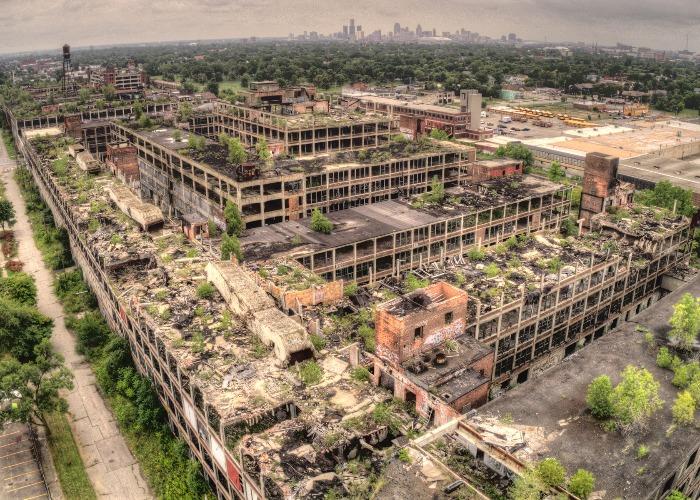
Factories that once supported generations of working-class families became abandoned warehouses, vacant lots, or distant memories.
The consequences extended beyond lost paychecks. Manufacturing employment had helped sustain homeownership, union membership, local businesses, and economic independence for millions of American men.
And while America’s economy grew wealthier, many of the communities that built its industrial foundation were left struggling to replace what disappeared. Bureau of Labor Statistics
The Great American Factory Exodus
Beginning in the late twentieth century, American manufacturers increasingly moved production to countries offering lower labor costs.
China, Mexico, and other manufacturing economies became attractive destinations for companies seeking cheaper production and access to international supply chains.
Trade liberalization accelerated the process. China’s entry into the World Trade Organization in 2001 intensified competition for American factories already confronting decades of industrial restructuring.
Communities built around steel, automobiles, machinery, furniture, and textiles suffered substantial employment losses.
The damage was especially severe in towns where a single major employer supported much of the local economy.
When a factory closed, workers lost their jobs. Restaurants lost customers. Property values suffered. Municipal tax revenues declined, making it harder to maintain schools, roads, and public services.
The economic damage often persisted long after the corporate executives responsible for relocation had moved on.
However, offshoring was not the only cause. Automation, changing consumer demand, recessions, and improvements in production efficiency also reduced the number of workers needed to manufacture goods.
America did not simply stop producing things. It increasingly produced goods with fewer workers while shifting portions of its industrial supply chain overseas.
The Working-Class Man Became Economically Disposable
Manufacturing once provided an important route into the middle class for men without four-year college degrees.
A factory worker could earn a competitive wage, obtain employer-sponsored health insurance, join a union, and develop skills that remained valuable throughout his career.
Those opportunities were especially important for workers who preferred practical, technical, and physically demanding occupations over university education.
As manufacturing employment declined, many displaced workers moved into retail, warehousing, food service, transportation, and other industries that did not always offer comparable compensation or benefits.
A September 2026 analysis from the Federal Reserve Bank of Cleveland found that manufacturing’s historical wage advantage has eroded, particularly for workers with less formal education.
The report also found that manufacturing’s share of American employment fell from approximately 25% in 1976 to roughly 10% by June 2025.
The workforce itself changed dramatically. In 1976, almost 80% of manufacturing workers lacked a college degree. By June 2025, that figure had fallen to approximately 39%.
For younger men without college credentials, the traditional factory-to-middle-class pipeline has become considerably narrower. Cleveland Federal Reserve
America Still Manufactures, but Its Industrial Capacity Has Serious Gaps
The manufacturing crisis is not simply about the number of factories operating. It also concerns what America can produce domestically, how quickly production can expand, and whether critical industries depend on foreign suppliers.
The United States remains a major manufacturer of aircraft, pharmaceuticals, machinery, chemicals, and advanced technology. Yet domestic production capacity is uneven, particularly in sectors such as electronics, semiconductor supply chains, and certain industrial components.
The COVID-19 pandemic exposed those weaknesses when shortages of protective equipment, medical supplies, and computer chips disrupted American businesses.
The problem is especially important for national security. A country that depends heavily on overseas suppliers for critical components can face serious vulnerabilities during wars, trade disputes, and international emergencies.
Federal Reserve data released in October 2026 showed that manufacturing output increased 0.3% in September. Overall industrial capacity utilization stood at 76.9%, below its long-run average.
That distinction matters. America has unused industrial capacity, but idle machinery cannot automatically manufacture products requiring different equipment, specialized suppliers, and skilled labor. Choose
Wall Street’s Priorities Were Not Always America’s Priorities
Corporate executives have frequently justified outsourcing through efficiency, shareholder returns, and lower consumer prices.
Those benefits are real. International trade can reduce production costs and make goods more affordable.
But the economic calculation looks different from the perspective of a 45-year-old machinist whose factory relocates overseas.
For shareholders, a factory closure may improve quarterly earnings. For the surrounding community, it can mean unemployment, declining property values, and decades of economic uncertainty.
American industrial policy has often struggled to reconcile those competing interests.
Successive Republican and Democratic administrations supported trade agreements, globalization, and market-oriented economic policies. Both parties have also pursued measures intended to protect or rebuild domestic manufacturing.
The central question is whether economic policy should evaluate corporate profitability alone or also account for employment, domestic production capabilities, and the long-term health of industrial communities.
Black Working-Class Men Lost Opportunities, Too
The decline of American manufacturing also had profound consequences for Black communities.
In cities such as Detroit, Chicago, Cleveland, and Baltimore, industrial employment once offered Black men opportunities to earn middle-class wages despite discrimination elsewhere in the labor market.
Unionized automobile plants, steel mills, and other industrial employers provided income that helped families purchase homes and build wealth.
These opportunities were never equally accessible. Black workers faced discriminatory hiring practices, occupational segregation, and unequal advancement.
Nevertheless, manufacturing represented an important source of economic mobility.
When factories closed or relocated, many Black neighborhoods lost major sources of stable employment.
The consequences compounded existing problems involving housing discrimination, underinvestment, and limited access to capital.
For Black American men already confronting barriers to economic opportunity, the disappearance of industrial employment removed another pathway toward financial independence.
Why Bringing Back Factories Doesn’t Automatically Bring Back Jobs
Both political parties now discuss rebuilding American manufacturing.
The Biden administration pursued semiconductor subsidies, infrastructure investment, and clean-energy manufacturing incentives. The Trump administration has emphasized tariffs, deregulation, energy production, and incentives for domestic investment.
These approaches differ considerably, but both reflect renewed recognition that domestic production matters.
Still, a new factory does not necessarily recreate the employment opportunities of 1979.
Modern manufacturing facilities use robotics, computer-controlled machinery, artificial intelligence, and sophisticated automation.
A plant that once required thousands of employees may now produce comparable output with a much smaller workforce.
The Cleveland Fed’s 2026 research also identified a troubling development: younger workers have become less likely to enter manufacturing, while employers continue reporting difficulties finding qualified employees.
That means rebuilding manufacturing requires more than constructing buildings. It requires technical education, apprenticeships, competitive wages, and career pathways that do not automatically demand four-year degrees.
America Needs an Industrial Strategy That Rebuilds the Middle Class
A meaningful manufacturing revival would require sustained investment in domestic supply chains, vocational education, modern infrastructure, and strategically important industries.
It would also require stronger connections between industrial investment and workers’ economic security.
Taxpayer-supported factories should be evaluated not only by how much they produce, but also by the quality of employment they create.
Manufacturing policy should encourage companies to establish apprenticeship programs, train workers without college degrees, and provide wages that support homeownership and family formation.
At the same time, policymakers must recognize that tariffs and subsidies have costs. Import restrictions can increase prices for consumers and domestic manufacturers, while poorly designed incentives can transfer public money to corporations without delivering lasting economic benefits.
The objective should not be to recreate every factory job from the 1970s. It should be to establish a modern industrial economy that provides comparable opportunities for financial independence.
A Nation Cannot Rebuild Its Middle Class With Slogans
America’s manufacturing decline represents more than an economic statistic. It marks the weakening of an employment system that once helped millions of working-class families build stable lives.
Manufacturing was never exclusively a male occupation, and women also suffered when industrial jobs disappeared. But the decline was particularly consequential for men without college degrees who had historically depended on factory employment.
Today, those workers are frequently told to retrain, relocate, attend college, or adapt to an economy that offers fewer comparable opportunities.
Some successfully make those transitions. Others face significant financial and personal obstacles.
The United States remains capable of extraordinary industrial production. Its challenge is ensuring that manufacturing strength translates into broad economic opportunity rather than simply higher output and corporate earnings.
Rebuilding factories without rebuilding middle-class careers would leave much of the original problem unresolved.
America does not merely need more products stamped “Made in USA.” It needs an industrial economy in which the Americans making those products can afford to live in the country that produces them.
—Josh Allen, B1Daily





Leave a Reply