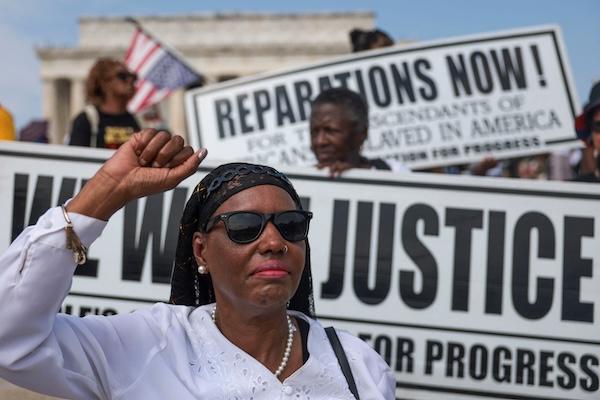
—Barrington Williams, B1Daily
America has a remarkable talent for remembering slavery while avoiding the bill.
The country acknowledges that millions of enslaved Black Americans were forced to work without compensation. It recognizes that Jim Crow laws, discriminatory housing policies, and government-backed exclusion from economic opportunities helped prevent their descendants from accumulating wealth. Yet the moment reparations enter the conversation, suddenly everyone becomes a constitutional scholar, a budget hawk, or an enthusiastic defender of individual responsibility.
The central question is not whether every opponent of reparations harbors racial hatred. That accusation would be impossible to establish and intellectually lazy. The more serious question is whether opposition to compensating American Freedmen helps preserve an economic system in which the consequences of historical racial discrimination remain profoundly unequal.
And that question deserves considerably more attention than another tired lecture about pulling oneself up by the bootstraps.
America Inherited the Wealth. Freedmen Inherited the Debt.
Slavery was not simply an episode of racial cruelty. It was an economic institution that transferred the value of enslaved people’s labor to slaveholders, businesses, and an expanding national economy.
Emancipation ended legal ownership of human beings, but it did not provide formerly enslaved families with compensation for generations of stolen labor. Subsequent discriminatory policies further restricted Black Americans’ ability to acquire property, obtain credit, and pass wealth to their descendants.
Those consequences remain visible in the nation’s balance sheet.
According to the Federal Reserve’s 2022 Survey of Consumer Finances, the median white family possessed approximately $285,000 in wealth, compared with just $44,900 for the median Black family.
That is a difference of roughly $240,000.
The figures do not mean every white family inherited slavery-derived wealth or that every Black family experienced identical losses. They do demonstrate that substantial racial disparities in accumulated assets persist.
And accumulated assets matter. Wealth purchases homes, finances businesses, pays tuition, absorbs emergencies, and provides inheritances. Families with assets can make investments that families without them frequently cannot afford.
This is why the reparations debate cannot be reduced to whether people alive today personally participated in slavery.
The question concerns the continuing consequences of policies that distributed economic opportunities unequally across generations.
Does Opposing Reparations Protect an Inherited Advantage?
There is an uncomfortable economic reality behind the argument that reparations would unfairly benefit one group.
Refusing compensation does not erase the consequences of historical discrimination. It leaves the existing distribution of wealth largely undisturbed.
That does not establish that every opponent benefits personally from the racial wealth gap. Nor does it prove that opposition is necessarily motivated by racism.
But the practical effects of maintaining the status quo deserve examination.
When a government refuses to address documented economic injuries that it helped create, the burden of those injuries remains disproportionately concentrated among the people and descendants who experienced them.
The advantages accumulated through earlier access to property, credit, and investment opportunities can continue passing between generations.
In that sense, opposition to reparations can help preserve inherited economic disparities even when the stated objection is constitutional, fiscal, or philosophical.
The distinction between intention and consequence is essential.
A policy position can have racially unequal consequences without every person supporting it being motivated by racial hostility. Equally, concerns about those consequences should not be dismissed merely because the policy’s defenders claim race-neutral intentions.
The Constitution Is Not a Substitute for an Economic Argument
Opponents frequently contend that lineage-based reparations would violate the Constitution’s guarantee of equal protection.
That objection cannot simply be brushed aside.
Supreme Court decisions, including City of Richmond v. J.A. Croson Co. and Adarand Constructors v. Peña, establish demanding constitutional scrutiny for government classifications based on race.
A reparations program explicitly distributing benefits according to race would face substantial legal challenges.
But lineage-based compensation presents a more specific question.
A program designed to compensate descendants of people enslaved under American law could potentially use documented ancestry and historical injury as eligibility criteria rather than present-day racial identity alone.
Such an approach would recognize that reparations are intended to address a particular historical wrong, not distribute benefits to everyone who shares a racial classification.
That distinction could strengthen the legal justification for a program, but it would not automatically make the legislation constitutional. Courts could still examine whether ancestry functions as a racial classification and whether the remedy satisfies applicable constitutional requirements.
The legal questions are real. They are also questions that lawmakers can investigate, debate, and attempt to resolve rather than treating constitutional uncertainty as a reason to abandon the subject altogether.
Reparations Are Not Charity
Perhaps the most persistent misunderstanding surrounding reparations is the suggestion that descendants of slavery are asking the government for a charitable handout.
Compensation for a documented injury is conceptually different from public assistance.
Governments regularly establish compensation programs for identifiable harms, including wrongful imprisonment, unlawful property seizures, and other forms of official misconduct.
The central issues are whether a legally recognizable injury occurred, who bears responsibility, who qualifies for compensation, and how an appropriate remedy should be calculated.
For Freedmen reparations, those questions are complicated by the passage of time, the scale of slavery, subsequent discrimination, and the difficulty of measuring cumulative economic losses.
But complexity is not the same thing as impossibility.
Congress has repeatedly been asked to study these issues through H.R. 40, legislation proposing a federal commission to examine slavery, subsequent discrimination, and possible reparative remedies.
A separate proposal introduced in 2026, the Land Reparations Commission Act, specifically addresses land reparations for descendants of enslaved Americans.
Neither proposal establishes an enacted nationwide compensation program. Both demonstrate that lineage-based remedies can be considered through concrete legislative mechanisms rather than slogans.
What Would Genuine Economic Repair Look Like?
Reparations advocates disagree about the appropriate structure of compensation.
Some support direct payments to eligible descendants of American slavery. Others propose combinations of housing assistance, land restoration, business capitalization, educational investment, and institutional development.
Each approach raises difficult questions.
Direct payments could provide households with immediate financial assets, but their long-term effect would depend on the amounts distributed and subsequent economic conditions. Housing initiatives could expand ownership but might also face supply constraints. Business grants could encourage entrepreneurship while requiring safeguards against waste and favoritism.
A serious federal proposal would need clear eligibility standards, transparent administration, credible estimates of historical injury, and mechanisms for evaluating outcomes.
It would also need to explain whether its objective is individual compensation, narrowing the racial wealth gap, repairing specific government harms, or some combination of those goals.
Those distinctions matter because even a substantial reparations program would not necessarily eliminate every racial wealth disparity.
Economic justice requires more than a dramatic announcement and a ceremonial signing pen.
The Question Opponents Still Have to Answer
The strongest objections to reparations concern constitutional limits, fairness to people who did not personally commit historical wrongs, the difficulty of determining eligibility, and the financial obligations imposed on taxpayers.
Those arguments deserve serious engagement.
But opponents should also explain what alternative remedy, if any, they support for the economic consequences of slavery and subsequent government discrimination.
If the answer is simply that the past cannot be changed, that response overlooks the fact that economic consequences can persist long after the original injustice ends.
If the answer is that ordinary economic growth will eventually close the gap, the continued magnitude of wealth disparities demands an explanation of how that outcome would occur.
And if the answer is that no compensation should ever be considered, then the position is not merely an objection to one particular reparations proposal. It is opposition to using compensation as a remedy for those historical injuries.
That is a legitimate position to debate, but its consequences should be examined openly.
Is Opposition to Reparations Anti-Black?
Not automatically.
Racism concerns beliefs, actions, or systems involving racial prejudice or discrimination. Opposition to a particular reparations proposal, by itself, does not establish an individual’s motives.
But arguments against reparations can become racially prejudiced when they rely on stereotypes about Black Americans, deny documented historical discrimination, or apply standards of responsibility inconsistently depending on who suffered the harm.
The more consequential issue is institutional.
A country can condemn historical injustice while declining to repair its continuing economic consequences. That contradiction deserves scrutiny regardless of the personal motives of individual voters.
The uncomfortable truth is that refusing reparations does not create a neutral economic starting line. It leaves families competing with assets and disadvantages accumulated under profoundly unequal historical conditions.
America does not have to accept every proposed reparations program. It does, however, owe the descendants of people it enslaved a serious accounting of the injuries inflicted, the wealth denied, and the remedies that remain possible.
Because acknowledging a debt while refusing even to calculate it is not a particularly convincing definition of justice.
—Barrington Williams, B1Daily





Leave a Reply