—Sylvester Loving, B1Daily
Black America has never suffered from a shortage of educated, influential, or politically connected individuals. It has produced attorneys, physicians, corporate executives, university presidents, and politicians who occupy some of the nation’s most prestigious institutions.
Yet despite generations of Black professional advancement, the racial wealth gap remains enormous.
This contradiction raises uncomfortable questions about the responsibilities of Black America’s elite institutions, including Sigma Pi Phi, commonly known as the Boulé.
Founded in Philadelphia in 1904, Sigma Pi Phi is the nation’s oldest Black Greek-letter fraternity. Its invitation-only membership has historically included accomplished Black professionals, corporate figures, and individuals holding influential political positions.
The organization’s exclusivity has contributed to its reputation as an influential network within Black professional society.
But influence and accountability are not interchangeable.
If Black America’s most accomplished individuals possess access to powerful institutions, how much of that influence is being directed toward closing the economic divide separating Black Americans from white Americans?
The Boulé: A Brotherhood of Black Influence
Unlike traditional collegiate fraternities, Sigma Pi Phi was established as a professional organization for accomplished Black men.
Its members, known as Archons, participate in a network emphasizing intellectual development, professional achievement, fellowship, and community service.
The organization reports thousands of members across more than 100 local chapters. Its charitable foundation supports educational opportunities and leadership development.
Those activities are significant, but they also invite examination of the difference between philanthropy and structural economic reform.
Scholarships can help individual students obtain degrees. Mentorship can create professional opportunities. Charitable contributions can strengthen community organizations.
However, none of those initiatives independently resolves the racial wealth gap.
The Boulé’s institutional history illustrates a larger question about elite Black organizations: whether they should measure their success primarily through the accomplishments of individual members or through broader improvements in Black economic conditions.
Black Political Access Is Not the Same as Black Political Power
For decades, Black Americans have watched prominent Black professionals enter political and corporate institutions while the economic circumstances of many Black households remain precarious.
Black elected officials have gained influence within both major political parties. Black executives have entered corporate boardrooms. Black academics have achieved national recognition.
Yet the Federal Reserve’s 2022 Survey of Consumer Finances found that median white family wealth stood at approximately $285,000, compared with just $44,900 for Black families.
The figures reveal a profound economic disparity that cannot be explained simply by individual educational attainment or professional ambition. Federal Reserve+1
That disparity is not proof that the Boulé caused the wealth gap or deliberately maintained it. The organization does not control federal economic policy, and there is no established evidence that it secretly directs Black voters or coordinates political manipulation.
Nevertheless, the gap provides a legitimate basis for questioning the effectiveness of elite-centered approaches to Black advancement.
Political access should produce more than invitations to prestigious events and opportunities for individual advancement.
It should create measurable benefits for the communities that prominent leaders claim to represent.
Has Elite Representation Become a Substitute for Economic Reform?
One criticism of Black establishment politics is that representation has increasingly become an achievement celebrated independently of material results.
The election of another Black official becomes a milestone. The appointment of another Black corporate executive becomes a symbol of progress. The inclusion of another Black professional in an influential organization becomes evidence that barriers are disappearing.
Those accomplishments matter, particularly given the historical exclusion of Black Americans from political and economic institutions.
But they do not automatically translate into higher homeownership rates, stronger Black-owned businesses, greater household savings, or expanded access to investment capital.
A wealthy Black executive and a working-class Black family may share a racial identity while occupying dramatically different economic positions.
Their interests can overlap without being identical.
This creates a responsibility for elite institutions to explain how their influence benefits people who will never receive an invitation to join their networks.
The Question of Reparations and the Freedmen Wealth Gap
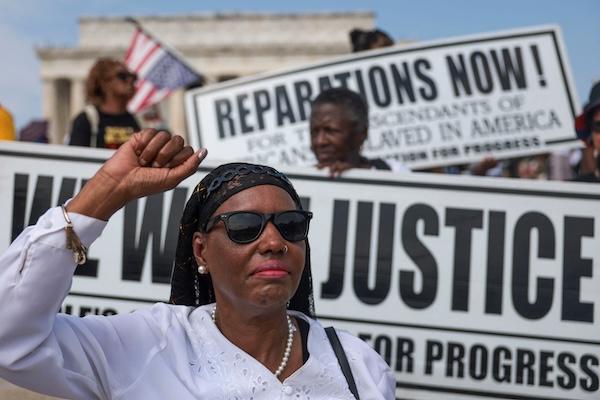
Perhaps the most consequential test of Black political leadership concerns reparations for descendants of American slavery.
For advocates of Freedmen-specific reparations, the racial wealth gap reflects generations of government-sanctioned exclusion from landownership, financial institutions, federal benefits, and opportunities to accumulate wealth.
Addressing that history requires more than scholarships, mentorship programs, or corporate diversity initiatives.
It requires serious consideration of policies designed to repair documented historical economic harms.
These could include federal reparations legislation, targeted housing assistance, business capitalization programs, land restoration initiatives, and mechanisms addressing discriminatory lending.
Different approaches would involve substantial legal, financial, and administrative questions. Their effectiveness would need to be evaluated rather than assumed.
The Boulé does not publicly present itself as a national reparations lobbying organization, and its charitable mission differs from that of a political advocacy group.
Nevertheless, its influential membership creates a reasonable question: How could prominent Black professional networks contribute to substantive policy discussions about reparative economic justice?
Philanthropy Is Not a Replacement for Structural Change
The Boulé Foundation reports that its endowment exceeds $35 million and that it has distributed more than $25 million in grants over its history.
Those contributions represent real investments in education and community development. They should not be dismissed simply because the racial wealth gap persists.
But philanthropy and economic transformation operate at different scales.
A scholarship may help a student enter the professional class. A structural housing policy could affect hundreds of thousands of families. A community grant may support a nonprofit, while sustained changes in lending and procurement could expand economic opportunities across entire industries.
The challenge for elite organizations is determining how charitable investments can complement, rather than substitute for, broader institutional reform. Sigma Pi Phi
Black Leadership Must Be Accountable to Black Communities
The Boulé’s history reflects the achievements of Black professionals who overcame substantial racial barriers.
Its members’ accomplishments deserve recognition.
But neither professional achievement nor racial identity should exempt influential institutions from public scrutiny.
Black communities have legitimate reasons to ask whether their most prominent leaders support policies addressing household wealth, affordable housing, business ownership, educational opportunity, and economic independence.
Those questions should be directed not only toward the Boulé, but also toward elected officials, civil rights organizations, corporate leadership networks, universities, and political advocacy groups.
The standard should be consistent: What resources are being invested, what policies are being advanced, and what measurable outcomes are being achieved?
Without those measures, public celebrations of Black advancement risk overlooking the communities still excluded from its benefits.
Black America Needs Institutional Power, Not Just Powerful Individuals
The fundamental challenge facing Black American leadership is not the existence of wealthy or influential Black individuals.
It is the distance between individual success and collective economic advancement.
Organizations such as Sigma Pi Phi have opportunities to use their professional networks to support entrepreneurship, research, education, and economic development.
Whether those efforts translate into broad, lasting progress is a question that deserves public examination.
Black Americans do not simply need more influential people who happen to be Black. They need institutions capable of translating influence into durable economic opportunities, political accountability, and measurable reductions in inequality.
For the Boulé and the wider Black professional establishment, that is a far more demanding measure of leadership than prestige alone.
—Sylvester Loving, B1Daily



Leave a Reply