–Marcus Davis, B1Daily
Somebody needs to tell Hollywood that just because you keep calling somebody a generational talent doesn’t mean the rest of us have to agree.
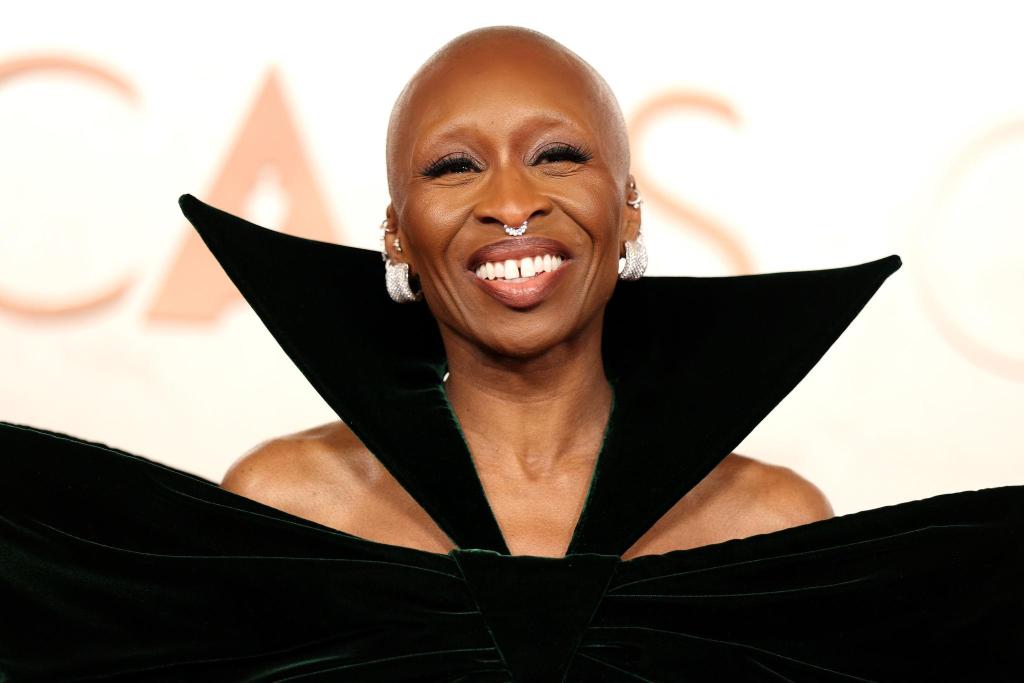
And that brings us to Cynthia Erivo.
Now, before the Wicked fan club starts throwing broomsticks, let’s get something straight: Sis can sing. Nobody’s disputing that. The woman has lungs, range, and enough vocal power to shake the paint off a theater ceiling.
But acting? Baby, that’s a whole different conversation.
Erivo has mastered the art of looking intensely distressed while delivering every other line like she’s auditioning for a Tony Award in the middle of a hostage negotiation. The trembling lips, the dramatic pauses, the thousand-yard stares. Girl, we get it. You’re experiencing an emotion.
Will someone get this bald-headed wench out of here!?
Sorry. Sometimes I tend to get carried away.
But sometimes, less really is more.
Hollywood keeps presenting Erivo as the second coming of theatrical greatness, but some of these performances feel like somebody forgot to tell her the camera can pick up subtle facial expressions.
Not every scene needs to be somebody’s Broadway finale.
Black American Actresses Are Right There, Hollywood!
Here’s where things get especially irritating.
Hollywood has an entire roster of talented Black American actresses who have spent decades perfecting their craft, only to watch the industry act like finding a qualified Black woman is some kind of international scavenger hunt.
Viola Davis? Right there.
Regina King? Right there.
Angela Bassett? Been right there.
Taraji P. Henson? Still right there.
And that’s before we even get into the younger generation of Black American actresses who barely get an opportunity to audition for substantial leading roles.
Yet somehow, when Hollywood needs somebody to portray a major figure from Black American history, the casting department starts checking international flight schedules.
Remember Harriet?
Erivo, a British actress, was selected to portray Harriet Tubman, one of the most significant figures in Black American history.
Now, can British actors play Americans? Of course. Acting is acting.
But Black Americans are allowed to ask why our own historical figures so frequently become opportunities for everybody except the people whose communities produced those stories.
We can’t even get first dibs on our own ancestors?
Hollywood, please explain the math.
Is Hollywood Shopping in the Discount Aisle?
Then there’s the money question.
Is Hollywood choosing performers like Erivo because they’re potentially cheaper than established Black American actresses who have the résumés, industry experience, and bargaining power to demand serious compensation?
We don’t have verified salary comparisons proving that’s why Erivo gets hired, so we’re not going to pretend somebody slipped us the studio payroll.
But the broader question is worth asking.
Hollywood has a documented history of undervaluing Black actresses, and Taraji P. Henson has publicly discussed the exhausting negotiations surrounding compensation in the industry.
So when studios overlook experienced Black American actresses, it’s fair to wonder whether the decision is always about artistic merit or whether economics sometimes enters the picture.
Because let’s be serious. Hollywood executives aren’t exactly known for waking up in the morning asking how they can pay actresses more money.
That said, Erivo’s casting in Wicked makes sense from a musical standpoint. Her Broadway credentials are formidable.
But that doesn’t mean every casting decision involving her should automatically receive a standing ovation.
An Award Collection Doesn’t Mean Everybody Has to Clap
Whenever somebody criticizes Erivo’s acting, her defenders start pulling out the awards like they’re presenting evidence in a federal courtroom.
She’s got a Tony! She’s got an Emmy! She’s got a Grammy! She’s been nominated for Oscars!
Okay, and?
Awards establish professional recognition. They do not establish that every performance is compelling or that every audience member must enjoy her acting style.
Some people love her theatrical intensity. Others find it exhausting.
For this critic, Erivo sometimes acts like she’s trying to convince the audience she’s acting rather than simply becoming the character.
It’s giving theater-kid energy at maximum volume.
And there’s nothing inherently wrong with theatrical acting. But when every emotional moment arrives wrapped in another layer of dramatic emphasis, the performance can start feeling more like an acting demonstration than a believable human experience.
Sis, we saw the emotion the first time. You don’t have to send a follow-up email.
Meanwhile, Black American Talent Is Still Waiting Outside
The bigger problem isn’t that Cynthia Erivo has a career.
Good for her. Get your money.
The problem is that Hollywood keeps talking about representation while maintaining an entertainment economy where Black American actresses still struggle to secure consistent leading roles, meaningful creative control, and compensation comparable to their peers.
The industry can find millions for marketing campaigns, elaborate premieres, and celebrity publicity operations, but somehow becomes financially cautious when it’s time to invest in original films centered on Black American women.
And when audiences question those priorities, they’re expected to accept whatever casting decisions the studios hand them.
No, ma’am.
Black American actresses deserve more than occasional historical biopics, supporting roles, and the same recycled trauma narratives.
They deserve opportunities to play complicated, funny, powerful, ordinary, glamorous, flawed, and fully realized characters.
Hollywood should be developing new stars instead of treating a handful of familiar names as the entire universe of Black female talent.
Hollywood Can Keep the Hype. We’ll Keep Our Opinions.
Cynthia Erivo is an accomplished performer. Nobody can erase her awards, her musical abilities, or the work she’s put into her career.
But accomplishments don’t make somebody immune to criticism.
If audiences think her acting is overrated, they’re allowed to say so. If Black American viewers want more Black American actresses portraying their own historical figures, they’re allowed to demand that too.
And if Hollywood wants us to believe every casting decision is made purely in the name of artistic excellence, then perhaps it should offer greater transparency about the financial and commercial considerations shaping those decisions.
Until then, the entertainment industry can stop acting surprised when viewers question the hype.
Because Hollywood might have decided Cynthia Erivo is everybody’s favorite actress.
But somebody forgot to ask everybody.
–Marcus Davis, B1Daily



Leave a Reply