—Kerry Hill, B1Daily
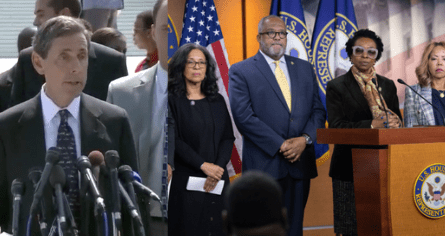
Ed Blum is back in the legal weeds again, filing yet another lawsuit that critics are calling a “nuisance suit” aimed squarely at the Congressional Black Caucus (CBC), reigniting a familiar political friction that refuses to cool down. And like clockwork, the reaction is less about surprise and more about exhaustion mixed with outrage.
Blum, long known for his involvement in high-profile affirmative action and voting-related litigation, is once again positioning himself as a challenger to what he frames as entrenched racial preference systems in American political life. His latest filing, however, has been met with sharp backlash from civil rights advocates who argue the case is less about legal principle and more about persistent legal harassment of Black political institutions.
The Congressional Black Caucus, for its part, is no stranger to political scrutiny. As one of the most visible blocs in Washington advocating for Black communities, it has been both celebrated and criticized across the ideological spectrum. Yet even among its critics, there is a noticeable line that many refuse to cross.

Grassroots sentiment is complicated but unusually unified on one point: frustration with establishment politics does not translate into support for repeated legal attacks perceived as targeting Black political representation. Even people who are openly skeptical of the CBC’s effectiveness tend to view Blum’s latest suit as another entry in a long pattern of courtroom activism that feels less like reform and more like provocation.
In community discussions, that distinction matters. There is a difference between disagreeing with the CBC’s strategies and endorsing what many perceive as targeted litigation aimed at weakening Black political influence. That gap is where public opinion sharpens. The grassroots may grumble about the CBC’s leadership and priorities, but it draws a firmer boundary when legal challenges appear to center race and representation in ways that feel adversarial rather than constructive.
Legal observers note that Blum’s litigation strategy often relies on challenging the constitutionality or fairness of race-conscious frameworks in public institutions. Supporters describe this as civil rights consistency. Critics describe it as repetitive courtroom pressure that keeps the same cultural and political debates on loop, with Black institutions frequently in the crosshairs.
What makes this moment particularly tense is the perception that America is once again stuck in a feedback loop where legal systems become battlegrounds for unresolved racial politics. The CBC stands as both a symbolic and functional target in that struggle, and Blum’s continued involvement ensures that the argument is far from over.
At the center of it all is a divided public response that refuses to align neatly. The grassroots skepticism toward elite Black political leadership exists, but it does not translate into enthusiasm for lawsuits that many interpret as adversarial toward Black representation itself. That tension is the real story beneath the headlines.
In the end, the lawsuit becomes more than just a legal filing. It becomes another flare shot into an already crowded sky of racial, political, and institutional conflict, where trust is thin and every move is read through decades of unfinished history.
—Kerry Hill, B1Daily





Leave a comment