—Travis Luyindama, B1Daily
Europe’s energy transition is entering its “giant batteries everywhere” phase.
In Belgium, engineering giant SPIE announced it will install 180 Tesla Megapack 3 battery systems for one of the country’s largest energy storage parks, a project that signals how rapidly Europe is moving toward utility-scale battery infrastructure to stabilize renewable-heavy power grids.
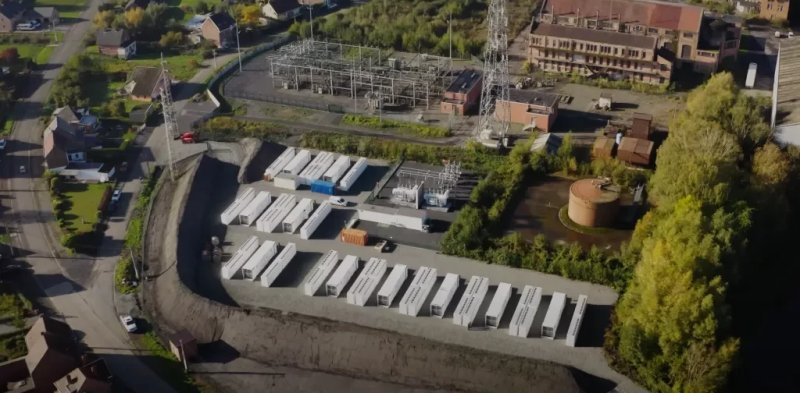
The project, located in Kluisbergen at the site of a former power plant, is being developed by Storm and will reportedly exceed €100 million in total value. Once completed, the site is expected to provide several hundred megawatt-hours of storage capacity, making it one of Belgium’s most significant battery energy storage systems, or BESS, currently under construction.
That may sound like dry infrastructure jargon until you understand what these giant battery parks actually represent.
This is not just a backup battery.
This is the electrical equivalent of turning the national grid into a rechargeable organism.
Modern renewable energy systems have a fundamental weakness: the sun and wind do not care when humans need electricity. Solar panels overproduce during bright midday hours. Wind farms spike unpredictably. Traditional power grids were designed around controllable fossil fuel generation, not intermittent renewable floods.
Battery storage changes the equation.
Tesla’s Megapack systems absorb excess renewable energy during periods of overproduction and then discharge electricity back into the grid during peak demand. In simple terms, the batteries act like shock absorbers for the electrical network, smoothing out volatility that would otherwise destabilize the grid.
The scale here is staggering.
A single Megapack 3 unit is roughly the size of a shipping container packed with lithium-ion cells, thermal management systems, power electronics, and grid software. Multiply that by 180 units and the result starts looking less like a battery installation and more like a digital power fortress humming beside the transmission network.
SPIE Belgium will handle the complete electrical integration of the project, including high-voltage cabling, transformers, substation construction, and direct integration into Belgium’s 380 kV transmission infrastructure.
That key detail matters because grid-scale batteries are becoming less about the batteries themselves and more about software, transmission engineering, and energy orchestration.
The real battlefield is no longer just generation.
It is grid intelligence.
Europe is increasingly betting that large-scale storage will become essential for surviving the continent’s energy transformation. As coal plants shut down and renewable penetration rises, countries need infrastructure capable of rapidly balancing fluctuating electricity flows in real time. Battery systems can react in milliseconds, dramatically faster than traditional gas peaker plants.
And Tesla is quietly becoming one of the dominant players in that future.
While most people still associate Tesla with electric vehicles, the company’s energy division has evolved into a colossal infrastructure business. Tesla Megapacks are now appearing in utility-scale projects across Europe, Australia, and North America as governments race to modernize aging grids.
The Belgian project also marks one of the first large-scale European deployments of Tesla’s newer Megapack 3 systems. According to SPIE, the updated generation offers higher energy density and more efficient integration into large-scale infrastructure environments.
That phrase “higher energy density” may sound technical, but it has massive implications. Better density means more energy can be stored in smaller physical footprints, reducing land requirements while improving overall efficiency. In the world of grid storage, that is the difference between a useful battery park and a transformative one.
The location itself is symbolic.
The battery facility is being built on the grounds of a former fossil fuel power plant, almost like Europe physically rewiring its industrial skeleton in real time. Yesterday’s coal infrastructure is becoming tomorrow’s digital energy reservoir.
There are still serious questions looming over the battery boom, of course. Large-scale lithium-ion storage raises concerns about mineral supply chains, thermal runaway risks, recycling bottlenecks, and long-term sustainability. Europe is also heavily dependent on foreign battery manufacturing ecosystems, particularly in Asia.
But despite those concerns, the direction is unmistakable.
The age of giant centralized power plants is slowly colliding with the age of decentralized energy storage networks.
And projects like Belgium’s Megapack installation show what the next grid may actually look like:
Not smokestacks.
Not spinning turbines.
But silent rows of industrial batteries behaving like giant electronic lungs for an increasingly renewable world.
—Travis Luyindama, B1Daily






Leave a comment