—Vanessa Edwards, B1Daily
Fannie Lou Hamer did not enter the Civil Rights Movement with a prestigious degree, a political title or connections in Washington.
She entered it with something considerably more dangerous to Jim Crow Mississippi: she had lost her fear of the system.
Born in 1917 in Montgomery County, Mississippi, Hamer was the youngest of 20 children in a sharecropping family. She began working in cotton fields as a child and eventually became a timekeeper on a plantation near Ruleville. Her life exposed her to the interconnected machinery of Southern racial oppression: poverty, political exclusion, economic dependence and medical abuse.
Yet the woman who emerged from those circumstances would eventually stare directly into the machinery of American political power and demand that Black Mississippians be treated as citizens.
Fannie Lou Hamer became one of the great grassroots warriors of the Black freedom struggle.
The Day Hamer Discovered the Power of the Ballot
Hamer’s political awakening came relatively late.
In August 1962, at age 44, she attended a civil-rights meeting at William Chapel Missionary Baptist Church where organizers explained that Black Mississippians had the right to register and vote.
Hamer later recalled that she hadn’t known until 1962 that Black people could register to vote.
That revelation changed her life.
On August 31, Hamer joined 17 other Black residents traveling to the Sunflower County Courthouse in Indianola to attempt to register.
Mississippi’s white political establishment had constructed barriers specifically designed to keep Black citizens away from the ballot box. Applicants could be subjected to deliberately difficult literacy tests involving interpretations of the state constitution.
Hamer failed the test.
But she had committed an even greater offense in the eyes of the segregationist order.
She had tried.
When Hamer returned to the plantation where she lived and worked, the owner demanded that she withdraw her attempt to register.
She refused.
Hamer was forced from the plantation and lost her employment. Instead of destroying her political awakening, the retaliation liberated it. She later devoted herself to voter-registration organizing.
The system had attempted to frighten a sharecropper back into silence.
Instead, it created Fannie Lou Hamer the activist.
Beaten, But Not Broken
Mississippi’s resistance to Black voting wasn’t confined to paperwork.
It could become brutally physical.
On June 9, 1963, Hamer and fellow activists were arrested in Winona, Mississippi, after members of their group attempted to receive service at a bus-station restaurant. While imprisoned, Hamer was subjected to a savage beating. Officers ordered Black prisoners to beat her with a blackjack, leaving her with lasting injuries.
The violence reveals something easily sanitized when the Civil Rights Movement is compressed into schoolbook photographs.
Black Americans weren’t merely asking impolite politicians to change laws.
They were confronting governments capable of using economic retaliation, police power and physical violence to preserve racial hierarchy.
Hamer knew exactly what resistance could cost.
She continued anyway.
Taking Black Mississippi to the Democratic National Convention
Hamer’s greatest confrontation with national political power arrived in 1964.
Mississippi’s Democratic Party effectively excluded Black citizens from meaningful political participation. Civil-rights organizers responded by helping establish the Mississippi Freedom Democratic Party, or MFDP, as an interracial alternative challenging the legitimacy of Mississippi’s segregationist Democratic delegation.
Hamer became one of its most powerful voices.
At the 1964 Democratic National Convention in Atlantic City, the MFDP challenged the seating of Mississippi’s regular delegation.
Then Hamer testified before the Credentials Committee.
She described attempting to register to vote, losing her livelihood and suffering violence because she demanded rights supposedly guaranteed by American citizenship. Her testimony turned the bureaucratic subject of convention credentials into an indictment of American democracy itself.
President Lyndon Johnson recognized the political danger.
Johnson called an impromptu press conference while Hamer was testifying, drawing television coverage away from her. But networks later broadcast her testimony anyway, carrying Hamer’s voice into homes across America.
Imagine the significance.
A Black Mississippi sharecropper with little formal education had become politically dangerous enough that the president of the United States wanted to keep her testimony off national television.
That alone tells you something about Fannie Lou Hamer.
“We Didn’t Come All This Way for No Two Seats”
National Democratic leaders attempted to resolve the convention fight through compromise.
The MFDP would receive two at-large seats rather than replace Mississippi’s segregationist delegation.
Hamer and the MFDP rejected the arrangement.
They weren’t fighting merely for symbolic inclusion.
They were challenging whether a delegation produced by systematic Black disenfranchisement could legitimately claim to represent Mississippi.
Hamer’s refusal helped establish something fundamental about grassroots political power: representation without actual power can become decoration.
The MFDP lost the immediate credentials fight.
But history was moving.
The national attention surrounding Mississippi’s voter suppression became part of the mounting pressure for federal voting-rights protections. The Voting Rights Act followed in 1965, attacking many of the mechanisms Southern governments had used to prevent Black citizens from voting.
Hamer had helped drag Mississippi’s political reality before the nation.
Her Fight Was Bigger Than Voting
Reducing Fannie Lou Hamer to voting rights misses half of her political philosophy.
Hamer understood something profoundly important:
Political freedom without economic power could remain dangerously fragile.
What good was registering to vote if a plantation owner could make your family homeless?
What did political equality mean if hunger controlled your choices?
What did freedom mean if Black families owned no land?
Hamer increasingly turned toward economic justice.
In 1969 she established the Freedom Farm Cooperative, beginning with approximately 40 acres near Ruleville. It eventually expanded dramatically, providing food and creating opportunities for housing, employment and greater economic independence.
The philosophy behind Freedom Farm was radical precisely because it was practical.
Hamer understood that land could provide food.
Land could provide housing.
Land could provide employment.
Land could reduce dependence upon white landowners who had historically used economic power to discipline Black workers.
The ballot gave people political leverage.
Ownership gave them economic leverage.
Hamer wanted Black Mississippians to possess both.
The Black Woman America Couldn’t Easily Package
Hamer also represented a kind of leadership that American history sometimes struggles to properly recognize.
She wasn’t born into privilege.
She wasn’t groomed by a political machine.
She didn’t speak in carefully manufactured consultant language.
Her authority came from lived experience.
When Hamer discussed hunger, she knew hunger.
When she discussed sharecropping, she had picked cotton.
When she discussed voter suppression, she had personally faced it.
When she discussed police brutality, she carried its consequences in her body.
That gave her speeches an authenticity no communications director could manufacture.
Her famous declaration that she was “sick and tired of being sick and tired” became bigger than a slogan. It captured the exhaustion of people who had been instructed to patiently wait for rights they supposedly already possessed.
A Freedom Fighter Until the End
Hamer continued working for political representation, women’s political participation, economic opportunity and Black freedom throughout the remaining years of her life.
She helped establish the National Women’s Political Caucus in 1971 and continued arguing that liberation could not exclude poor people or Black women.
She died in 1977 at only 59.
But consider the distance she traveled.
From a sharecropping family in Mississippi.
To the cotton fields.
To voter-registration drives.
To a Mississippi jail.
To congressional challenges.
To the Democratic National Convention.
To building a cooperative designed to give poor Black families economic independence.
That trajectory is why Fannie Lou Hamer belongs among the giants of American history.
Remember the Battle Angel
The heroic version of the Civil Rights Movement can sometimes become too clean.
America remembers victories after forgetting how viciously those victories were opposed.
Fannie Lou Hamer prevents that sanitization.
Her story reminds us that Black Americans trying to vote could lose their jobs.
Activists could be beaten inside jails.
Families could face violence for challenging segregation.
And national politicians who supported civil rights in principle could become considerably less enthusiastic when grassroots Black activists demanded actual political power.
Yet Hamer kept pushing.
She understood that citizenship meant more than possessing theoretical rights written on paper. It meant having enough political and economic power to exercise those rights without asking someone else’s permission.
Fannie Lou Hamer never became president.
She never became governor of Mississippi.
She never accumulated the wealth of the people whose political systems she challenged.
She achieved something more enduring.
She demonstrated what happens when an ordinary Black woman whom the system expected to remain powerless discovers that her voice is a weapon, her vote is power, and fear no longer works.
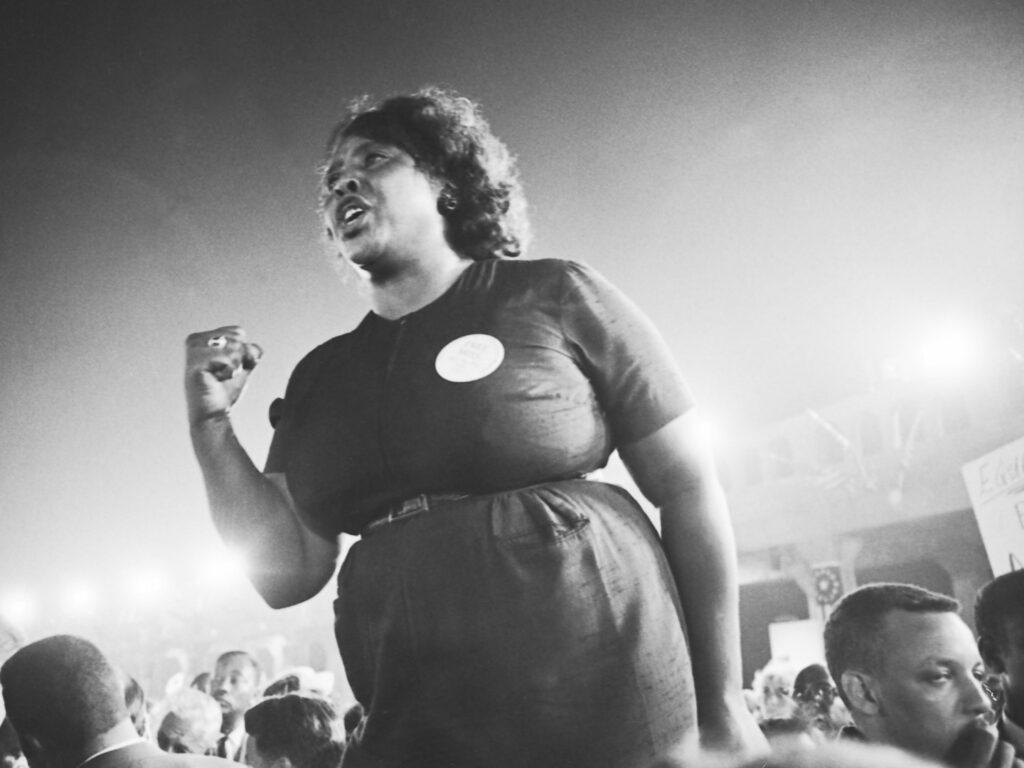
That is the Fannie Lou Hamer worth remembering: not merely a historical figure frozen inside a black-and-white photograph, but a battle-tested architect of Black political power who forced America to hear people it had spent generations trying to silence.
—Vanessa Edwards, B1Daily




Leave a comment