—Terrence Dorner, B1Daily
The Pacific is becoming a steel latticework of alliances. Every year, warships, air wings, engineers, cyber units, medics, and disaster-response teams from across Asia and the West converge in sprawling multinational exercises that increasingly resemble a permanent security ecosystem rather than occasional drills.
From the massive U.S.-Philippines Balikatan exercises to the humanitarian-centered Pacific Partnership missions, the Indo-Pacific has evolved into a region where militaries train together almost continuously. Africa, despite facing terrorism, piracy, insurgencies, coups, trafficking networks, and border instability, still lacks the same dense culture of intra-regional military cooperation.
That gap matters.
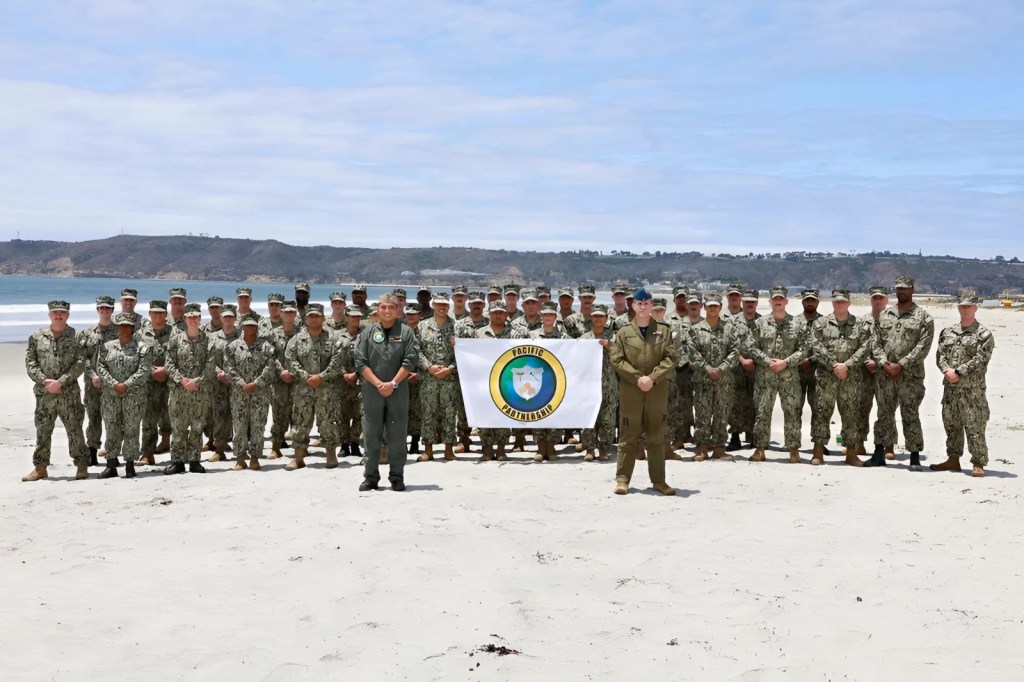
This week, the U.S. Navy launched Pacific Partnership 2026, a humanitarian and disaster-response mission involving forces from nations including Australia, Canada, Germany, Japan, New Zealand, Singapore, South Korea, the United Kingdom, and the United States. The operation will move through Vietnam, Indonesia, Malaysia, Timor-Leste, and the Philippines conducting engineering projects, medical exchanges, and emergency preparedness training.
The mission is now in its twentieth anniversary cycle and has become the largest annual multinational humanitarian readiness mission in the Indo-Pacific.
The genius of these Indo-Pacific exercises is that they are rarely just about war. They create habits of cooperation long before a crisis erupts. Officers build relationships. Communications systems become interoperable. Navies learn how to share intelligence. Disaster response protocols get standardized. Countries that historically distrusted one another slowly normalize working side by side.
The Indo-Pacific understands something Africa’s regional blocs often struggle to operationalize: military exercises are not merely tactical rehearsals. They are political infrastructure.
In Asia, countries increasingly treat regional security as collective insurance. China’s growing assertiveness in the South China Sea has accelerated this mindset. Balikatan 2026 reportedly involved more than 17,000 personnel from multiple nations and included land, sea, air, cyber, and drone warfare components. Japan and Canada participated at unprecedented levels while Australia, France, and New Zealand deepened integration efforts.
That kind of interoperability does not appear overnight. It comes from repetition. Repetition creates trust. Trust creates alliances. Alliances create deterrence.
Africa, by comparison, remains fragmented by colonial borders, political instability, uneven military funding, language divides, and mutual suspicion between neighboring governments. While the continent does host multinational exercises such as African Lion, Justified Accord, and Obangame Express, most are heavily organized, funded, or coordinated by external powers like the United States, France, or NATO partners rather than by African states independently.
That distinction is crucial.
Many African militaries still operate as isolated national forces rather than components of a larger continental security framework. Regional organizations such as ECOWAS or the African Union often struggle with logistics, command coordination, political consensus, and rapid deployment capability. Coups in West Africa have further fractured trust between neighboring states. Some governments are more focused on regime survival than regional integration.
There is also the brutal reality of economics. Sustained multinational exercises cost enormous amounts of money. Fuel, transport aircraft, naval operations, live-fire exercises, maintenance, communications systems, and cyber infrastructure all require stable defense budgets. Many African states simply do not possess the industrial or fiscal base to conduct exercises at Indo-Pacific scale without foreign sponsorship.
But money alone is not the entire story.
The Indo-Pacific’s training culture is also driven by strategic urgency. Nations across Asia increasingly believe they face shared external threats that require collective preparation. Africa’s security threats, however, are often viewed as localized crises. A jihadist insurgency in the Sahel may not feel immediately existential to southern African governments. Piracy in the Gulf of Guinea may not mobilize East African states. The continent’s threats are interconnected, but politically they are still treated as compartmentalized emergencies.
The result is a continent fighting fires with scattered hoses.
Ironically, Africa may need regional military cooperation even more than Asia does. Terrorist groups move fluidly across borders. Smuggling networks exploit weak coordination. Coups in one nation destabilize entire regions. Climate disasters are intensifying migration pressures and humanitarian crises. No single African military can effectively confront these problems alone.
The Indo-Pacific model offers lessons beyond combat readiness. Pacific Partnership itself emerged from the catastrophic 2004 tsunami and transformed disaster relief into long-term strategic cooperation. Africa could build similar recurring multinational missions focused on flood response, anti-piracy operations, medical readiness, infrastructure engineering, and counterterrorism coordination. Repetition would slowly create institutional muscle memory.
What the Indo-Pacific demonstrates is that alliances are not built during wars. They are built during years of drills, shared meals, port visits, engineering projects, and endless rehearsals under humid skies.
Military cooperation is like welding. Every exercise is another spark binding nations together.
Africa has the manpower. It has strategic geography. It has growing economies and increasingly professional officer corps in several states. What it still lacks is a continent-wide culture of habitual military integration.
Until that changes, external powers will continue filling the vacuum.
And in geopolitics, vacuums never stay empty for long.
—Terrence Dorner, B1Daily





Leave a comment