—Travis Luyindama, B1Daily
The global electric vehicle race is no longer just about batteries and range.
It is about data, infrastructure, software ecosystems, and geopolitical influence.
And at the center of this debate is a pressing question in Washington: should the United States open its auto market more broadly to Chinese electric vehicles, or treat them as a potential national security risk?
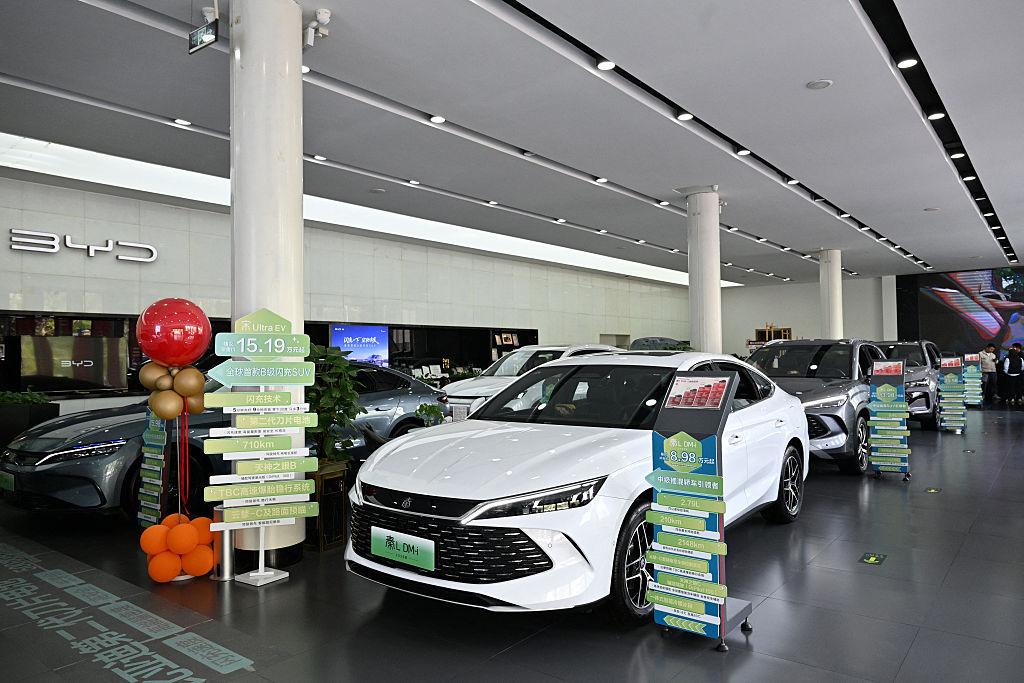
On one side of the argument, Chinese EV manufacturers such as BYD, NIO, and XPeng are producing vehicles that are increasingly competitive on price, technology, and production scale. Their rapid growth has been fueled by massive domestic manufacturing capacity, government subsidies, and vertically integrated supply chains that allow them to produce vehicles at lower costs than most Western competitors.
For American consumers, the appeal is obvious.
Cheaper EVs could accelerate adoption, reduce emissions faster, and increase market competition in a sector currently dominated by Tesla and legacy automakers transitioning slowly into electrification. From a pure consumer economics perspective, more competition often means lower prices, better features, and faster innovation cycles.
However, the issue is no longer just automotive.
Modern electric vehicles are effectively rolling computers.
They collect and transmit vast amounts of data, including driving behavior, geolocation patterns, voice inputs, sensor data, and in some cases even environmental mapping information. This raises a central concern among U.S. policymakers: who controls the data, and where does it go?
National security analysts warn that large-scale deployment of foreign-connected vehicles could create potential vulnerabilities. These concerns include data harvesting, remote software updates controlled by foreign entities, and the theoretical risk of embedded software being exploited for surveillance or disruption purposes.
Even if such risks are never realized, the possibility alone introduces strategic uncertainty.
The U.S. has already taken steps to address these concerns. Restrictions have been placed on certain Chinese automotive software systems, and investigations into connected vehicle technologies have intensified. Some policymakers argue that allowing unrestricted entry of Chinese EVs into the U.S. market could create long-term dependencies similar to past concerns around telecommunications infrastructure.
Supporters of a more open market counter that economic competition itself is a form of national strength.
They argue that isolating U.S. markets could slow domestic innovation and keep prices artificially high, ultimately delaying the transition away from internal combustion engines. They also point out that cybersecurity risks exist across all connected vehicles, including those manufactured by Western companies, and should be addressed through regulation rather than outright exclusion.
There is also a broader geopolitical dimension.
China’s dominance in EV battery supply chains, rare earth processing, and large-scale manufacturing gives it significant leverage in the global energy transition. Allowing Chinese EVs into the U.S. market could deepen interdependence, while restricting them could accelerate decoupling and push global EV markets into separate technological blocs.
At the heart of the debate is a balancing act between three competing priorities: affordability, innovation, and security.
Opening the market could accelerate EV adoption and reduce consumer costs.
Restricting it could reduce perceived security risks and protect domestic industry growth.
Neither path is without tradeoffs.
The most likely outcome may not be an all-or-nothing approach, but a tightly regulated middle ground: limited market access with strict cybersecurity requirements, domestic data storage mandates, and software transparency standards designed to reduce risk while preserving competition.
In the end, the question is not just whether Chinese EVs are better or cheaper.
It is whether the next generation of automobiles will be treated purely as consumer goods, or as strategic digital infrastructure on wheels.
—Travis Luyindama, B1Daily






Leave a comment