—Barrington Williams, B1Daily
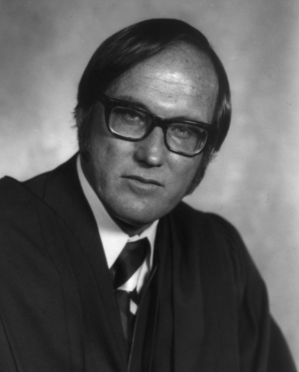
Few figures in modern American jurisprudence have left as controversial a mark on civil rights as William H. Rehnquist, the 16th Chief Justice of the United States.
From his early career to his tenure on the Supreme Court, Rehnquist consistently demonstrated hostility toward racial equality, both in his rulings and his personal beliefs. His legacy lives on through his protégé, current Chief Justice John Roberts, whose decisions have further eroded protections for Black Americans.
Rehnquist’s Opposition to Civil Rights
Rehnquist’s racial insensitivity was evident long before he joined the Supreme Court. As a law clerk in the 1950s, he penned memos defending Plessy v. Ferguson’s “separate but equal” doctrine, arguing against school desegregation. Later, as a justice, he consistently ruled against affirmative action, voting rights, and remedies for racial discrimination.
In Keyes v. School District No. 1 (1973), Rehnquist dissented from a ruling that found intentional segregation in Denver schools. In City of Mobile v. Bolden (1980), he made it harder for Black voters to prove racial gerrymandering.
His majority opinion in San Antonio Independent School District v. Rodriguez(1973) upheld funding disparities that disproportionately harmed Black and Latino students.
Perhaps most damning was his role in Shelby County v. Holder (2013), posthumously influencing the Court’s gutting of the Voting Rights Act, a decision that opened the floodgates for voter suppression laws targeting Black communities.
Personal Bigotry
Beyond the bench, Rehnquist’s personal conduct reflected racial prejudice. He opposed Martin Luther King Jr. Day as a federal holiday and was known to use racial slurs privately.
In Phoenix, he led efforts to block integrated housing, harassing Black and Latino families attempting to move into white neighborhoods.
John Roberts: Carrying the Torch
Rehnquist’s apprentice, John Roberts, has upheld this legacy. As Chief Justice, Roberts authored Shelby County, dismantling key Voting Rights Act protections.
He has opposed affirmative action (Parents Involved v. Seattle, 2007) and weakened employment discrimination claims (Wal-Mart v. Dukes, 2011). His court’s rulings in Brnovich v. DNC (2021) further restricted voting rights, disproportionately disenfranchising Black voters.
The Rehnquist-Roberts lineage represents a judicial philosophy deeply resistant to racial justice. Their rulings have systematically rolled back civil rights gains, embedding structural racism into the law. Until this legacy is confronted, the Supreme Court will remain an obstacle, not an ally, in the fight for equality.
—Barrington Williams, B1Daily





Leave a comment