—Sylvester Loving, B1Daily
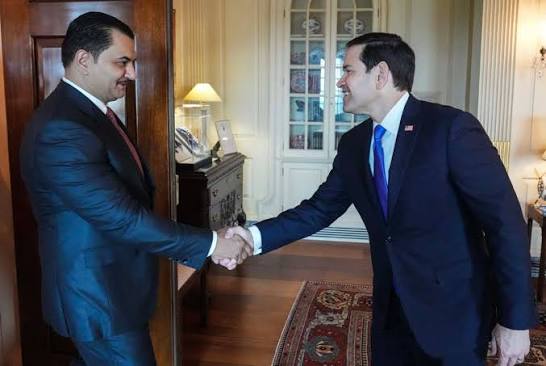
Libya’s long-running political fracture is once again at the center of international diplomacy, as Washington intensifies efforts to bring the country’s rival power centers into a unified governing framework. In a high-level meeting that signals renewed American engagement, U.S. Secretary of State Marco Rubio met with Saddam Haftar, deputy commander of the Libyan National Army (LNA), in discussions focused on ending Libya’s institutional divide and advancing a unified national government.
The talks reflect a broader U.S. strategy aimed at stabilizing Libya by encouraging cooperation between its competing eastern and western authorities. According to official readouts, the discussions centered on “possible avenues for cooperation” to unify Libya’s military, economic, and political institutions, alongside efforts to support long-term peace and governance reforms.
At the heart of the American approach is a recognition that Libya’s instability is no longer just a domestic issue but a regional fault line affecting migration routes, energy markets, and security dynamics across North Africa and the Mediterranean. More than a decade after the 2011 NATO-backed uprising that toppled longtime leader Muammar Gaddafi, Libya remains split between rival administrations, armed coalitions, and competing claims to legitimacy.
The eastern bloc, aligned with the LNA and centered around the Haftar family’s influence, continues to operate in parallel with the internationally recognized Government of National Unity based in Tripoli. Despite a formal ceasefire agreement reached in 2020, the country has remained politically divided, with periodic tensions and stalled negotiations over unified elections and institutional integration.
Rubio’s meeting with Saddam Haftar is particularly significant because it underscores Washington’s willingness to engage directly with figures tied to Libya’s eastern military leadership, signaling a pragmatic shift toward working with existing power brokers rather than attempting to impose a top-down settlement. Observers note that Saddam Haftar, often described as a potential successor to his father Khalifa Haftar, has increasingly become a key diplomatic interlocutor in regional discussions about Libya’s future governance structure.
The United States has in recent years expanded its diplomatic footprint in Libya, supporting initiatives aimed at unifying fiscal policy, stabilizing oil revenues, and encouraging joint military cooperation between rival factions. Previous efforts have included joint drills and limited agreements on economic coordination, particularly around oil production and public sector spending, which remains central to Libya’s economy.
Libya’s strategic importance amplifies the stakes of these negotiations. Sitting atop Africa’s largest proven oil reserves and located near critical Mediterranean shipping lanes, the country’s stability is closely tied to European energy security and broader regional migration pressures. Any sustained political settlement would have implications not only for Libyans but for international actors competing for influence in the region.
However, the path to unity remains deeply complex. Decades of mistrust between eastern and western factions, overlapping foreign influence from regional powers, and the entrenchment of armed groups have repeatedly undermined previous peace initiatives. While diplomatic engagement has increased, the structural divisions within Libya’s political and security institutions remain deeply entrenched.
Still, the tone of recent U.S. engagement suggests cautious optimism. American officials have emphasized support for a “Libyan-led” process aimed at overcoming divisions and building conditions for a democratically elected government capable of restoring national unity.
Whether this renewed diplomatic push leads to meaningful breakthroughs remains uncertain. Libya’s history of stalled negotiations and fragile agreements serves as a reminder that external mediation alone is rarely enough to resolve internal fragmentation.
But Rubio’s meeting with a key figure in Libya’s eastern power structure underscores a clear message: Washington is once again investing political capital in trying to stitch together a country that, more than a decade after its revolution, still struggles to function as a unified state.
—Sylvester Loving, B1Daily



Leave a comment