
—Greg Hart, B1Daily
When Southern University hired NFL Hall of Famer Marshall Faulk to lead one of the most recognizable HBCU football programs in America, the excitement was immediate. One of the greatest running backs to ever touch a football had returned home to Louisiana with a chance to restore the Jaguars to championship form.
But after watching Faulk’s recent media appearance, another storyline is beginning to emerge.
For a coach who has spent his entire life dominating on football fields and television studios, Faulk looked unusually guarded. Instead of projecting complete confidence, he appeared cautious, defensive, and almost uncomfortable discussing the realities of leading Southern football.
That isn’t necessarily a criticism. It may simply be the reality of taking over one of the toughest coaching jobs in HBCU football.
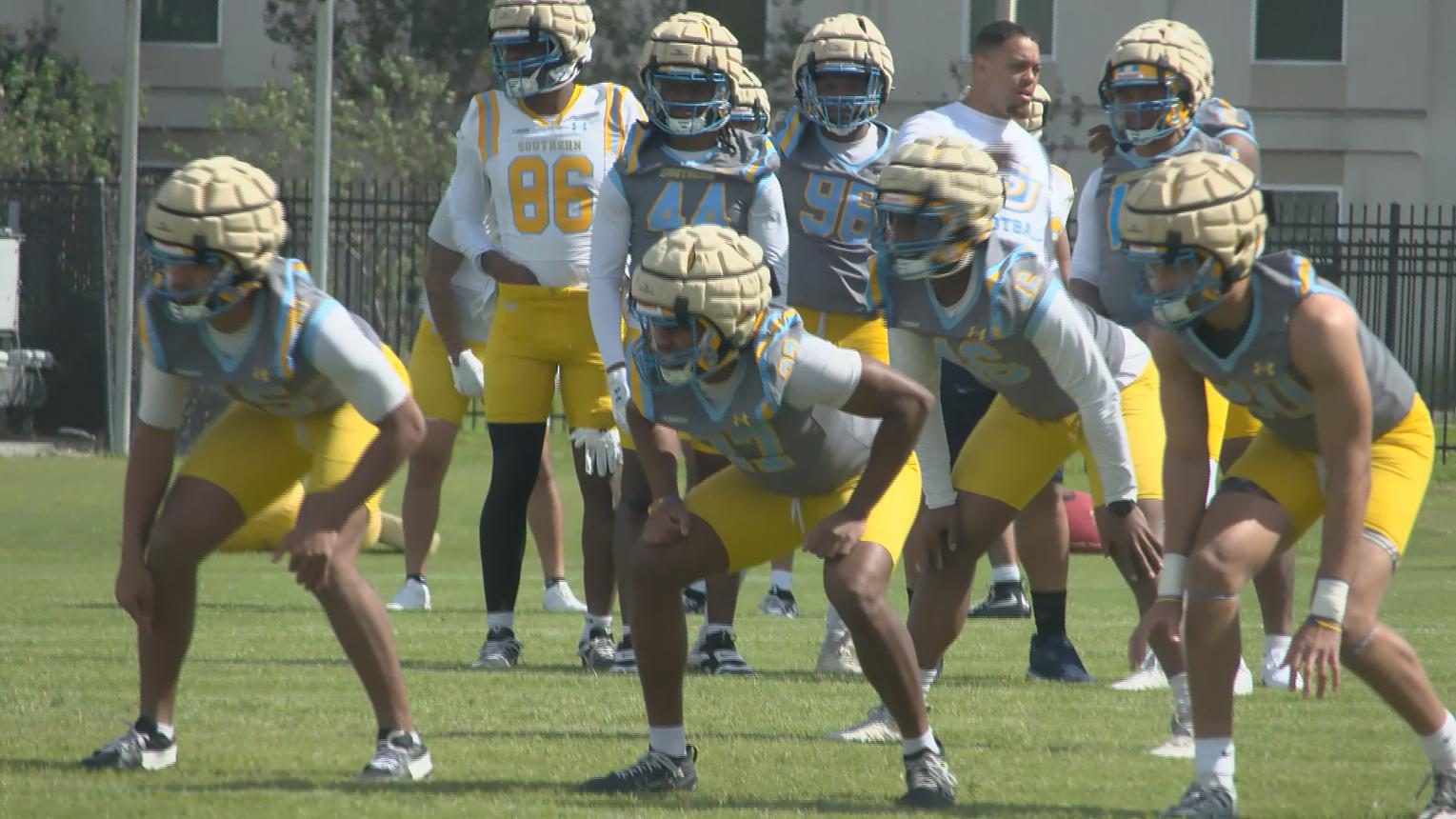
Southern isn’t just another program.
Every decision is scrutinized. Every loss becomes statewide conversation. Alumni expect championships. Fans expect SWAC titles. The Bayou Classic isn’t simply another rivalry game. It is an event with national attention, and anything less than excellence quickly becomes unacceptable.
For someone entering his first season as a collegiate head coach, that’s a mountain of pressure.
Throughout the interview, Faulk repeatedly emphasized protecting information and avoiding revealing too much about his football program. While every coach values secrecy, the level of caution suggested someone still adjusting to life where every statement could become tomorrow’s headline.
That can sometimes come across as paranoia.
Again, that doesn’t necessarily mean Faulk is literally paranoid. It means he appears hyper-aware that people are evaluating every word, every roster decision, every practice, and every personnel move.
That feeling isn’t imaginary.
Opposing coaches are studying him.
Media members are looking for clues.
Fans are comparing him to legendary Southern coaches before he’s even coached a regular season game.
The pressure is enormous.
What’s fascinating is that Faulk spent over a decade in the NFL surrounded by cameras every day. Yet coaching creates a completely different type of spotlight.
As a player, your performance speaks for itself.
As a head coach, every decision becomes public debate.
Should you start the freshman?
Should you fire an assistant?
Should you go for it on fourth down?
Should you change quarterbacks?
Every answer creates another wave of criticism.
There is also another factor many people overlook.
Marshall Faulk has never failed publicly in football.
He was a college superstar.
An NFL MVP.
A Super Bowl champion.
A Pro Football Hall of Famer.
His résumé is nearly flawless.
Coaching introduces something entirely different: uncertainty.
No matter how great your playing career was, none of it guarantees success on Saturdays.
History is filled with legendary players who struggled as head coaches.
That reality alone can create enormous pressure for someone whose football reputation has been built on excellence.
Still, being cautious isn’t automatically a weakness.
Many successful coaches obsess over protecting competitive advantages. Bill Belichick famously gave little away publicly. Nick Saban carefully controlled information around his program. Deion Sanders has also been selective about what he reveals despite his larger-than-life personality.
The question isn’t whether Faulk is keeping secrets.
The question is whether that cautious mindset eventually evolves into confident leadership once games begin.
Southern fans aren’t expecting perfection overnight.
They want discipline.
Development.
Recruiting success.
And most importantly, wins.
If those victories start piling up, today’s nervous energy will quickly be remembered as simply the growing pains of a first-year head coach.
But if Southern struggles early, every guarded interview and every cautious answer will be revisited through a much harsher lens.
Marshall Faulk has conquered nearly every challenge football has thrown at him. Now comes perhaps his most difficult test yet: proving that greatness as a player can translate into greatness on the sideline.
Only the season itself will answer that question. Faulk, a Pro Football Hall of Famer, became Southern’s head coach after serving as Colorado’s running backs coach, marking his first collegiate head coaching opportunity.
—Greg Hart, B1Daily



Leave a comment