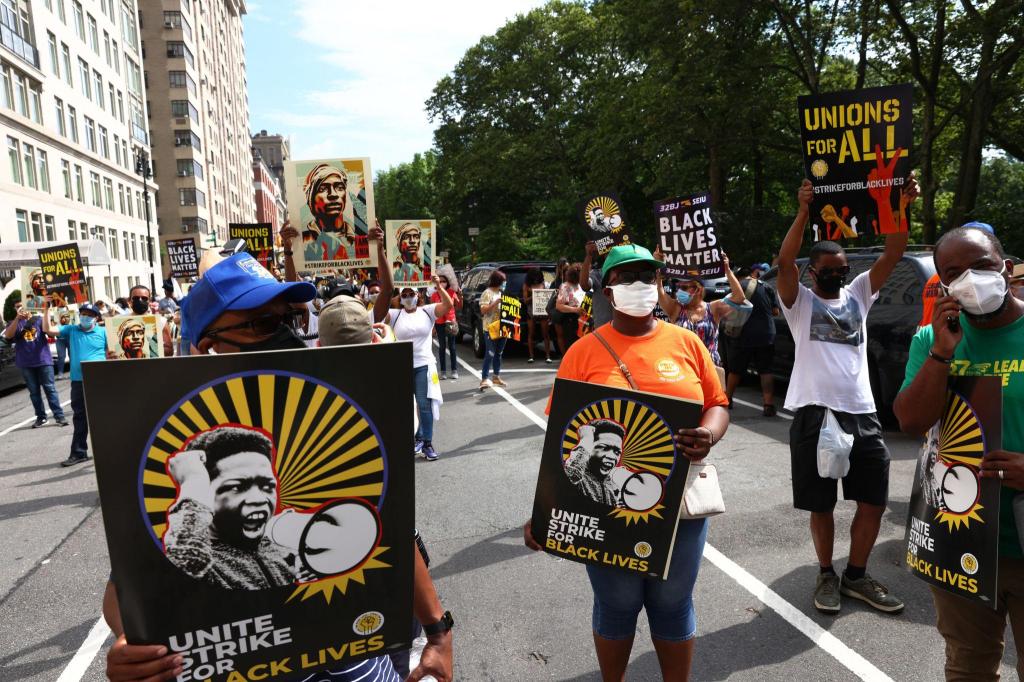
—Michael Lyles, B1Daily
A. Philip Randolph understood the equation nearly a century ago.
If Black workers wanted economic power, they needed bargaining power.
Randolph’s Brotherhood of Sleeping Car Porters represented more than an effort to secure better wages from the Pullman Company. It represented a larger proposition: individually vulnerable workers could become collectively powerful when they organized.
America in 2026 looks radically different from Randolph’s railroad economy.
But the question he confronted has returned wearing new clothes.
Housing costs remain punishing. Automation threatens occupations once considered stable. Benefits increasingly depend upon the employer. Gig work has blurred the meaning of employment. Artificial intelligence promises enormous productivity gains while workers wonder how much of those gains will appear in their paychecks.
For Black workers, there is another question underneath all of it:
Could organized labor once again become an engine for building the Black middle class?
Black Workers Remain America’s Most Unionized Major Racial Group
The answer cannot begin with nostalgia.
It has to begin with numbers.
According to the Bureau of Labor Statistics, only 10 percent of American wage and salary workers belonged to unions in 2025, compared with 20.1 percent in 1983, the first year of directly comparable BLS data. About 14.7 million workers belonged to unions in 2025.
But Black workers stand out.
Their union membership rate was 11.4 percent in 2025, compared with 9.9 percent among white workers, 8.7 percent among Asian workers and 8.9 percent among Hispanic workers. Black men registered an even higher 12.4 percent rate.
That is not a historical footnote.
It suggests organized labor remains disproportionately relevant to Black economic life even after decades of declining union density.
The Union Paycheck Still Matters
The simplest argument for unions remains the paycheck.
BLS reported that the median full-time union member earned $1,404 per week in 2025, compared with $1,174 for nonunion workers. BLS appropriately cautions that such a comparison does not control for differences in occupations, industries and worker characteristics.
More sophisticated research still finds a union advantage.
A Treasury Department review of economic research concluded that unionization raises worker wages by roughly 10 to 15 percent after accounting for factors that make simple wage comparisons imperfect. Treasury also found benefits involving retirement plans, workplace grievance procedures and scheduling.
For a household trying to move from survival into asset accumulation, those differences matter.
An additional paycheck does not automatically create wealth. But higher wages, stronger benefits and greater job stability can make it easier to build emergency savings, qualify for mortgages, contribute to retirement accounts and avoid draining assets during financial shocks.
That is how labor policy can become wealth policy.
Black Workers Know What Happens When Bargaining Power Disappears
The decline of organized labor did not affect every community equally.
Black workers historically benefited from unionized public-sector jobs, transportation, manufacturing and other occupations that offered pathways into stable middle-class employment.
The problem was that organized labor itself was never innocent of racial discrimination.
Some unions excluded Black workers, tolerated segregated locals or protected white workers from competition. Randolph’s own career was partly a battle against racism inside the labor movement.
That history should not be sanitized.
But neither should it obscure what happened when Black workers successfully gained access to unionized employment.
Collective bargaining provided something individual workers frequently lacked: leverage.
The New Factory Floor May Be an Algorithm
The modern labor question extends beyond factories.
Artificial intelligence and automation may transform clerical work, customer service, transportation, warehousing, media, finance and professional occupations.
That creates a new bargaining question.
When technology makes workers dramatically more productive, who receives the gains?
Shareholders?
Executives?
Consumers through lower prices?
Workers through higher wages and shorter hours?
All four?
Without bargaining power, employees may have little influence over the answer.
The union of the future therefore cannot merely negotiate over hourly wages. It may need to negotiate over automation, retraining, surveillance, algorithmic management, artificial intelligence, scheduling and who benefits when technology eliminates tasks.
The battleground is changing beneath everyone’s feet.
Public Employment Remains Crucial
Public-sector employment deserves particular attention.
BLS reported a 32.9 percent union membership rate among public-sector workers in 2025, more than five times the 5.9 percent private-sector rate.
Teachers, transit employees, sanitation workers, government administrators and other public employees have historically provided stable employment opportunities for Black families.
That makes battles over public-sector collective bargaining more than abstract disputes between unions and state governments.
They can directly affect Black household economics.
Unions Cannot Rebuild the Middle Class Alone
Organized labor is not a magic wrench capable of repairing every broken piece of the economy.
Union membership will not eliminate the racial wealth gap.
It cannot independently fix housing shortages.
It cannot erase discriminatory lending.
It cannot guarantee affordable healthcare.
And badly managed or exclusionary unions can become institutions protecting insiders rather than engines of broader mobility.
But dismissing unions because they cannot solve everything would be equally shortsighted.
Workers need mechanisms for negotiating how economic gains are distributed.
For more than a century, collective bargaining has been one of those mechanisms.
Randolph’s Question Returns
This brings the story back to A. Philip Randolph.
Randolph did not view labor organizing simply as a method for getting another dollar in the paycheck.
He saw organized workers as a political constituency.
The Brotherhood could bargain with a corporation, but organized Black workers could also pressure presidents, challenge discrimination and demand changes from government.
That fusion of economic organization and political leverage helped make Randolph one of the most formidable Black leaders of his era.
The modern Black middle class faces different circumstances, but the underlying power equation has not disappeared.
Voting creates political leverage.
Ownership creates capital.
And organization creates bargaining power.
Black America may need all three.
The labor question, then, isn’t whether America should recreate the economy of A. Philip Randolph’s time.
It is whether workers can rediscover something Randolph understood perfectly:
A worker asking alone has a request. Workers negotiating together have leverage.
—Michael Lyles, B1Daily





Leave a Reply