—Sylvester Loving, B1Daily
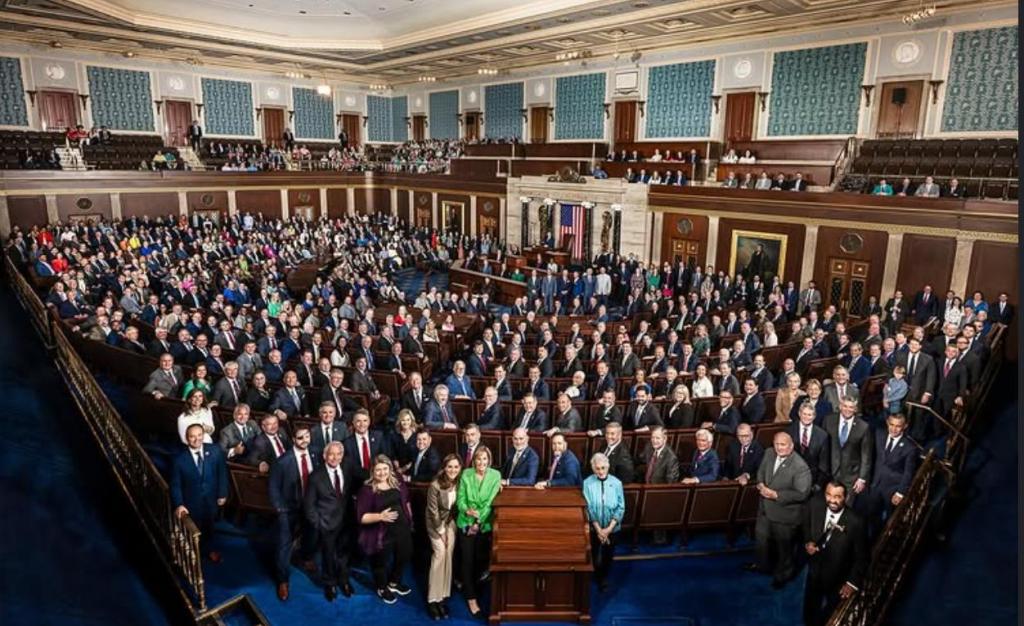
The United States has added tens of millions of citizens, transformed from an industrial nation into a continental economic superpower, and entered the digital age while leaving one important piece of its democracy largely frozen in the early 20th century: the size of the House of Representatives.
There are currently 435 voting members of the U.S. House, a number established more than a century ago and subsequently entrenched by federal apportionment law. The 63rd Congress, which began in 1913, was the first with 435 members, and the Permanent Apportionment Act of 1929 effectively cemented that number. The only modern interruption came when Alaska and Hawaii entered the Union, temporarily increasing the House to 437 before it returned to 435 after reapportionment.
America should seriously consider changing that.
Not because the country needs more politicians for the sake of having more politicians, but because 435 representatives are being asked to represent a country vastly larger than the America for which that number was designed.
America Grew. The House Didn’t.
After the first census in 1790, each House member represented roughly 34,000 people. Today, according to the Census Bureau, representatives serve constituencies exceeding 700,000 people. The 2020 apportionment population alone exceeded 331 million.
That is an extraordinary transformation.
Congressional districts have effectively become small cities unto themselves. One representative may be responsible for hundreds of thousands of people spread across numerous cities, towns, neighborhoods and sometimes enormous geographic areas.
Yet the House was supposed to be the chamber closest to ordinary Americans.
The Senate represents states. Every state gets two senators regardless of population.
The House represents people, with seats apportioned among states according to population.
If that chamber becomes increasingly distant from individual citizens, something fundamental about its purpose begins to erode.
435 Isn’t Written in the Constitution
Perhaps the greatest misconception surrounding House expansion is that 435 representatives is some sacred constitutional number.
It isn’t.
The Constitution establishes rules governing representation but doesn’t command Congress to maintain exactly 435 representatives. The current number is established by federal statute, meaning Congress can change the size of the House through legislation rather than a constitutional amendment. Congressional Research Service analysis confirms that Congress has discretion to alter House size within constitutional requirements.
That opens the door to a serious national discussion.
Should there be 500 representatives?
550?
600?
There isn’t one magical number. The better question is whether 435 still provides adequate representation for a nation of more than 330 million people.
Smaller Districts Could Bring Congress Closer to the People
Expanding the House would produce smaller congressional districts on average.
That could have meaningful consequences.
A representative responsible for 500,000 constituents instead of roughly three-quarters of a million would theoretically have fewer people competing for the attention of the same congressional office.
That could make constituent services more manageable and allow representatives to concentrate on smaller geographic communities.
A 2024 law-review article advocating House expansion calculated that the average district had grown from roughly 280,000 residents around the era of the 1929 cap to approximately 761,000 following the 2020 census. The author argues that these enormous constituencies make constituent assistance and meaningful representation increasingly difficult.
Congressional researchers likewise note that proponents of expansion have historically argued that a larger House could represent a broader range of interests and help members remain more knowledgeable about local concerns.
That matters.
A member of Congress shouldn’t feel like a distant celebrity whom ordinary citizens encounter primarily through television.
The House should feel local.
Expansion Could Open the Political Door
There is another potential benefit that deserves attention: more seats mean more opportunities for political representation.
Creating additional districts wouldn’t guarantee ideological, racial, economic or demographic diversity. District boundaries and voting patterns would still matter enormously.
But mathematically, increasing the number of seats creates more opportunities for communities to elect representatives.
Instead of squeezing enormous and sometimes dramatically different communities into the same congressional district, additional seats could allow districts to represent somewhat narrower populations and geographic areas.
For Black communities, Latino communities, rapidly growing metropolitan areas, rural regions and other constituencies that sometimes find their political influence divided during redistricting, House expansion could alter the representational landscape.
It wouldn’t eliminate gerrymandering.
But it could give mapmakers more pieces on the chessboard.
It Could Also Change Presidential Politics
House expansion wouldn’t stop at the Capitol.
The number of electors assigned to each state in presidential elections is based partly on its number of representatives in Congress. Congressional Research Service analysis notes that changing House size can therefore affect states’ representation in the Electoral College.
That makes House expansion much more consequential than simply adding desks to a chamber.
A larger House would increase the House-based portion of the Electoral College while the Senate-based component remains fixed at two electors per state.
The political effects would depend heavily on the particular expansion formula and resulting apportionment, so neither party should automatically assume expansion would permanently benefit it.
And that is exactly how reform should be approached.
Design the system around representation, not around engineering the next election.
There Are Legitimate Arguments Against Expansion
Expanding the House isn’t free.
More representatives mean additional congressional salaries, staff, offices, committee assignments, security requirements and administrative expenses.
A chamber containing 600 or 700 representatives could also become harder to manage.
Debates could become more cumbersome. Committee structures might require changes. Office space would become an issue. Leadership would need to coordinate substantially larger caucuses.
Those aren’t imaginary problems.
Indeed, efficiency and cost have historically been among the arguments for maintaining the 435-member House.
But Congress shouldn’t confuse administrative convenience with democratic necessity.
If representation requires spending additional money, then democracy has operating costs.
The federal government spends trillions of dollars. The proposition that the country simply cannot afford another hundred or two hundred elected representatives and their offices deserves skepticism.
A Moderate Expansion Makes Sense
America doesn’t need a 5,000-member House.
But it also doesn’t need to pretend that a number inherited from the political realities of 1913 is automatically perfect for the United States of the 21st century.
A reasonable reform would expand the House gradually, perhaps beginning somewhere around 550 to 600 voting representatives, followed by periodic reviews after future censuses.
At 600 seats, using the 2020 apportionment population merely as an illustration, the nationwide average would fall from roughly 761,000 people per seat at 435 seats to about 552,000 per seat. Actual district populations would vary because seats must be apportioned among states.
That still creates large congressional districts.
But it would move representation substantially closer to the population.
Congress could also establish a formula allowing House membership to grow gradually with population rather than forcing future generations to repeatedly fight over an arbitrary numerical cap.
Make the People’s House About the People Again
The strangest argument against expanding Congress may simply be tradition.
There are 435 representatives because America has become accustomed to having 435 representatives.
But America’s earlier history followed a different tradition. As the country expanded and its population increased, the House generally grew as well. That pattern largely stopped after the 1910 census.
America didn’t stop growing.
Congress did.
The United States now asks a relatively tiny group of representatives to serve a population unimaginably larger than the country governed by the first Congress.
Expanding the House wouldn’t cure polarization, destroy gerrymandering or suddenly make Washington responsive to every citizen.
But it would attack a quieter democratic problem: the growing distance between a representative and the people that representative is supposed to know.
The House of Representatives is called the People’s House.
Perhaps it is time to make a little more room for the people.
—Sylvester Loving, B1Daily






Leave a Reply