—Barrington Williams, B1Daily
Tulsa’s Greenwood District has become the most famous symbol of Black economic achievement destroyed by racial violence. But Greenwood was not an isolated miracle. Across the United States, Black Americans built prosperous commercial districts containing banks, insurance companies, theaters, restaurants, professional offices and stores.
Many were eventually weakened or physically destroyed, sometimes by racial violence, but also by highway construction, urban renewal, discriminatory lending, displacement and changing commercial patterns.

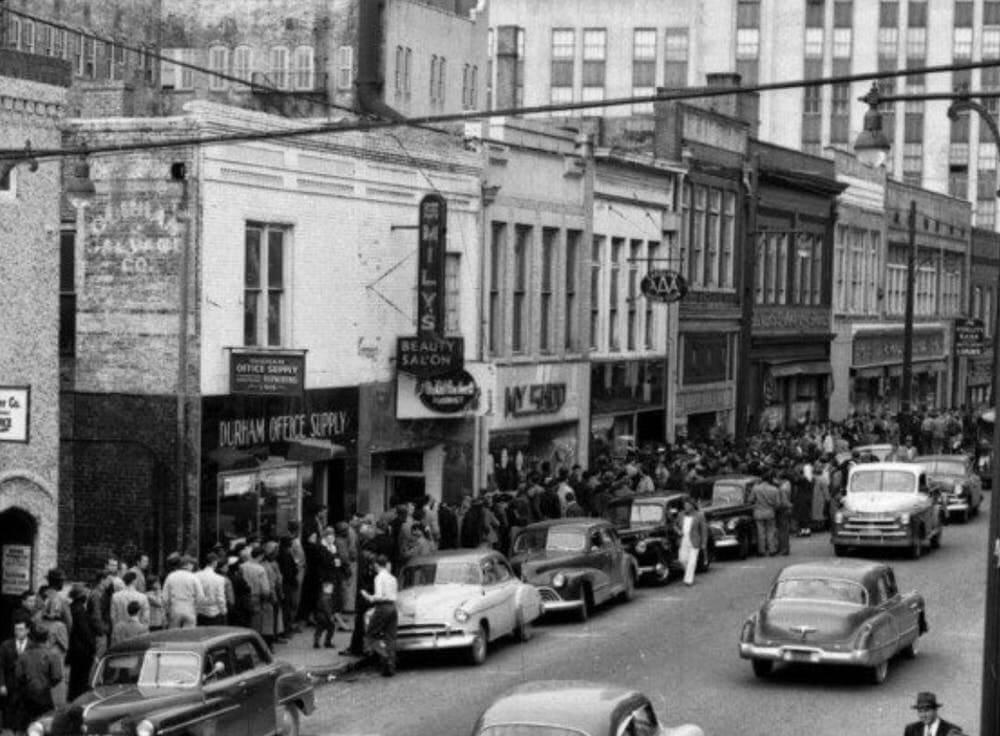
Durham’s Hayti and Black Wall Street
Durham, North Carolina, developed one of America’s strongest Black business communities. Black entrepreneurs established successful businesses, insurance companies and institutions in and around Hayti, while nearby Parrish Street became famous as Black Wall Street.
Then came “urban renewal.”
Construction of the Durham Freeway cut through Hayti. Duke research estimates that urban renewal and freeway construction displaced more than 4,000 households and roughly 500 businesses, devastating the community’s economic base.
Richmond’s Jackson Ward
Richmond, Virginia’s Jackson Ward became another center of Black capitalism despite Jim Crow.
Black Richmonders created banks, insurance companies, theaters and other businesses. Maggie L. Walker established the St. Luke Penny Savings Bank, while Second Street became so economically significant that it was known as a Black Wall Street by the early twentieth century.
Its success developed despite deliberate political suppression, including gerrymandering and Black voter disenfranchisement.
Atlanta’s Sweet Auburn
Atlanta had Sweet Auburn, which became the center of Black commercial life in the city.
Between 1900 and 1920, the number of Black businesses along Auburn Avenue grew from 10 to 72. Major institutions included Citizens Trust Company, Standard Life Insurance Company and Atlanta Life Insurance Company.

Sweet Auburn eventually faced economic decline and physical disruption. Interstate construction divided the surrounding community, while broader suburbanization and commercial changes weakened the district.
Yet portions survived, and today the National Park Service preserves significant parts of the neighborhood associated with Martin Luther King Jr. and Atlanta’s Black history.
Chicago’s Black Metropolis
Chicago developed another extraordinary Black commercial center around 35th and State Streets, part of what became known as the Black Metropolis.
Black banks, insurance companies and businesses prospered there during the Great Migration. But the Great Depression devastated Black financial institutions, while white-owned chains with greater access to capital increasingly competed for Black customers.
Urban renewal delivered another blow during the 1950s and 1960s. Entire blocks were demolished for public housing and expansion of the Illinois Institute of Technology.
The Highway Through Black America
These stories reveal a national pattern.
Durham was hardly alone. Federally financed highway projects cut through Black communities in cities including Atlanta, Nashville, New Orleans, Kansas City, St. Paul, Milwaukee and others.
Jacksonville’s Sugar Hill provides another example. Once a center of Black prosperity, the neighborhood was largely destroyed through urban renewal and construction of Interstate 95 during the 1950s and 1960s.
Not every Black business district disappeared for the same reason. Some suffered riots or massacres. Others declined through economic competition, the Great Depression, suburbanization or desegregation. But government redevelopment and highway construction repeatedly inflicted enormous damage.
That history matters because destroying a business district does more than eliminate buildings.
A Black-owned bank can finance homeowners. A grocery store circulates money locally. A successful company creates jobs. Property ownership generates equity that can be inherited.
When hundreds of those institutions disappear together, the loss can echo across generations.
Tulsa deserves to be remembered. But Greenwood should also be understood as part of a much larger American story.
Black America built economic centers across the country.
And in too many cities, highways and bulldozers accomplished what mobs could not.
—Barrington Williams, B1Daily





Leave a Reply