—Sylvester Loving, B1Daily
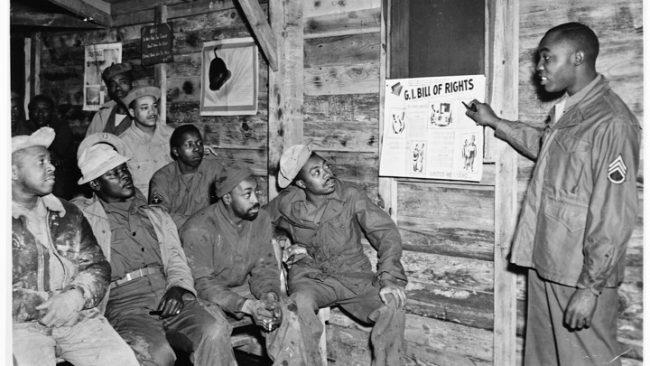
Black American soldiers returned from World War II having fought for democracy abroad, only to discover that some of the most valuable benefits awaiting veterans at home were filtered through the machinery of Jim Crow.
The GI bill could’ve changed things for Black Americans. But in practice, discrimination by colleges, banks, housing markets and government administrators prevented many Black veterans from receiving the same benefits as white veterans.
The Homeownership Door Closed
Housing was perhaps the greatest lost opportunity.

The GI Bill helped millions of veterans purchase homes with federally backed mortgages at the same moment America’s suburbs were rapidly expanding. Homeownership subsequently became an extraordinary source of middle-class wealth.
But Black veterans encountered banks that refused to lend to them, redlining and neighborhoods that excluded Black residents.
The disparities could be staggering. In 1947, only two of more than 3,200 VA-guaranteed home loans across 13 Mississippi cities went to Black borrowers. In New York and northern New Jersey suburbs, fewer than 100 of roughly 67,000 GI Bill-insured mortgages reportedly went toward purchases by nonwhite borrowers.
That meant many white veterans were purchasing homes whose values could appreciate for decades while Black veterans were denied access to the same wealth-building opportunity.
College Wasn’t Equal Either
Education presented another barrier.
Segregated Southern universities could simply prevent Black veterans from attending, while historically Black colleges and universities lacked the capacity and resources to accommodate everyone seeking admission.
Black veterans were also sometimes directed toward vocational programs rather than universities. A later congressional proposal examining the GI Bill’s discriminatory legacy cited figures showing that only 6% of Black World War II veterans earned college degrees compared with 19% of white veterans.
The benefit technically existed. Access to the institutions necessary to use it did not exist equally.
They Served the Same Country, But Returned to Different Americas
The injustice becomes clearer when examining the broader treatment of Black veterans.
More than one million Black servicemembers were returning from World War II. Yet segregation remained embedded even within veterans’ institutions. The VA acknowledges that 47 of its 166 hospitals remained segregated in some form through 1953, nearly a decade after the GI Bill became law.
The Department of Veterans Affairs has since acknowledged the historical failure directly. In 2023, then-VA Secretary Denis McDonough said the country had failed approximately one million Black veterans through racism operating at local, state and federal levels.
The Cost Was Generational
This history matters because the GI Bill was not merely another government benefit.
It helped finance education, careers and houses, three of the most important building blocks of America’s postwar middle class.
A veteran who bought a suburban house in 1950 could eventually leave an appreciating asset to children. A veteran who obtained a university degree could increase lifetime earnings. Those advantages could compound across generations.
Black veterans had fought in the same war and qualified under the same federal law, yet discrimination prevented many from fully participating in that extraordinary economic expansion.
The GI Bill therefore represents one of the great contradictions of twentieth-century America.
Black veterans helped defend American freedom overseas, returned home entitled to the benefits of their service, and then had to fight another battle simply to receive them equally.
—Sylvester Loving, B1Daily






Leave a Reply