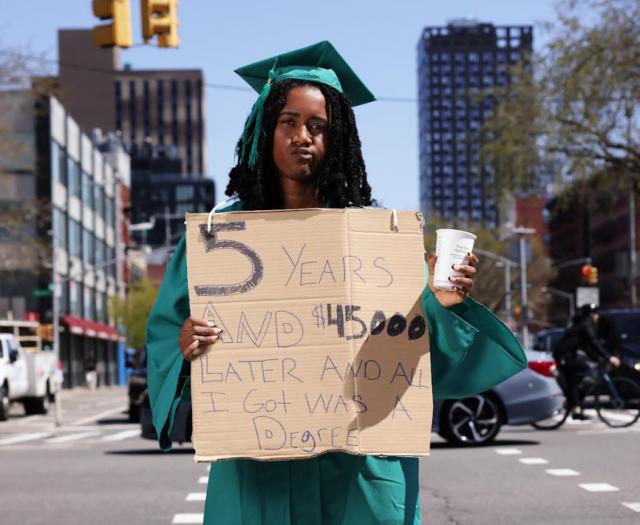
—Kerry Hill, B1Daily
For years, the formula sounded straightforward: go to college, earn a degree, get a good job and enter the middle class. But for Black Americans borrowing heavily to finance that promise, today’s labor market is raising an uncomfortable question: what happens when the degree survives but the expected career disappears?
The problem is not that college has suddenly become worthless. Bachelor’s degree holders still generally experience lower unemployment than workers with less education. But the pathway from diploma to professional career has become considerably less certain. In December 2025, 42.5% of recent college graduates were underemployed, meaning they worked in jobs that typically did not require a college degree.
That uncertainty becomes especially dangerous for Black graduates because the financial cost of obtaining the credential is often higher.
Black Americans Carry More of the Risk
Federal Reserve data show that in 2025, 28% of Black adults had student loans, compared with 14% of white adults. Among borrowers required to make payments, only 52% of Black borrowers reported making their full required payment in the previous month, compared with 83% of white borrowers.
Black graduates also continue to face labor-market disparities even after earning credentials. Federal Reserve research has found that Black workers experience lower wages and higher unemployment than white workers even after accounting for education.
That creates a particularly punishing equation:
Borrow more for the credential + face weaker employment outcomes + enter a rapidly changing labor market = greater financial risk.
The Jobs Are Changing Faster Than the Degrees
Artificial intelligence, automation, outsourcing and corporate restructuring are changing many of the white-collar occupations traditionally marketed to college students.
The danger is not necessarily that professional employment will disappear altogether. New occupations will emerge while others expand. The larger problem is that students can spend four or six years preparing for a labor market that may look substantially different by graduation.
Yet the student loan remains wonderfully resistant to technological disruption.
A $40,000 education does not become cheaper because the entry-level position a student expected to obtain was automated, outsourced or eliminated.
College Still Pays, But Choosing Wisely Matters More
The answer is not telling Black students to abandon higher education. College remains economically valuable for many people, particularly in fields with strong demand and clearly defined career paths.
Instead, students should become more ruthless about return on investment.
Before borrowing heavily, families should examine graduation rates, typical salaries, job-placement outcomes, total borrowing requirements and whether employers in the intended occupation actually require the degree being sold.
Community colleges, apprenticeships, certifications and skilled trades should also be treated as legitimate economic pathways rather than consolation prizes for people who did not attend universities.
The old advice was simply: get a degree.
The better advice now is: get a credential that has a realistic chance of paying for itself.
For Black Americans already facing a substantial racial wealth gap, taking on decades of debt for a credential disconnected from labor-market demand can transform education from a ladder into an anchor.
—Kerry Hill, B1Daily






Leave a Reply