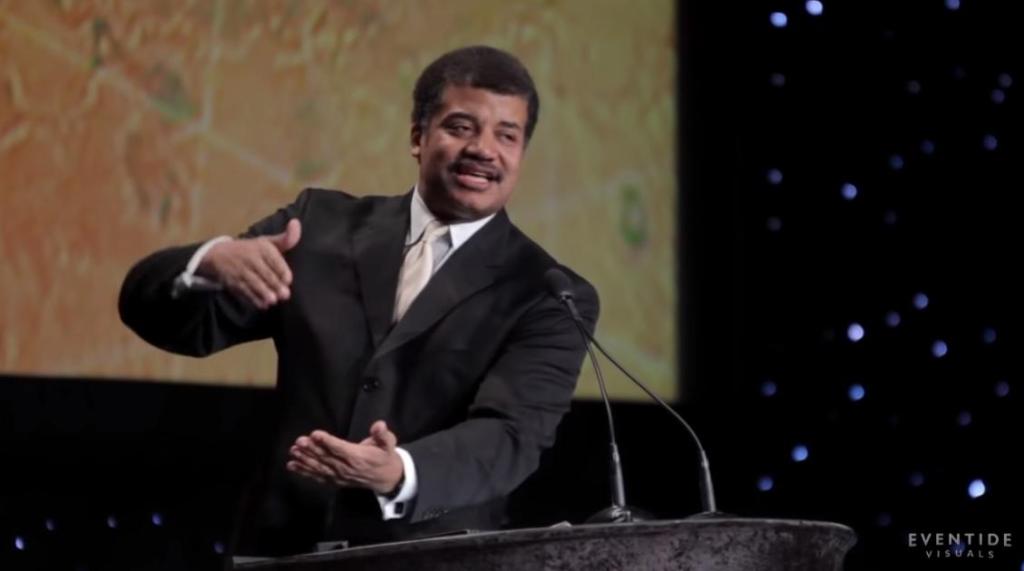
—Josh Allen, B1Daily
Neil deGrasse Tyson has spent much of his career staring into the universe.
But one of his most persistent warnings has been aimed squarely at Earth, and specifically at the United States.

Years ago, Tyson warned that he could feel the “fading of our luster” as America drifted away from the culture of scientific ambition that defined much of the 20th century. His argument was never simply that Americans needed better science classes. It was that the country had stopped dreaming big enough to create an environment where scientists, engineers and inventors wanted to build the future.
In 2026, that warning suddenly looks considerably less theoretical.
China is now estimated to have surpassed the United States in total research and development spending when adjusted for international comparability. It produces more scientific research papers, awards more science and engineering doctorates and commands enormous portions of global high-tech manufacturing.
So was Tyson right?
The answer is uncomfortable.
America remains a scientific superpower. But it can no longer assume that scientific leadership belongs to it.
Tyson’s Argument Was Never Just About NASA
Tyson has repeatedly argued that America’s extraordinary postwar economic rise was connected to something deeper than individual inventions.
America developed what he calls an innovation culture.
The Apollo program represented the most spectacular example.
The government didn’t merely tell young Americans to study harder. It gave them enormous problems to solve.
Build rockets.
Explore space.
Develop new materials.
Create computers.
Push engineering beyond anything previously attempted.
Tyson has argued that major national projects create an environment where innovation spreads beyond the original mission. Scientific investment becomes economic investment because discoveries eventually produce industries nobody anticipated when the original research began.
The laser is one of his favorite examples.
Albert Einstein wasn’t thinking about supermarket barcodes or LASIK surgery when his theoretical work helped establish principles that would eventually make lasers possible.
Quantum physicists weren’t trying to create smartphones.
Fundamental research frequently produces economic revolutions decades after the original discovery.
That is precisely Tyson’s point.
A country obsessed only with immediately profitable research risks never discovering the technology that creates tomorrow’s economy.
Then China Entered the Laboratory
For much of the 20th century, America enjoyed an extraordinary scientific advantage.
That era is ending.
According to the National Science Foundation’s State of U.S. Science and Engineering 2026 report, China was estimated to have performed about $1.028 trillion in R&D in 2024, adjusted for international comparability.
The United States performed roughly $1.009 trillion.
China accounted for approximately 30 percent of global R&D performance. America represented about 29 percent.
The symbolic importance is difficult to ignore.
China is also the world’s largest producer of peer-reviewed science and engineering publications, producing more than twice America’s total output. It has awarded more science and engineering doctorates annually than the United States since 2019.
And then there are patents.
Chinese inventors received roughly three-quarters of international-priority AI patents in 2024, according to NSF indicators.
The scientific world Tyson feared might pass America is no longer approaching somewhere over the horizon.
Parts of it have arrived.
But Declaring America Finished Would Be Ridiculous
This is where the “America is losing science” narrative needs restraint.
China winning the quantity battle doesn’t automatically mean it has won the innovation war.
American researchers continue producing a disproportionately strong share of highly cited scientific papers. American patents remain among the world’s most influential. The United States possesses the world’s strongest venture-capital ecosystem and remains extraordinarily powerful in pharmaceuticals, aerospace, medical technology and other advanced industries.
America also remains extremely attractive to international scientific talent.
More than half of U.S. science and engineering doctorates in computer science, engineering, mathematics and statistics were awarded to temporary visa holders in 2024, and NSF data indicate most remain in the United States afterward.
That is an enormous strategic advantage.
America doesn’t merely produce scientists.
It imports brilliant people from around the planet and turns many of them into American scientists, engineers, entrepreneurs and professors.
Tyson himself has emphasized how disproportionately important immigrants have been to American scientific achievement.
The United States therefore isn’t collapsing scientifically.
It is experiencing something potentially more dangerous:
competition.
The Classroom May Be the Real Warning Light
The most troubling numbers may not come from laboratories.
They come from schools.
The NSF reports that American K-12 mathematics and science scores remain below pre-pandemic levels. U.S. eighth graders performed at or below international averages in science, mathematics and computer-information literacy assessments in 2023.
That should concern Washington considerably more than another political argument over standardized testing.
The children sitting in middle-school mathematics classrooms today will become the engineers designing semiconductor plants, nuclear reactors, artificial-intelligence systems, spacecraft and quantum computers of the 2040s.
Or they won’t.
Someone else’s children will.
Tyson has long argued that science education isn’t merely about producing scientists. Scientific literacy gives ordinary citizens the ability to evaluate evidence and make informed decisions in a technological democracy.
A nation that consumes technology without understanding science eventually becomes dependent upon nations that produce it.
America Still Has the Engine. Does It Have the Ambition?
Perhaps Tyson’s most important observation isn’t about test scores or research budgets.
It’s psychological.
What exactly is America’s next Apollo?
Artificial intelligence?
Fusion energy?
Quantum computing?
A permanent lunar presence?
Mars?
Next-generation nuclear power?
Curing cancer?
Semiconductor independence?
There is no shortage of possibilities.
The question is whether America still possesses the political patience to invest heavily in projects whose economic returns might not arrive before the next election.
China clearly intends to compete over decades.
America frequently governs in increments of two and four years.
That difference matters.
Scientific supremacy isn’t inherited.
Britain once dominated industrial technology.
The Islamic world once contained some of Earth’s great centers of mathematics, astronomy and medicine.
Civilizations rise scientifically because they create institutions that reward discovery.
They decline when they assume yesterday’s accomplishments guarantee tomorrow’s leadership.
Tyson has repeatedly warned Americans against exactly that complacency.
So, Is Tyson Right?
Partly.
America has not lost its scientific edge.
Not yet.
The United States remains extraordinarily powerful in frontier research, elite universities, entrepreneurship, venture capital and commercially valuable innovation.
But Tyson’s larger warning has aged remarkably well.
China is spending more.
China is graduating more scientists.
China produces more research papers.
China dominates portions of advanced manufacturing that America once assumed would remain safely within its technological orbit.
The competition is no longer hypothetical.
America’s challenge therefore isn’t simply defeating China on a scientific scoreboard.
It is rediscovering the philosophy that made American science powerful in the first place:
Fund discoveries whose applications aren’t obvious. Educate children to question the world around them. Attract brilliant immigrants. Give engineers enormous problems to solve. Build things whose usefulness isn’t measured solely by next quarter’s earnings.
The country that does those things will probably dominate the technologies of the second half of the 21st century.
Neil deGrasse Tyson has spent years telling Americans to look upward.
Perhaps the more important reason was never the stars themselves.
It was reminding America that great nations need somewhere ambitious to go.
—Josh Allen, B1Daily






Leave a Reply