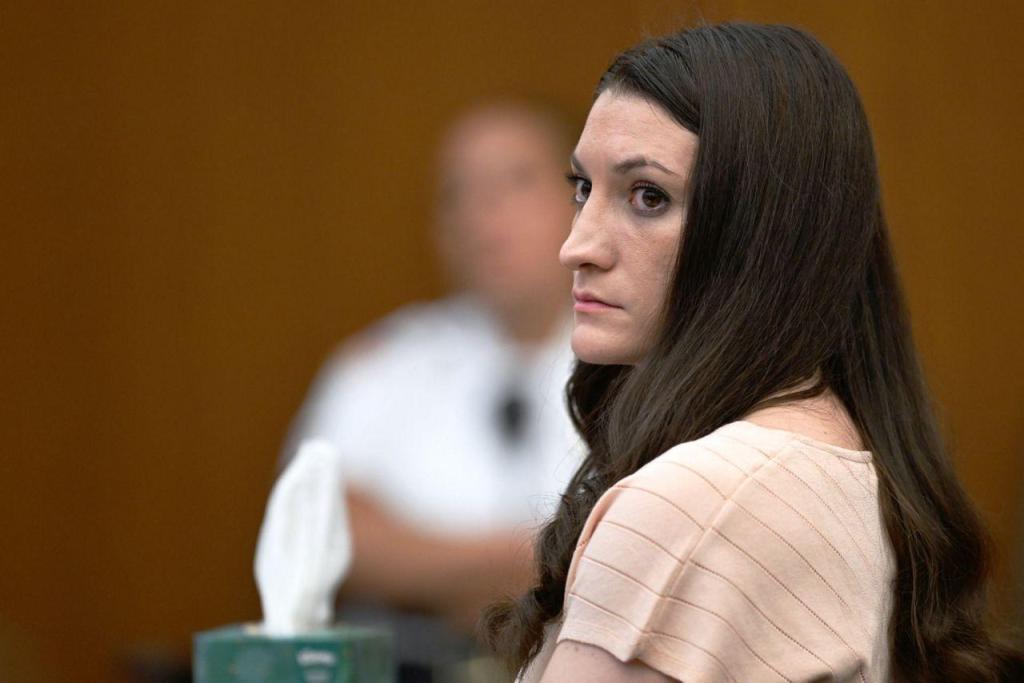
—Kerry Hill, B1Daily
Three children are dead.
Cora Clancy was five. Dawson was three. Callan was eight months old.
Their mother, Lindsay Clancy, admits that she killed them in their Massachusetts home in January 2023. What remains unresolved is the legal question now before a jury: whether Clancy was criminally responsible for the killings or suffering from postpartum psychosis so severe that she could not legally be held responsible.

That is an extraordinarily difficult question.
But another debate surrounding the trial deserves scrutiny: Why has so much public sympathy centered on Lindsay Clancy rather than the three children whose lives were taken?
The answer exposes an uncomfortable weakness in some corners of modern feminist discourse, where legitimate concern about women’s mental health can mutate into something very different: a reluctance to discuss female agency when a woman commits something horrific.
Mental Illness Matters. So Does Accountability.
Clancy’s defense is not frivolous.
Her attorneys argue she suffered from postpartum psychosis, experienced hallucinations and received inadequate psychiatric treatment. A defense expert testified that she was psychotic and experiencing command hallucinations when she killed her children.
Postpartum psychosis is also real, rare and potentially dangerous. Medical experts describe it as a psychiatric emergency affecting roughly one or two mothers per 1,000 births. Women who experience it deserve immediate treatment rather than stigma.
But acknowledging that fact doesn’t require automatically accepting Clancy’s legal defense.
Prosecution experts reached a dramatically different conclusion.

Forensic psychologist Kirk Heilbrun testified that although Clancy was mentally ill, she retained “moral awareness” and remained criminally responsible. Prosecutors argue that she deliberately arranged for her husband to leave, chose the timing of the killings and understood what she was doing.
That conflict is exactly why there is a trial.
Mental illness can explain behavior without necessarily satisfying the much narrower legal standard for insanity.
When Sympathy Becomes a Political Identity
The public reaction, however, has sometimes moved beyond careful consideration of psychiatric evidence.
Women wearing pink have gathered outside the courthouse in support of Clancy. Some supporters identify strongly with her experiences involving postpartum depression and maternal mental-health struggles.
That empathy is understandable.
But empathy becomes troubling when the accused begins occupying more emotional space than the victims.
Cora, Dawson and Callan cannot tell anyone what happened in that basement.
They cannot explain whether they were frightened.
They cannot grow older and demand justice themselves.
Their vulnerability deserves at least as much moral attention as their mother’s suffering.
A feminism genuinely concerned with vulnerable people should have no difficulty saying two things simultaneously:
Lindsay Clancy may have been profoundly mentally ill.
And:
Cora, Dawson and Callan were the victims.
Those propositions do not contradict each other.
Women Have Agency, Including When They Do Terrible Things
Modern feminism has spent decades fighting the idea that women are fragile creatures without agency.
Women can lead corporations, command military units, run governments, make independent decisions and take responsibility for their lives.
That principle cannot conveniently disappear when a woman’s decisions become morally disturbing.
Equality cannot mean demanding maximum recognition of female agency when women succeed while instinctively searching for someone else to blame when women commit crimes.
Sometimes medical systems fail women.
Sometimes husbands fail wives.
Sometimes society places unreasonable expectations on mothers.
And sometimes a woman can still be responsible for something terrible.
Determining which explanation applies to Clancy is the jury’s job.
But refusing even to entertain the final possibility isn’t feminism.
It is paternalism wearing feminist clothing.
The Double Standard Question
The Clancy case has inevitably produced arguments about whether the public would extend comparable sympathy to a father accused of killing three children while suffering from severe psychiatric illness.
There is no simple way to prove how an imaginary case would be received.
But the question is worth asking.
If equality means anything, mental illness should be evaluated according to evidence and consistent legal principles rather than assumptions about whether men or women are inherently more deserving of compassion.
A mentally ill father deserves serious consideration of legitimate psychiatric evidence.
So does a mentally ill mother.
Neither deserves automatic absolution.
Feminism Should Be Able to Hold Two Ideas at Once
The strongest lesson from the Clancy case should not be that postpartum mental illness is imaginary.
That would be dangerously wrong.
Nor should it be that mothers suffering postpartum psychiatric emergencies are potential murderers. The overwhelming majority are not, and sensationalizing an extremely rare tragedy risks creating additional stigma around women seeking treatment.
The lesson should instead be that compassion and accountability are not enemies.
America desperately needs better maternal mental healthcare. Families need to recognize postpartum psychiatric emergencies earlier. Doctors need adequate resources to treat them. Women should be able to admit frightening thoughts without believing they will automatically be condemned as bad mothers.
But none of those principles requires society to transform every accused woman into a symbol of female victimhood.
The jury will decide whether Lindsay Clancy was legally responsible for killing her children.
The rest of us have another responsibility.
Whatever verdict comes back, remember their names:
Cora. Dawson. Callan.
The cultural conversation surrounding this case should never become so consumed with explaining the person who killed them that we forget the three children who never got the opportunity to explain anything at all.
—Kerry Hill, B1Daily





Leave a Reply