—Barrington Williams, B1Daily
The most important politician in your life might not live at 1600 Pennsylvania Avenue.
Increasingly, that politician lives in your state capital.
America’s governors are behaving less like administrators waiting for Washington and more like mini-presidents, building their own political brands, issuing executive orders, directing agencies, fighting other states, challenging presidents in court and implementing policies that can dramatically change everyday life depending on which side of a state border someone happens to live.
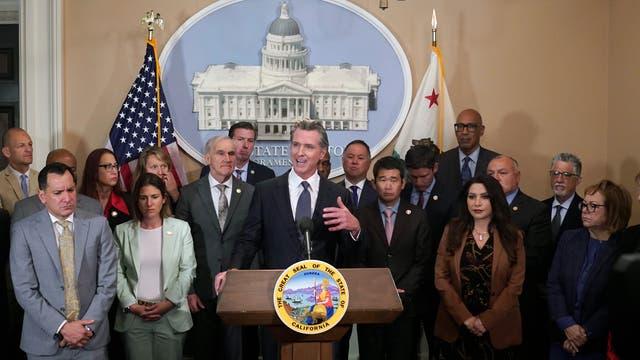
California’s Gavin Newsom can position his state as a counterweight to Donald Trump.
Texas Gov. Greg Abbott can turn immigration enforcement into a national political confrontation.
Maryland’s Wes Moore can use the governorship as a platform for a broader national agenda.
Florida, California, Texas and New York increasingly resemble competing political laboratories with their own visions of what America should become.
The United States still has one president.
Politically, however, it increasingly feels as though it has 50 smaller ones.
Governors Already Have Enormous Power
Governors aren’t merely ceremonial executives.
Depending on the state, they can issue executive orders, propose budgets, veto legislation, appoint agency leaders, grant clemency, respond to emergencies and influence judicial appointments. The National Governors Association describes governors as the chief executive officers of their states, responsible for implementing state law and overseeing state executive branches.
Sound familiar?
The structure resembles the presidency on a smaller scale.
A governor has an executive branch.
A legislature functions as the lawmaking branch.
State courts interpret state law.
Governors deliver State of the State addresses resembling miniature State of the Union speeches.
They propose budgets.
They sign legislation.
They deploy National Guard units under state authority.
And increasingly, they conduct political battles with Washington itself.
Washington’s Dysfunction Created an Opening
Congressional gridlock has made governors more important.
When Congress cannot agree on immigration, housing, abortion, education, energy, healthcare or policing, states increasingly stop waiting.
They experiment.
One state expands abortion protections while another restricts them.
One state increases environmental regulation while another courts fossil-fuel investment.
One state expands gun restrictions while another loosens them.
One governor cooperates with federal immigration authorities while another fights Washington in court.
The result is something resembling 50 competing versions of American government.
The National Governors Association openly describes states as laboratories where policies can be tested before spreading elsewhere.
That laboratory is becoming increasingly powerful because Washington frequently cannot produce a national formula.
Trump Has Accelerated the Transformation
Donald Trump’s second presidency has made the governor’s office even more important.
The administration’s aggressive use of federal power has repeatedly produced conflicts with states over immigration, federal grants, elections and law enforcement.
Twenty-five Democratic-led states recently challenged federal attempts to condition certain funding on compliance with the administration’s election demands. Separately, cities and local governments have challenged attempts to attach ideological conditions involving immigration and other policies to federal grants. A federal appeals court ruled this week that the administration exceeded its authority with some of those grant conditions.
The confrontation isn’t exclusively Democratic governors versus Trump.
Republican governors can also challenge Washington when federal policy collides with state interests.
The National Governors Association itself warned in January that federal authority should complement rather than supplant state and local government, specifically emphasizing the constitutional roles of different levels of government during disputes over immigration enforcement.
That is federalism becoming political combat.
Governors Are Even Fighting Each Other
The strangest development may be conflicts between states themselves.
Texas and Minnesota are currently embroiled in an extraordinary extradition dispute involving an ICE officer wanted on criminal charges in Minnesota.
Texas Gov. Greg Abbott declined to sign an extradition warrant before the officer’s detention period expired. The officer was subsequently released from a Texas jail, producing warnings from legal experts that politically motivated extradition disputes could create a dangerous precedent in relations between states.
Think about what that represents.
The United States has always contained ideological differences between states.
But when governors begin using state authority to resist legal demands from governments controlled by the opposing party, the governor’s office becomes something larger than a policy shop.
It becomes a fortress.
California and Texas Are Becoming Political Nations Within a Nation
No states illustrate the phenomenon better than California and Texas.
Each contains roughly the population of a major country.
Each possesses an enormous economy.
Each maintains substantial regulatory power.
And each has become shorthand for a competing model of American government.
California Democrats promote stronger environmental regulation, abortion protections, labor protections and expansive social programs.
Texas Republicans emphasize lower taxation, gun rights, aggressive border enforcement, energy production and socially conservative policies.
The governors of these states don’t simply govern.
They advertise.
Every California policy becomes an argument against Texas.
Every Texas policy becomes an argument against California.
Newsom and Abbott aren’t merely running states.
They’re selling competing versions of America.
The Governor’s Mansion Has Become the Presidential Waiting Room
There is another reason governors increasingly resemble mini-presidents.
Americans frequently promote them into the real presidency.
Jimmy Carter.
Ronald Reagan.
Bill Clinton.
George W. Bush.
All were governors before reaching the White House.
The position offers something senators cannot easily replicate: executive experience.
A governor can tell voters:
I already ran a government.
That argument will matter enormously heading toward 2028.
Several governors are already discussed as potential national contenders, and gubernatorial politics increasingly functions as an audition for presidential leadership.
A governor who successfully handles disasters, budgets, economic development and political crises can build a national résumé without spending a day in Congress.
The 2026 Elections Could Supercharge the Trend
This year’s elections make the phenomenon particularly important.
There are 39 gubernatorial elections scheduled for 2026, including races where 21 incumbent governors are either term-limited or not seeking reelection.
That represents an extraordinary turnover opportunity.
Voters aren’t simply choosing people to manage state bureaucracies.
Some of the governors elected this November could become major players in the 2028 presidential election.
Others could control their states during the approaching battle over the 2030 Census and subsequent redistricting.
And almost all will confront questions Washington has struggled to resolve.
Housing.
Artificial intelligence.
Energy.
Education.
Immigration.
Healthcare.
Infrastructure.
Crime.
Cybersecurity.
The National Governors Association’s 2026 priorities already show governors working across precisely these issues, from housing shortages and infrastructure to healthcare, jobs and disaster preparedness.
The United States May Become More Different Depending on Where You Live
There is a downside to all this state experimentation.
Americans increasingly experience radically different governments depending upon their ZIP code.
A worker in California can operate under labor regulations dramatically different from those governing someone doing the same job in Texas.
A woman’s access to abortion can change after crossing a state line.
Gun laws can transform during a road trip.
Tax burdens differ.
Voting rules differ.
Marijuana laws differ.
Healthcare programs differ.
Education policies differ.
The United States has always operated this way to some extent.
But political polarization is widening the distance.
Instead of states merely experimenting around the edges, they increasingly appear to be constructing fundamentally different political systems underneath the same federal flag.
America’s Next Great Political Battles May Begin in State Capitals
Washington will remain enormously powerful.
The president controls the executive branch, foreign policy and enormous portions of federal administration. Congress controls federal taxation, spending and legislation. Federal courts remain capable of overriding state governments when constitutional or federal-law conflicts arise.
Governors are not presidents.
But the political distance between the two jobs is shrinking.
Governors increasingly command their own political brands, bureaucracies, budgets, legal strategies and national audiences.
They negotiate with Washington.
They sue Washington.
They resist Washington.
Sometimes they cooperate with Washington.
And increasingly, they challenge one another.
That makes the governor’s mansion one of the most underestimated centers of power in American politics.
The next president will still be elected in 2028.
But Americans shouldn’t wait until then to ask who is shaping the country’s future.
Some of them are already doing it.
They just happen to govern one state at a time.
—Barrington Williams, B1Daily



Leave a Reply